← All lectures
Humanism And Superhumanism
Original manuscript — sheet 1
scan sheet 1
Transcription
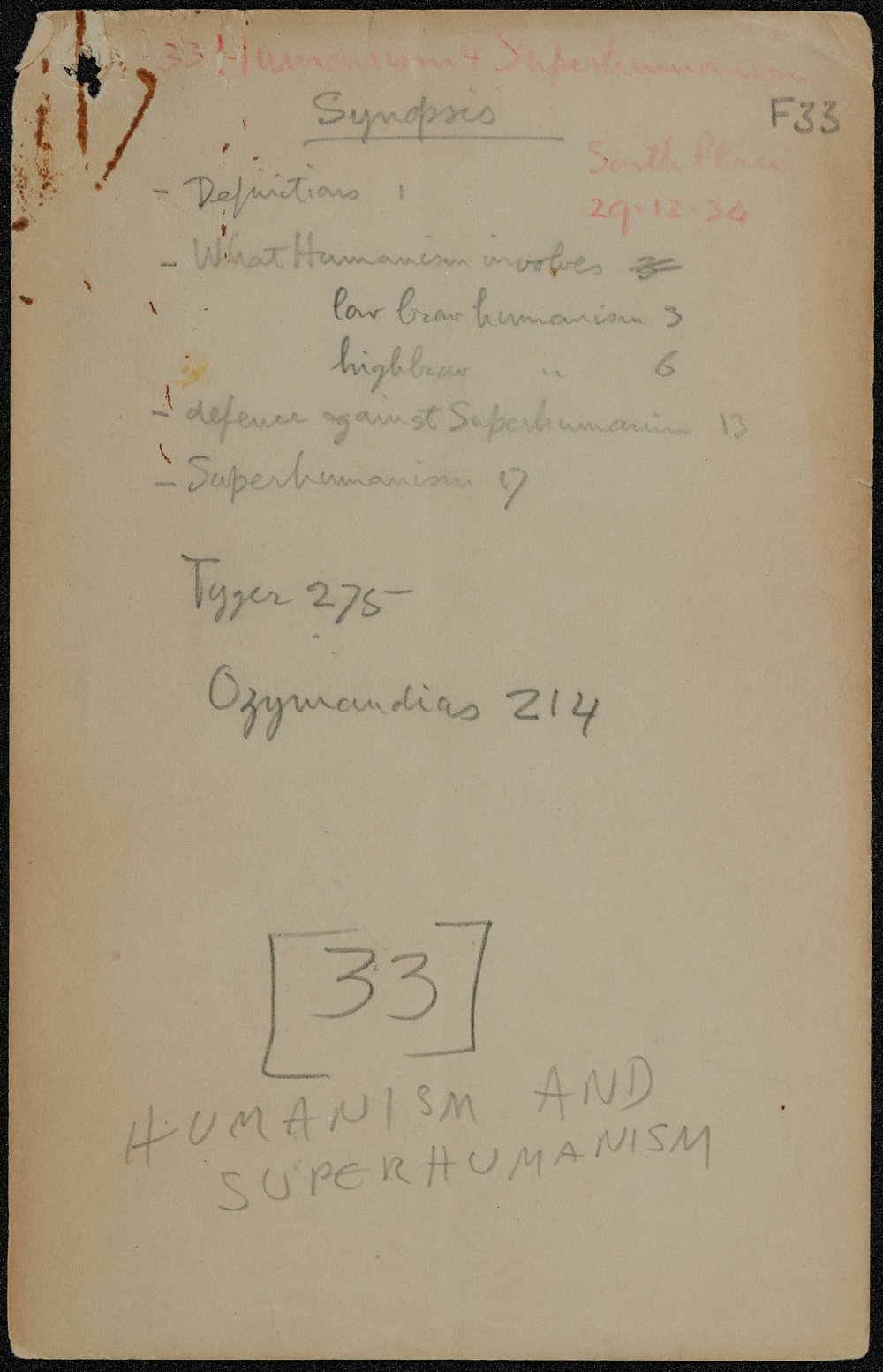
33 Humanism + Superhumanism
SynopsisF33
- Definitions 1South Place
29·12·34
- What Humanism involves 3
low brow humanism        3
highbrow        ,,        6
- defence against Superhumanism 13
- Superhumanism 17
Tyger 275-
Ozymandias 214
33
HUMANISM AND
SUPERHUMANISM
Original manuscript — sheet 2
scan sheet 2
Transcription
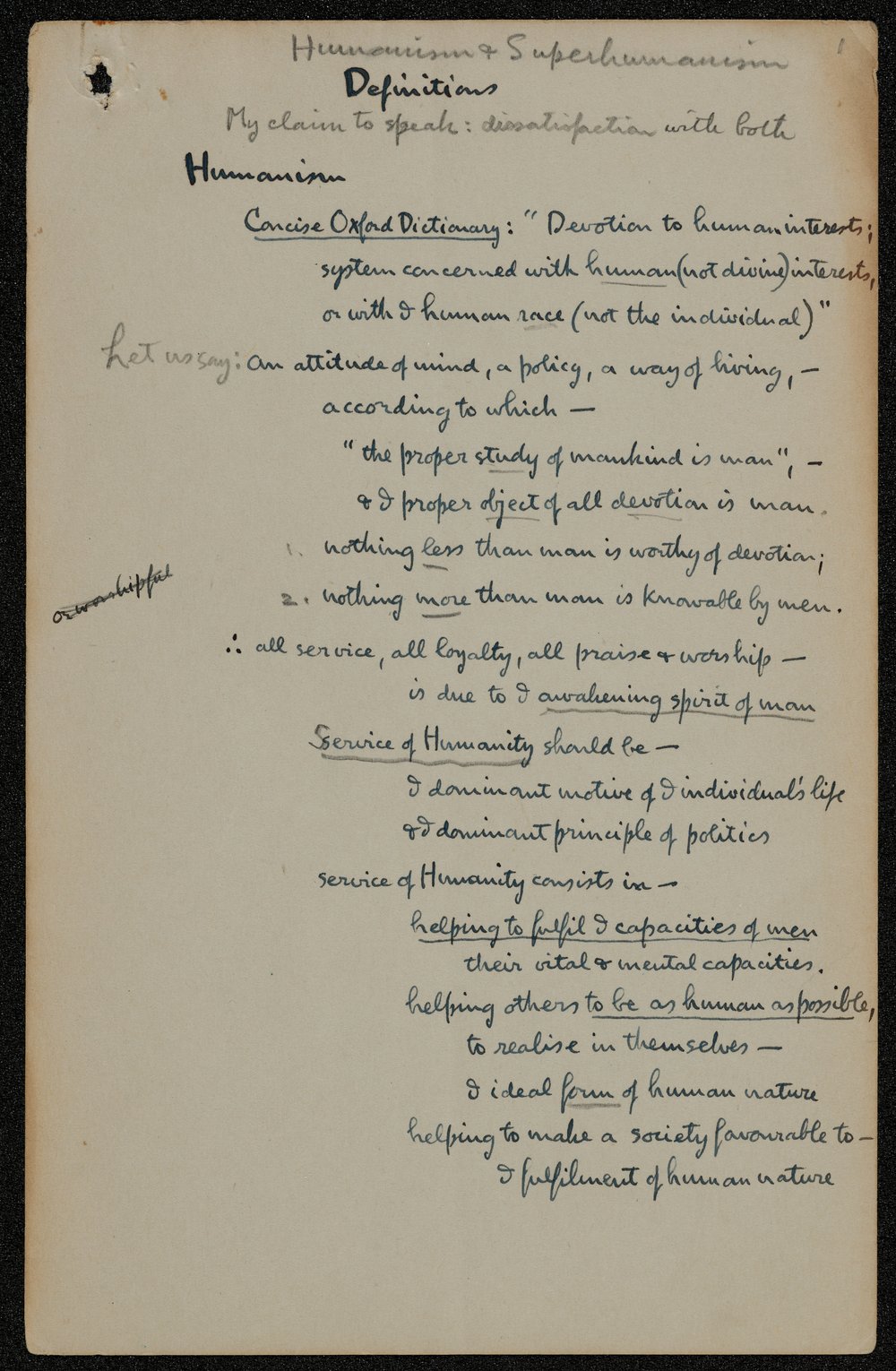
1
Humanism & Superhumanism
Definitions
My claim to speak: dissatisfaction with both
Humanism
Concise Oxford Dictionary: “Devotion to human interests;
system concerned with human(not divine) interests,
or with ð human race (not the individual)”
Let us say; An attitude of mind, a policy, a way of living, —
according to which —
“the proper study of mankind is man”, —
& ð proper object of all devotion is man.
1. nothing less than man is worthy of devotion;
or worshipful2. nothing more than man is knowable by men.
∴ all service, all loyalty, all praise & worship —
is due to ð awakening spirit of man
Service of Humanity should be —
ð dominant motive of ð individual's life
& ð dominant principle of politics
service of Humanity consists in —
helping to fulfil ð capacities of men
their vital & mental capacities,
helping others to be as human as possible,
to realise in themselves —
ð ideal form of human nature
helping to make a society favourable to —
ð fulfilment of human nature
Original manuscript — sheet 3
scan sheet 3
Transcription
2
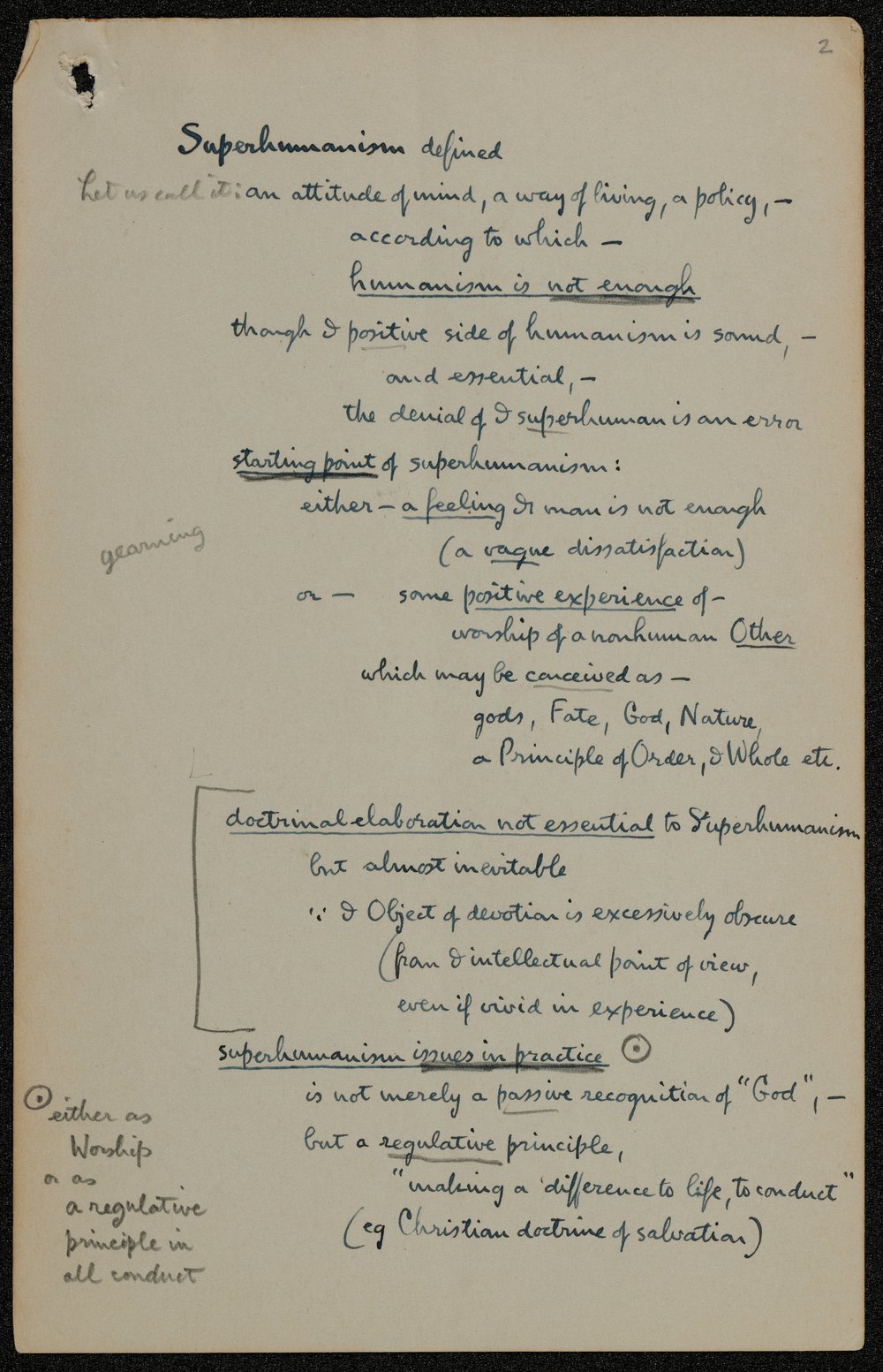
Superhumanism defined
Let us call it: an attitude of mind, a way of living, a policy, -
according to which -
humanism is not enough
though ð positive side of humanism is sound, -
and essential, -
the denial of ð superhuman is an error
starting point of superhumanism:
either - a feeling ðt man is not enough
yearning(a vague dissatisfaction)
or -    some positive experience of -
worship of a nonhuman Other
which may be conceived as -
gods, Fate, God, Nature,
a Principle of Order, ð Whole etc.
doctrinal elaboration not essential to Superhumanism
but almost inevitable
∵ ð Object of devotion is excessively obscure
(from ð intellectual point of view,
even if vivid in experience)
superhumanism issues in practice ⊙
⊙ either asis not merely a passive recognition of “God”, -
Worshipbut a regulative principle,
or as“making a difference to life, to conduct”
a regulative(eg Christian doctrine of salvation)
principle in
all conduct
Original manuscript — sheet 4
scan sheet 4
Transcription
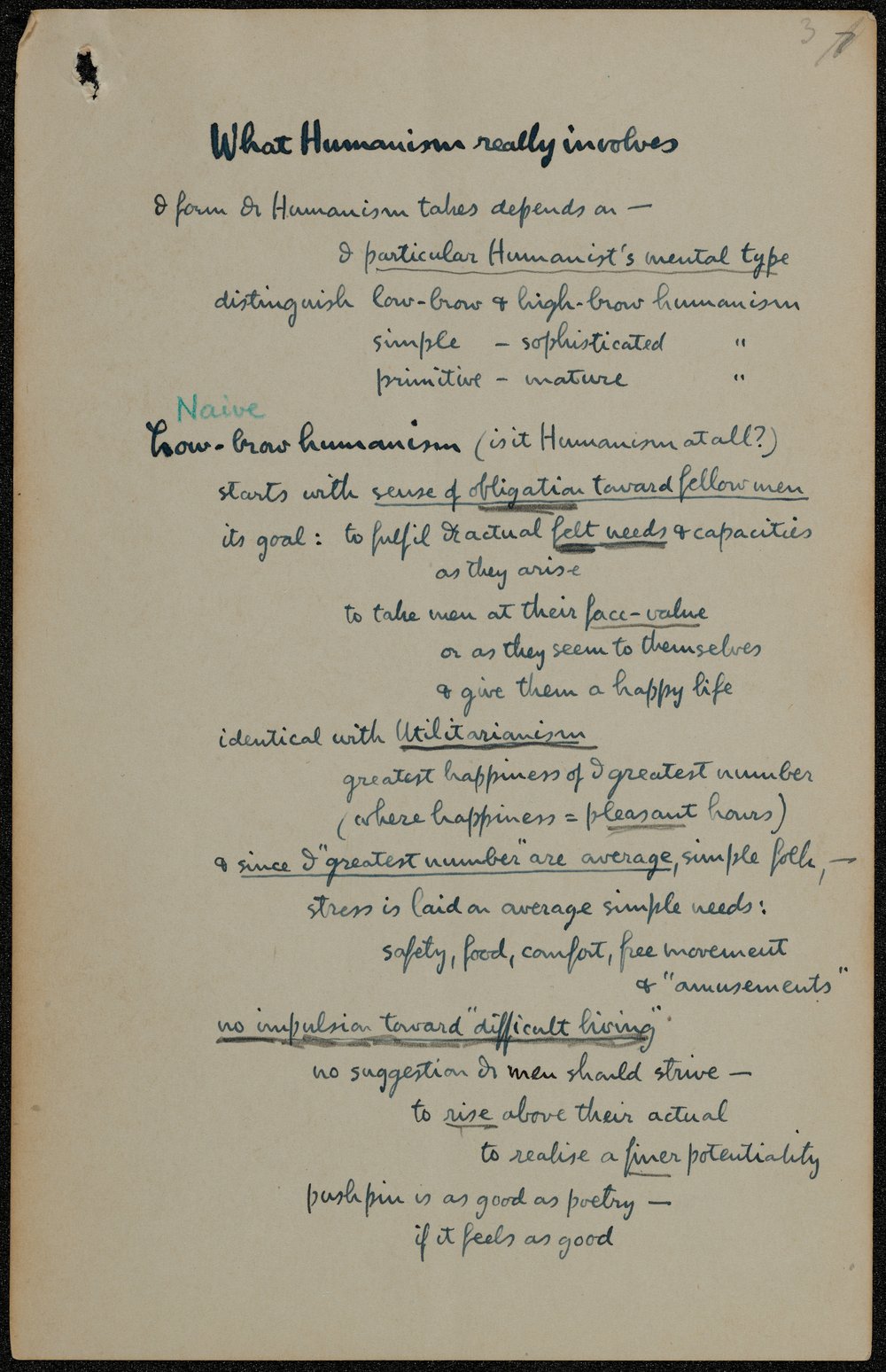
3  7
What Humanism really involves
θ form θ Humanism takes depends on —
θ particular Humanist’s mental type
distinguish low-brow & high-brow humanism
simple   - sophisticated     "
primitive - mature             "
Naive
low-brow humanism (is it Humanism at all?)
starts with sense of obligation toward fellow men
its goal: to fulfil θ actual felt needs & capacities
as they arise
to take men at their face-value
or as they seem to themselves
& give them a happy life
identical with Utilitarianism
greatest happiness of θ greatest number
(where happiness = pleasant hours)
& since θ “greatest number” are average, simple folk, —
stress is laid on average simple needs:
safety, food, comfort, free movement
& “amusements”
no impulsion toward “difficult living”
no suggestion ð men should strive —
to rise above their actual
to realise a finer potentiality
pushpin is as good as poetry —
if it feels as good
Original manuscript — sheet 5
scan sheet 5
Transcription
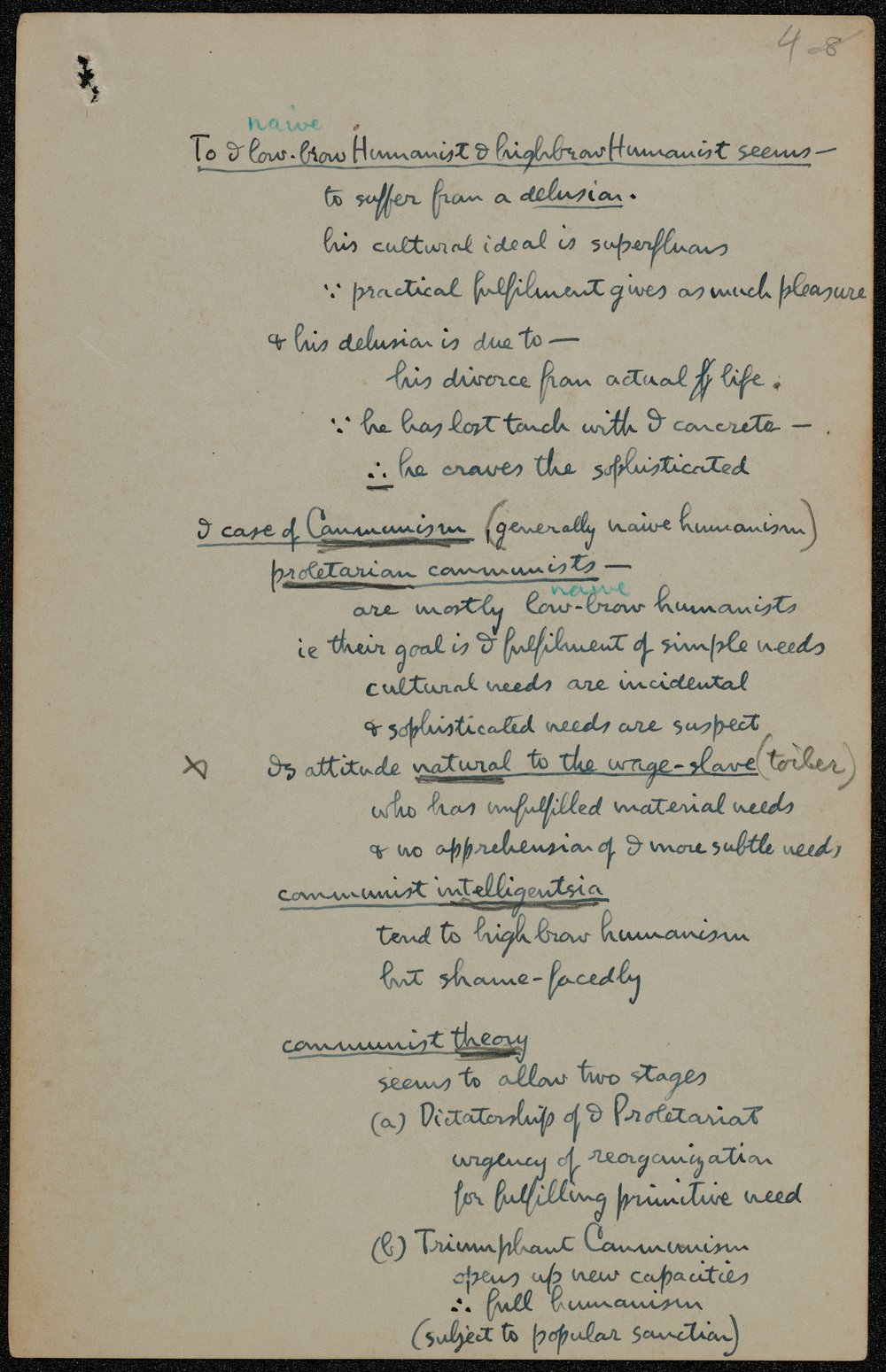
4-8
To ð naive low-brow Humanist ð highbrow Humanist seems—
to suffer from a delusion.
his cultural ideal is superfluous
∵ practical fulfilment gives as much pleasure
& his delusion is due to—
his divorce from actual ff life:
∵ he has lost touch with ð concrete—.
∴ he craves the sophisticated
ð case of Communism (generally naive humanism)
proletarian communists—
are mostly naive low-brow humanists
ie their goal is ð fulfilment of simple needs
cultural needs are incidental
& sophisticated needs are suspect
× ðs attitude natural to the wage-slave (toiler)
who has unfulfilled material needs
& no apprehension of ð more subtle needs,
communist intelligentsia
tend to high brow humanism
but shame-facedly
communist theory
seems to allow two stages
(a) Dictatorship of ð Proletariat
urgency of reorganization
for fulfilling primitive need
(b) Triumphant Communism
opens up new capacities
∴ full humanism
(subject to popular sanction)
Original manuscript — sheet 6
scan sheet 6
Transcription
59
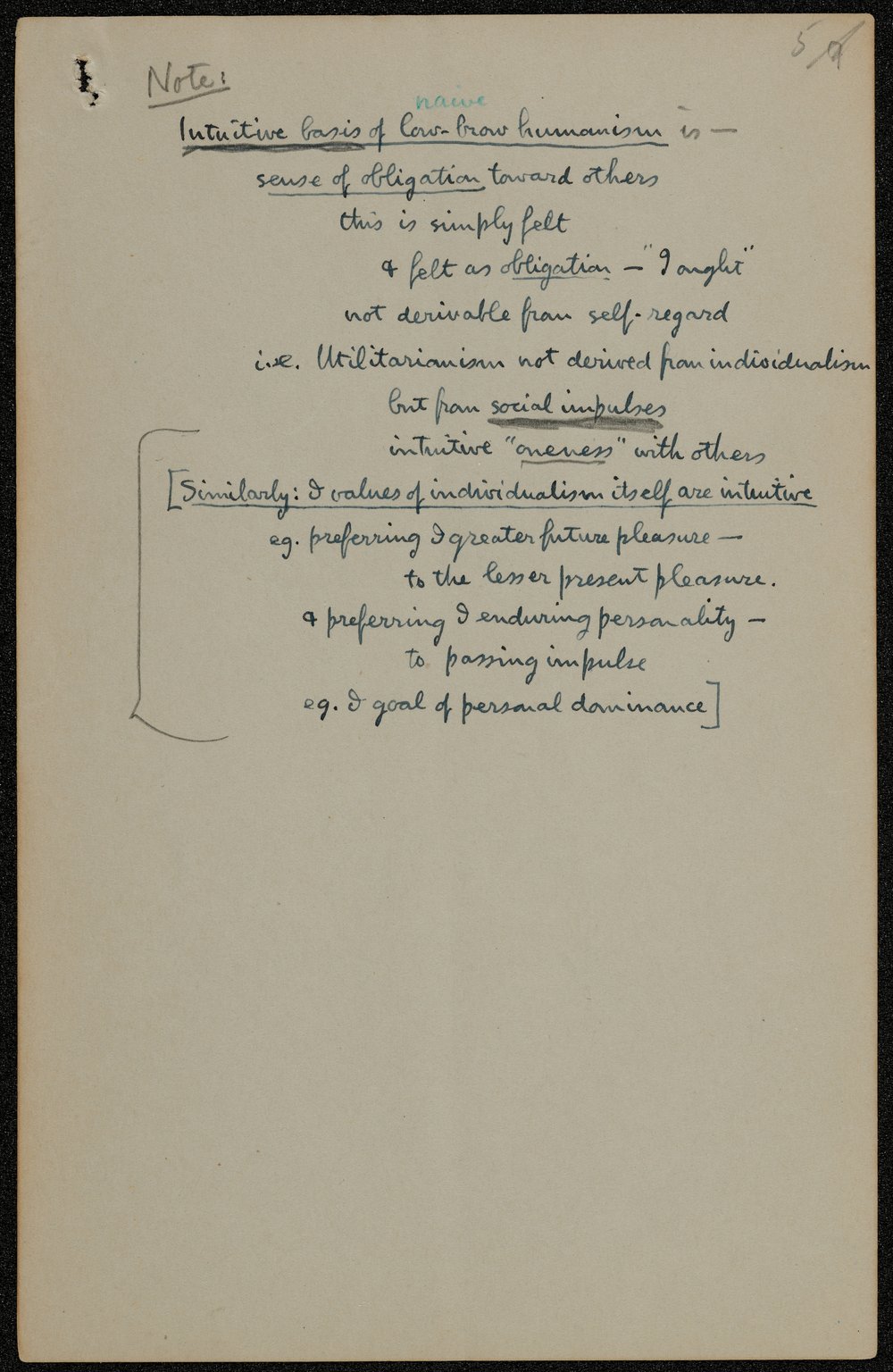
Note:
Intuitive basis of naive low-brow humanism is —
sense of obligation toward others
this is simply felt
& felt as obligation — “I ought”
not derivable from self-regard
i.e. Utilitarianism not derived from individualism
but from social impulses
intuitive “oneness” with others
[Similarly: ð values of individualism itself are intuitive
eg. preferring ð greater future pleasure —
to the lesser present pleasure.
& preferring ð enduring personality —
to passing impulse
eg. ð goal of personal dominance]
Original manuscript — sheet 7
scan sheet 7
Transcription
6 10
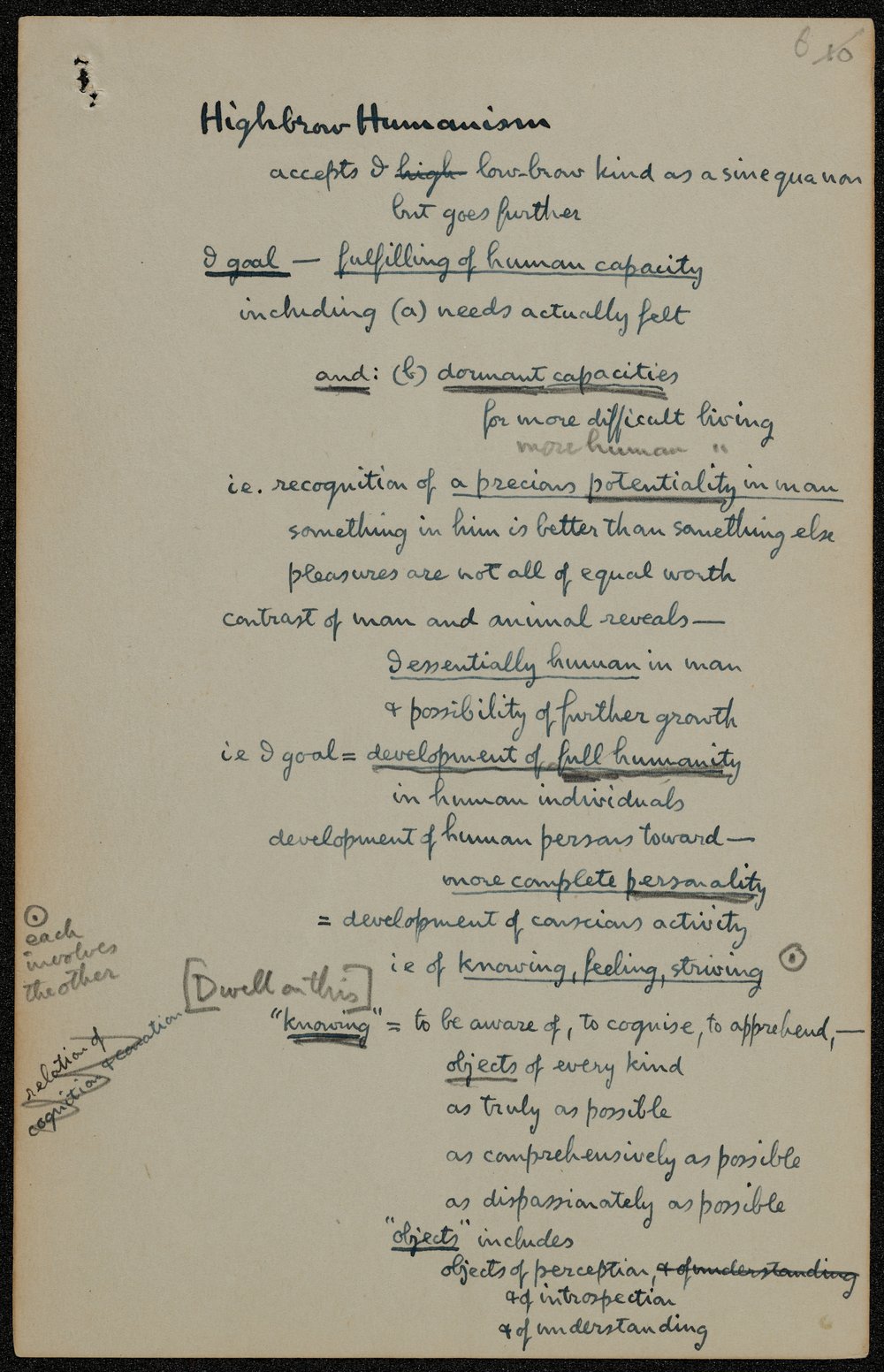
Highbrow Humanism
accepts ð high low-brow kind as a sine qua non
but goes further
ð goal — fulfilling of human capacity
including (a) needs actually felt
and: (b) dormant capacities
for more difficult living more human "
i.e. recognition of a precious potentiality in man
something in him is better than something else
pleasures are not all of equal worth
contrast of man and animal reveals—
ð essentially human in man
+ possibility of further growth
i.e. ð goal = development of full humanity
in human individuals
development of human persons toward—
more complete personality
⊙
each
involves
the other
= development of conscious activity
[Dwell on this] i.e. of knowing, feeling, striving ⊙
relation of
cognition & conation
"knowing" = to be aware of, to cognise, to apprehend,—
objects of every kind
as truly as possible
as comprehensively as possible
as dispassionately as possible
"objects" includes
objects of perception, + of understanding
+ of introspection
+ of understanding
Original manuscript — sheet 8
scan sheet 8
Transcription
7 μ
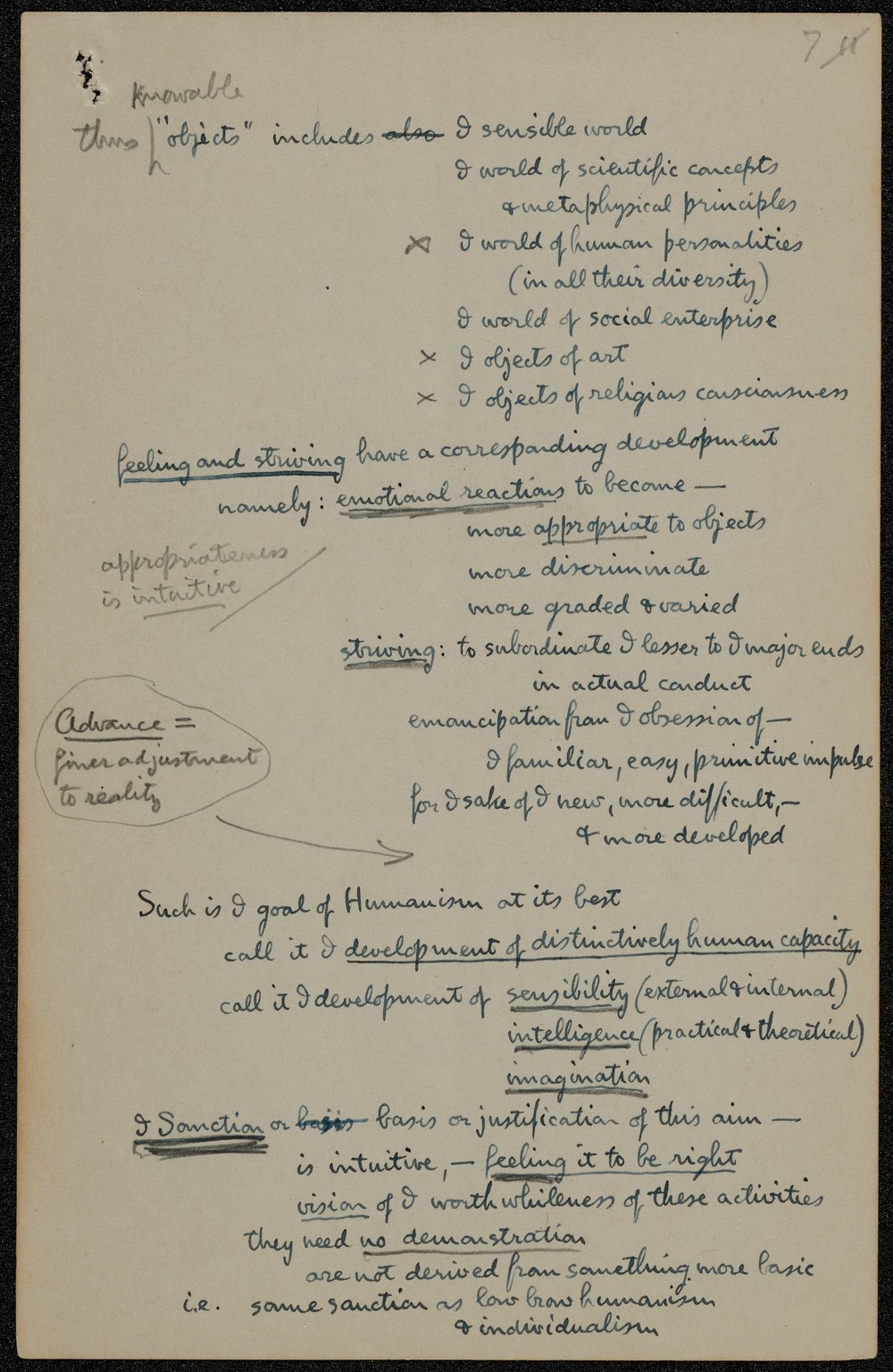
thus knowable "object" includes also ð sensible world
ð world of scientific concepts
+ metaphysical principles
×ð world of human personalities
.(in all their diversity)
ð world of social enterprise
×ð objects of art
×ð objects of religious consciousness
feeling and striving have a corresponding development
namely: emotional reactions to become —
appropriateness
is intuitive →
more appropriate to objects
more discriminate
more graded & varied
striving: to subordinate ð lesser to ð major ends
in actual conduct
Advance =
finer adjustment
to reality
→
emancipation from ð obsession of —
ð familiar, easy, primitive impulse
for ð sake of ð new, more difficult,—
+ more developed
Such is ð goal of Humanism at its best
call it ð development of distinctively human capacity
call it ð development of sensibility (external & internal)
intelligence (practical + theoretical)
imagination
ð Sanction or basis basis or justification of this aim —
is intuitive, — feeling it to be right
vision of ð worthwhileness of these activities
they need no demonstration
are not derived from something more basic
i.e.same sanction as low brow humanism
& individualism
Original manuscript — sheet 9
scan sheet 9
Transcription
8 ½
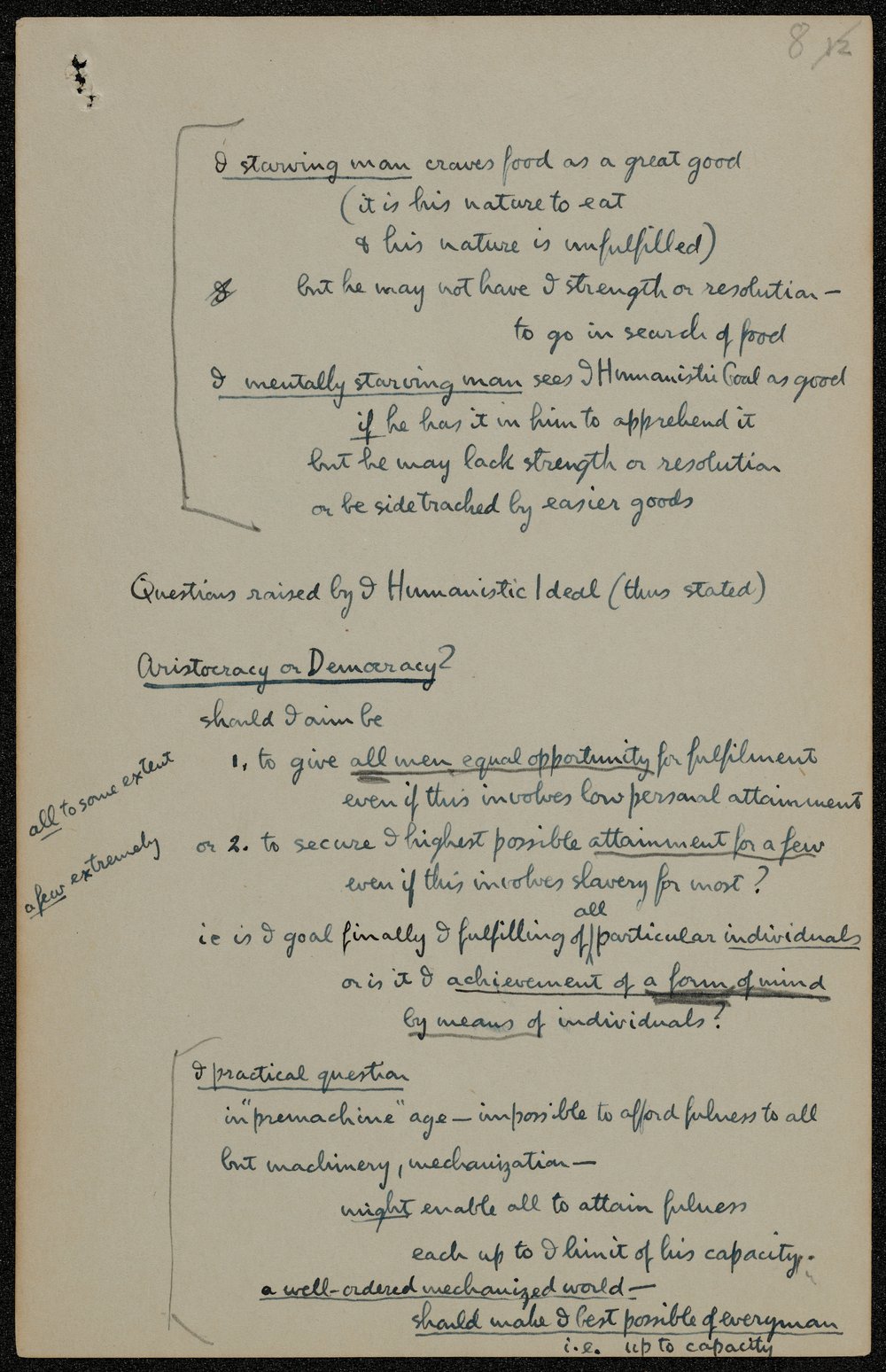
ð starving man craves food as a great good
(it is his nature to eat
& his nature is unfulfilled)
& but he may not have ð strength or resolution—
to go in search of food
ð mentally starving man sees ð Humanistic Goal as good
if he has it in him to apprehend it
but he may lack strength or resolution
or be side tracked by easier goods
Questions raised by ð Humanistic Ideal (thus stated)
Aristocracy or Democracy?
should ð aim be
all to some extent1, to give all men equal opportunity for fulfilmentˎ
even if this involves low personal attainment
a few extremelyor 2. to secure ð highest possible attainment for a few
even if this involves slavery for most ?
i.e is ð goal finally ð fulfilling of all particular individuals
or is it ð achievement of a form of mind
by means of individuals ?
ð practical question
“in” premachine age— impossible to afford fulness to all
but machinery, mechanization—
might enable all to attain fulness
each up to ð limit of his capacity,
a well-ordered mechanized world—
should make ð best possible of everyman
i.e. up to capacity
Original manuscript — sheet 10
scan sheet 10
Transcription
9.13
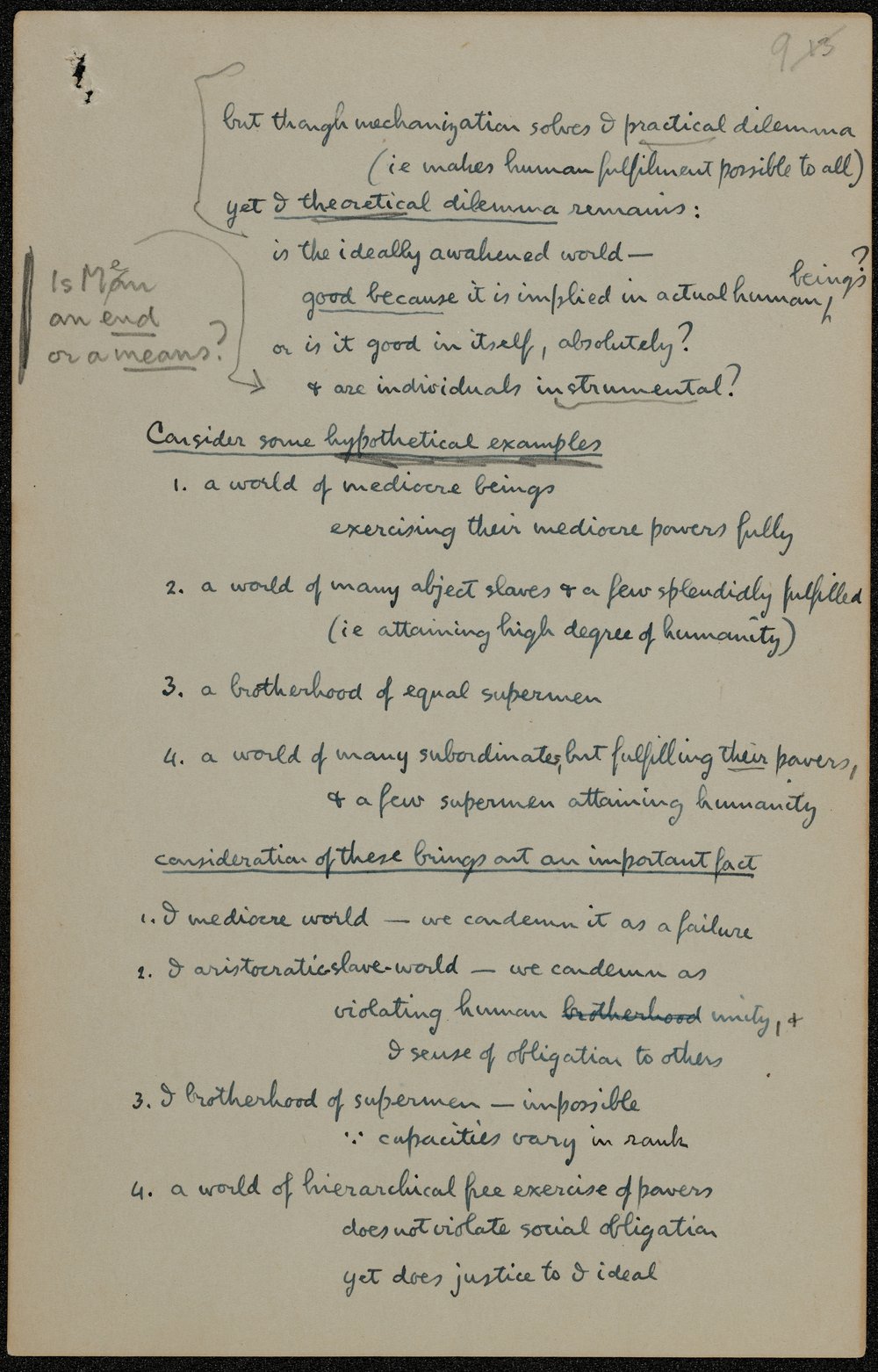
but though mechanization solves θ practical dilemma
(i e makes human fulfilment possible to all)
yet θ theoretical dilemma remains:
Is Meanis the ideally awakened world —
an endgood because it is implied in actual humanbeings?
or a means?or is it good in itself, absolutely?
↘& are individuals instrumental?
Consider some hypothetical examples
1. a world of mediocre beings
exercising their mediocre powers fully
2. a world of many abject slaves & a few splendidly fulfilled
(i e attaining high degree of humanity)
3. a brotherhood of equal supermen
4. a world of many subordinates, but fulfilling their powers,
& a few supermen attaining humanity
consideration of these brings out an important fact
1. θ mediocre world — we condemn it as a failure
2. θ aristocratic-slave-world — we condemn as
violating human brotherhood unity, &
θ sense of obligation to others
3. θ brotherhood of supermen — impossible
∵ capacities vary in rank
4. a world of hierarchical free exercise of powers
does not violate social obligation
yet does justice to θ ideal
Original manuscript — sheet 11
scan sheet 11
Transcription
10  14
[stitching holes — damage, not writing]
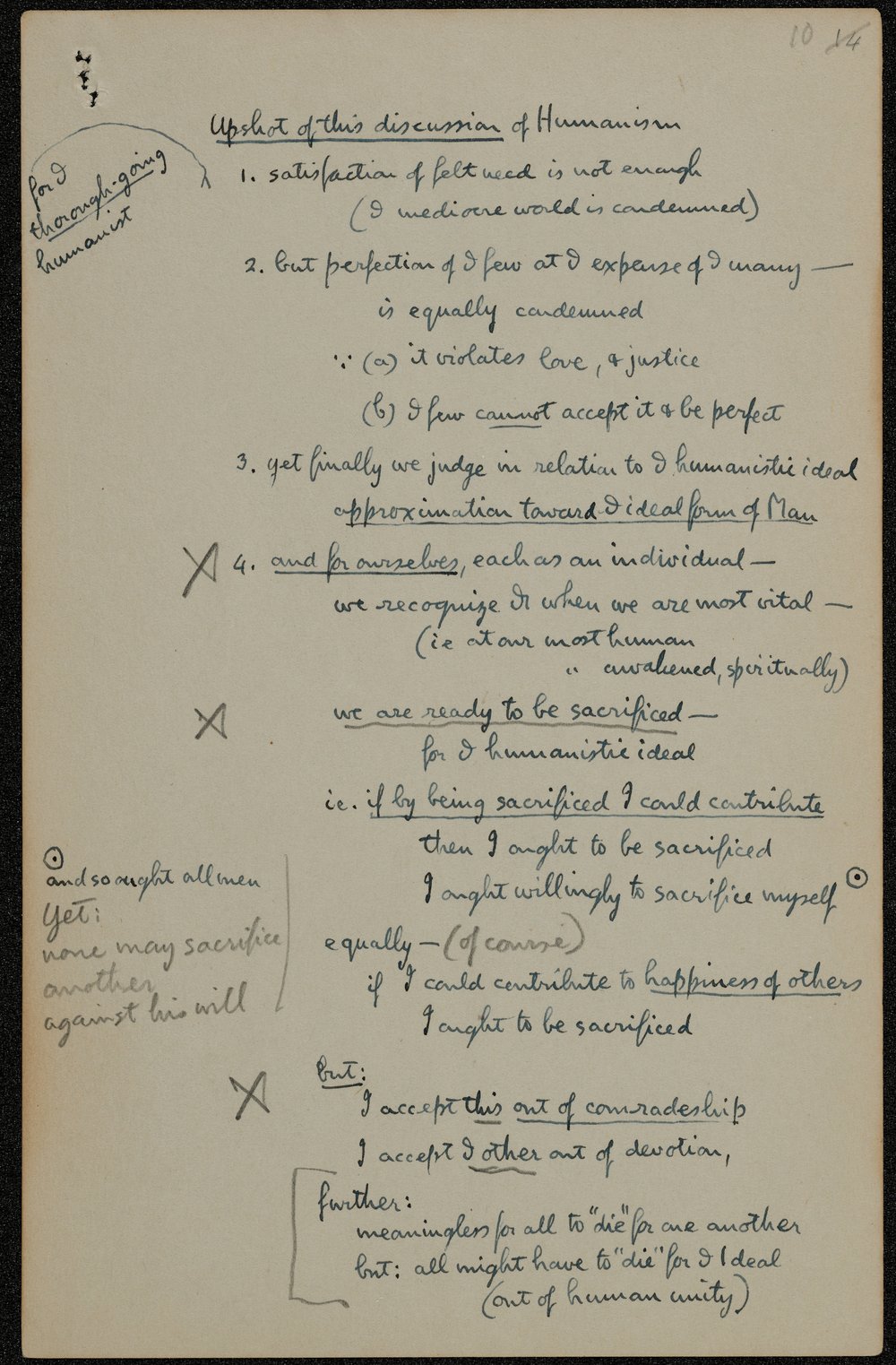
Upshot of this discussion of Humanism
for ð
thorough-going
humanist
∧
1. satisfaction of felt need is not enough
(ð mediocre world is condemned)
2. but perfection of ð few at ð expense of ð many —
is equally condemned
∴ (a) it violates love, & justice
(b) ð few cannot accept it & be perfect
3. yet finally we judge in relation to ð humanistic ideal
approximation toward ð ideal form of Man
×4. and for ourselves, each as an individual —
we recognize ðt when we are most vital —
(i.e at our most human
" awakened, spiritually)
×we are ready to be sacrificed —
for ð humanistic ideal
i.e. if by being sacrificed I could contribute
then I ought to be sacrificed
⊙
and so ought all men
⊙I ought willingly to sacrifice myself
Yet:equally — (of course)
none may sacrificeif I could contribute to happiness of others
another
against his willI ought to be sacrificed
×But:
I accept this out of comradeship
I accept ð other out of devotion,
further:
meaningless for all to “die” for one another
but: all might have to “die” for ð Ideal
(out of human unity)
Original manuscript — sheet 12
scan sheet 12
Transcription
11 15
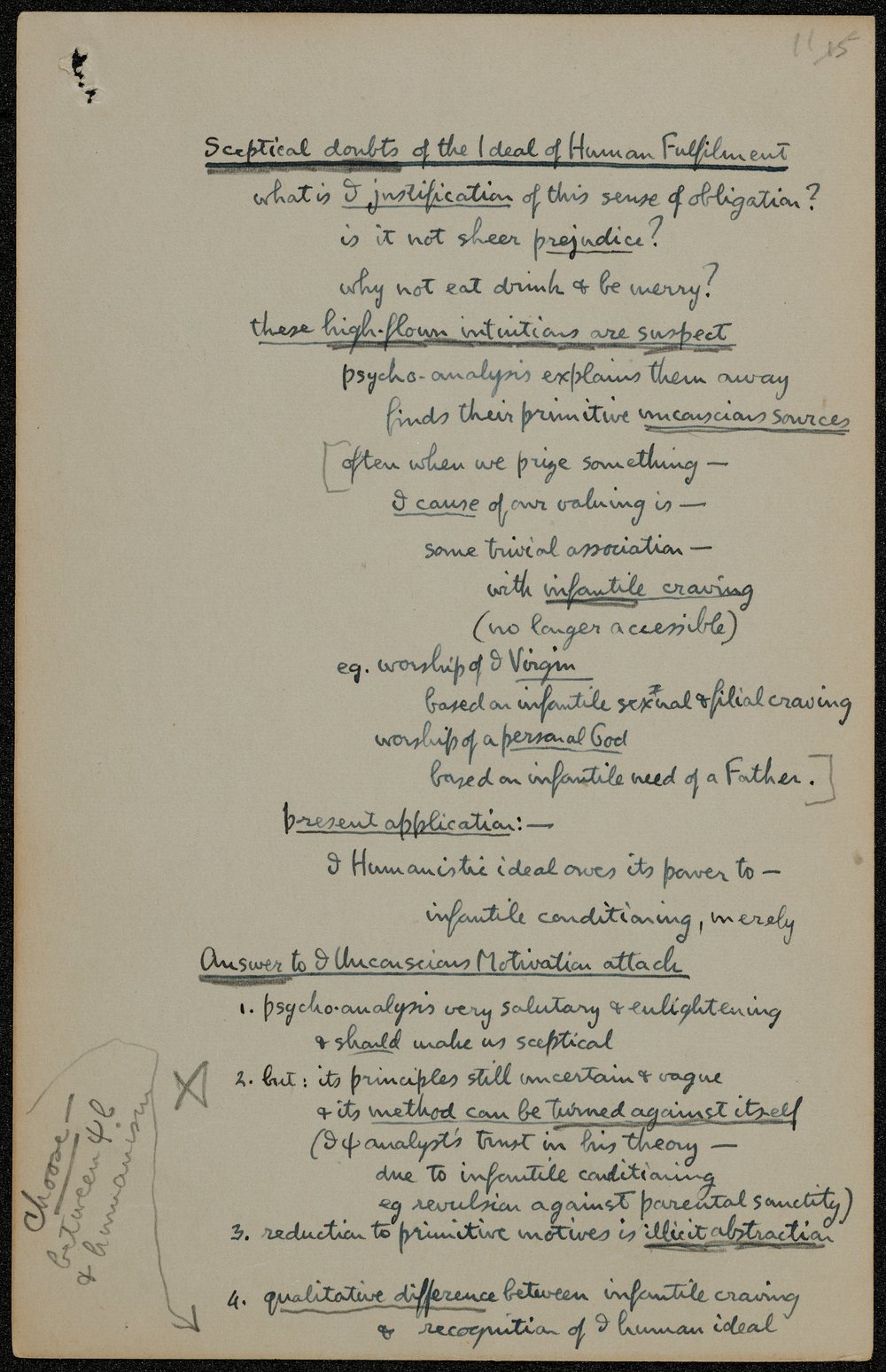
Sceptical doubts of the Ideal of Human Fulfilment
what is ð justification of this sense of obligation?
is it not sheer prejudice?
why not eat drink & be merry?
these high-flown intuitions are suspect
psycho-analysis explains them away
finds their primitive unconscious sources
(often when we prize something —
ð cause of our valuing is —
some trivial association —
with infantile craving
(no longer accessible)
eg. worship of ð Virgin
based on infantile sexual & filial craving
worship of a personal God
based on infantile need of a Father.
present application:—
ð Humanistic ideal owes its power to —
infantile conditioning, merely
Answer to ð Unconscious Motivation attack
1. psycho-analysis very salutary & enlightening
& should make us sceptical
Choose —
Between ψ.a.
& humanism
X2. but : its principles still uncertain & vague
& its method can be turned against itself
(ð ψ analyst's trust in his theory —
due to infantile conditioning
eg revulsion against parental sanctity)
3. reduction to primitive motives is illicit abstraction
4. qualitative difference between infantile craving
& recognition of ð human ideal
Original manuscript — sheet 13
scan sheet 13
Transcription
15
Sceptical
Original manuscript — sheet 14
scan sheet 14
Transcription
12 16
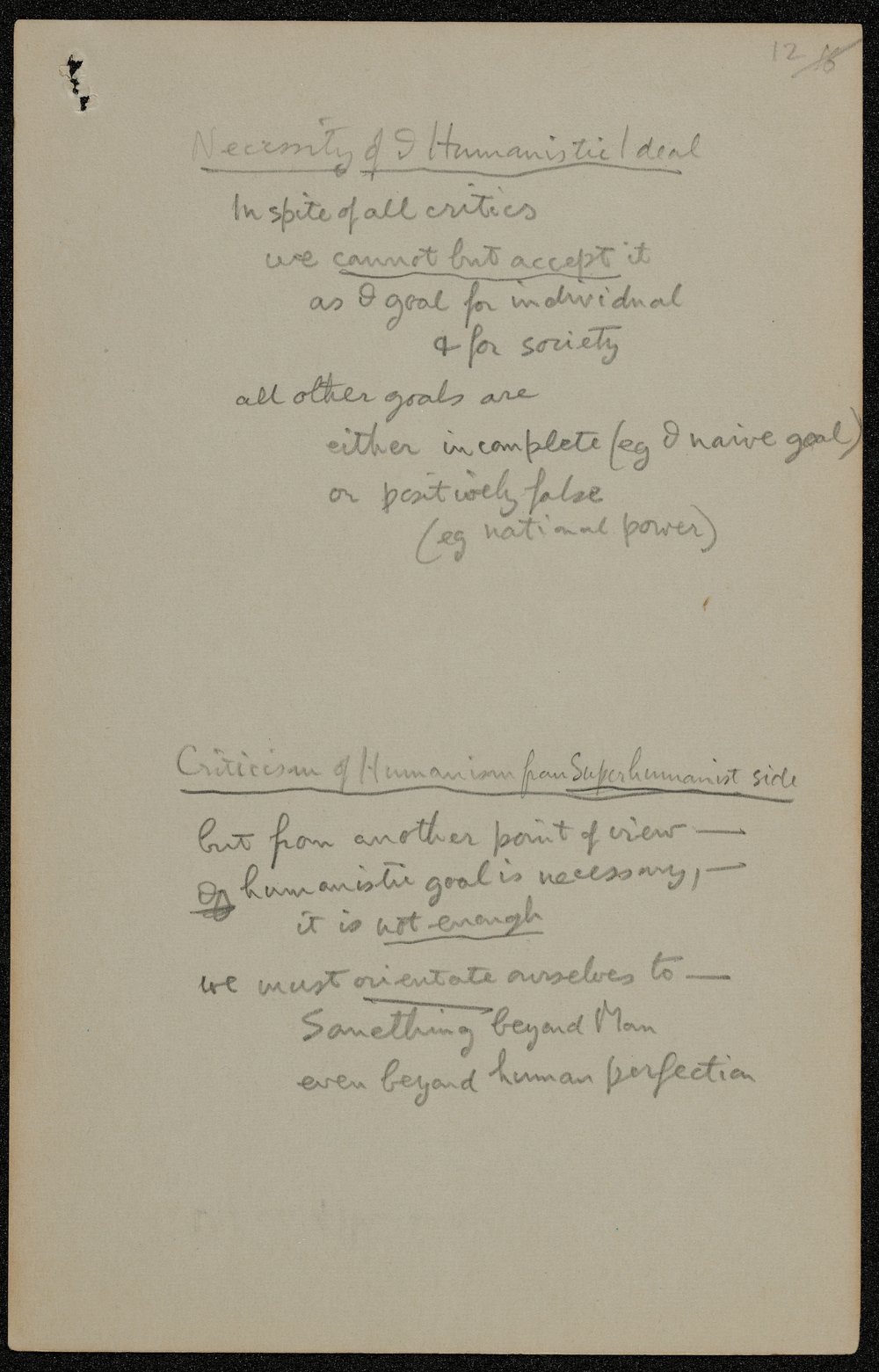
Necessity of θ Humanistic Ideal
In spite of all critics
we cannot but accept it
as θ goal for individual
& for society
all other goals are
either incomplete (eg θ naive goal)
or positively false
(eg nat’nal power)
Criticism of Humanism from Superhumanist side
but from another point of view —
θ humanistic goal is necessary, —
it is not enough
we must orientate ourselves to —
Something beyond Man
even beyond human perfection
Original manuscript — sheet 15
scan sheet 15
Transcription
9
Defence of Humanism
First, State ð Humanist's case as strongly as possible
Original manuscript — sheet 16
scan sheet 16
Transcription
3
13
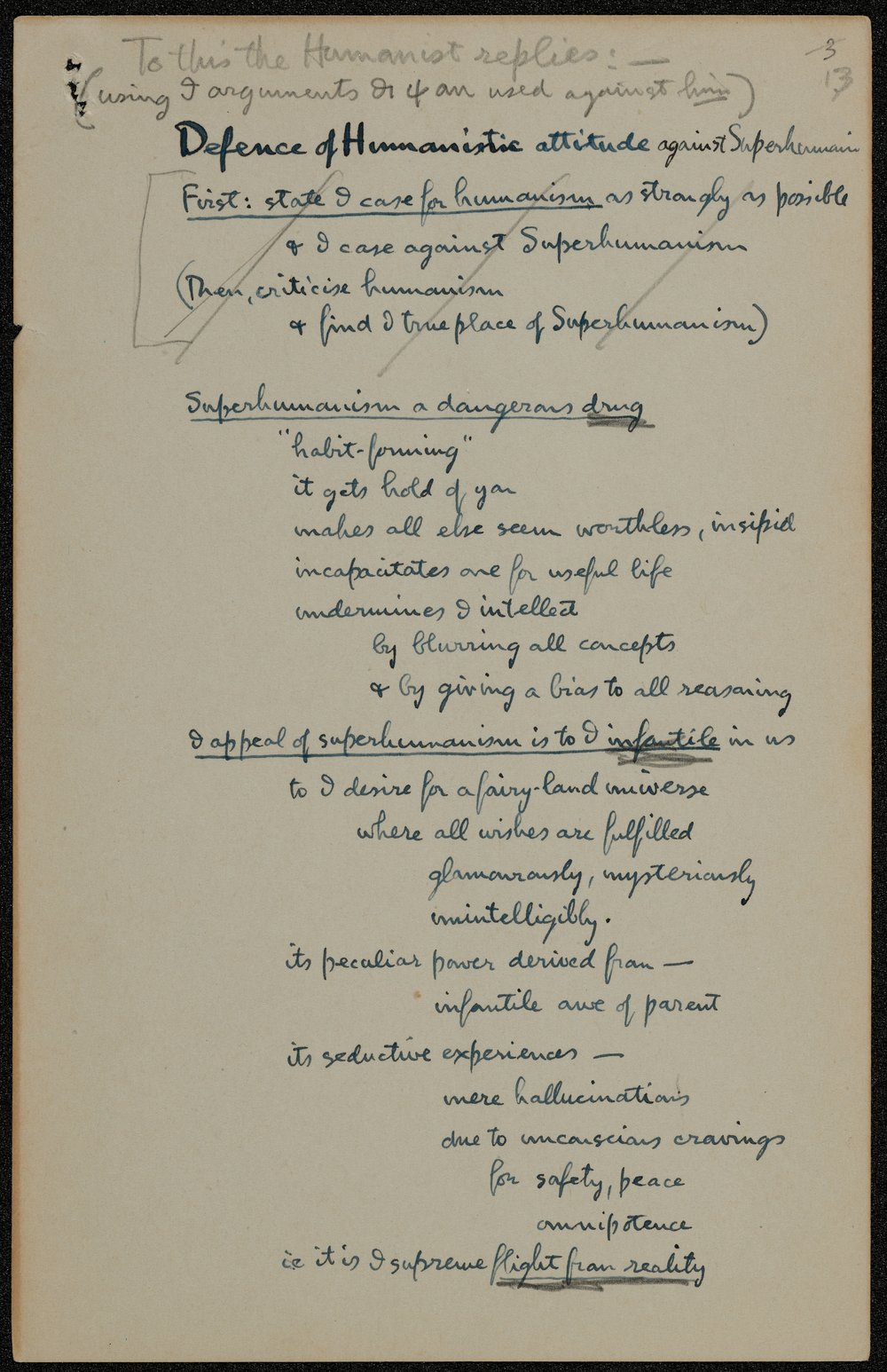
×To this the Humanist replies: —
×(using θ arguments θ 4 an used against him)
Defence of Humanistic attitude against Superhumanism
First: state θ case for humanism as strongly as possible
& θ case against Superhumanism
(Then, criticise humanism
& find θ true place of Superhumanism)
Superhumanism a dangerous drug
“habit-forming”
it gets hold of you
makes all else seem worthless, insipid
incapacitates one for useful life
undermines θ intellect
by blurring all concepts
& by giving a bias to all reasoning
θ appeal of superhumanism is to θ infantile in us
to θ desire for a fairy-land universe
where all wishes are fulfilled
glamourously, mysteriously
unintelligibly.
its peculiar power derived from —
infantile awe of parent
its seductive experiences —
mere hallucinations
due to unconscious cravings
for safety, peace
omnipotence
i.e. it is θ supreme flight from reality
Original manuscript — sheet 17
scan sheet 17
Transcription
14
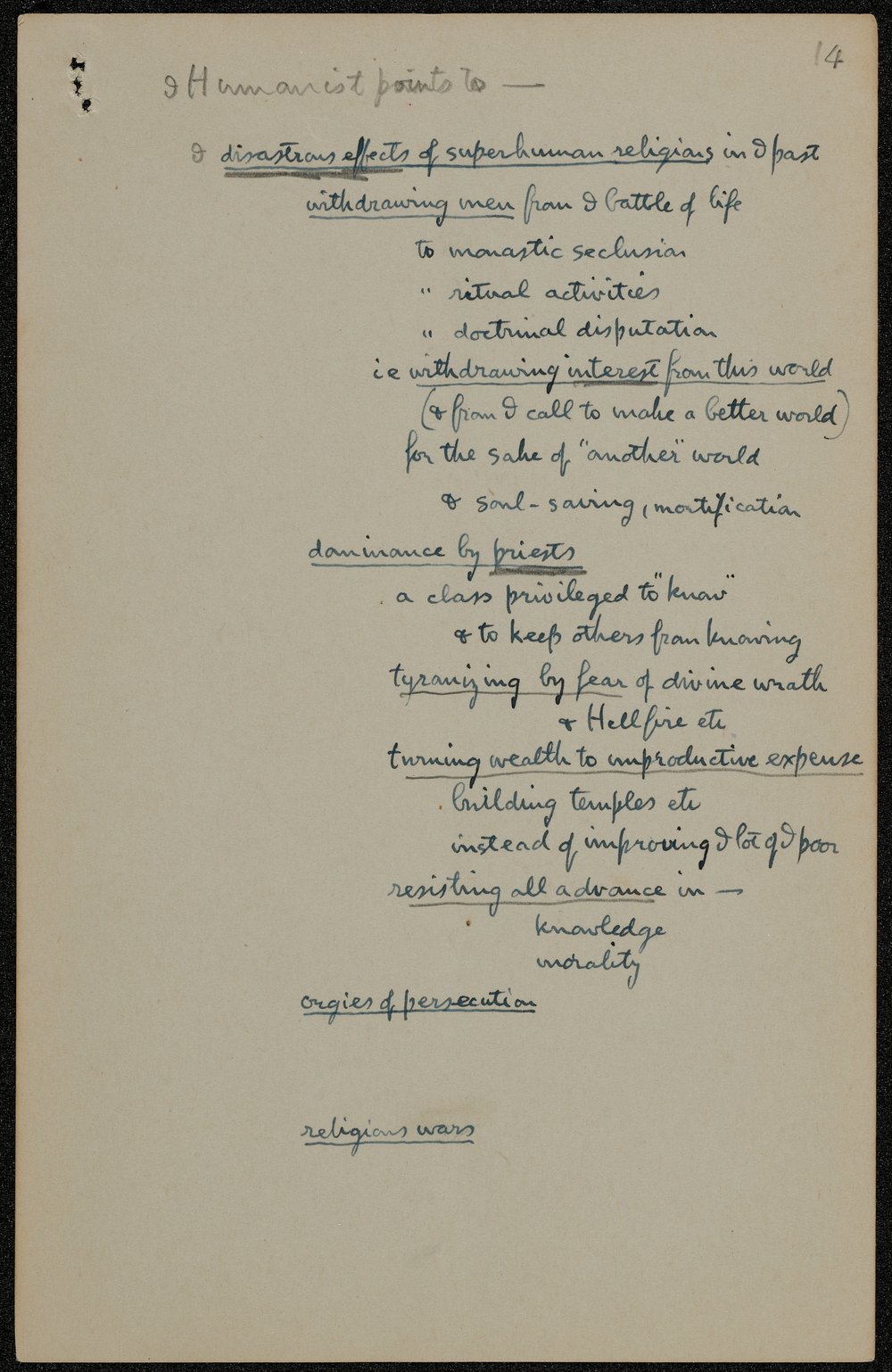
θ Humanist points to —
θ disastrous effects of superhuman religions in θ past
withdrawing men from θ battle of life
to monastic seclusion
" ritual activities
" doctrinal disputation
i e withdrawing interest from this world
(& from θ call to make a better world)
for the sake of "another" world
& soul - saving, mortification
dominance by priests
a class privileged to "know"
& to keep others from knowing
tyranizing by fear of divine wrath
& Hellfire etc
turning wealth to unproductive expense
building temples etc
instead of improving θ lot of θ poor
resisting all advance in —
knowledge
morality
orgies of persecution
religious wars
Original manuscript — sheet 18
scan sheet 18
Transcription
15
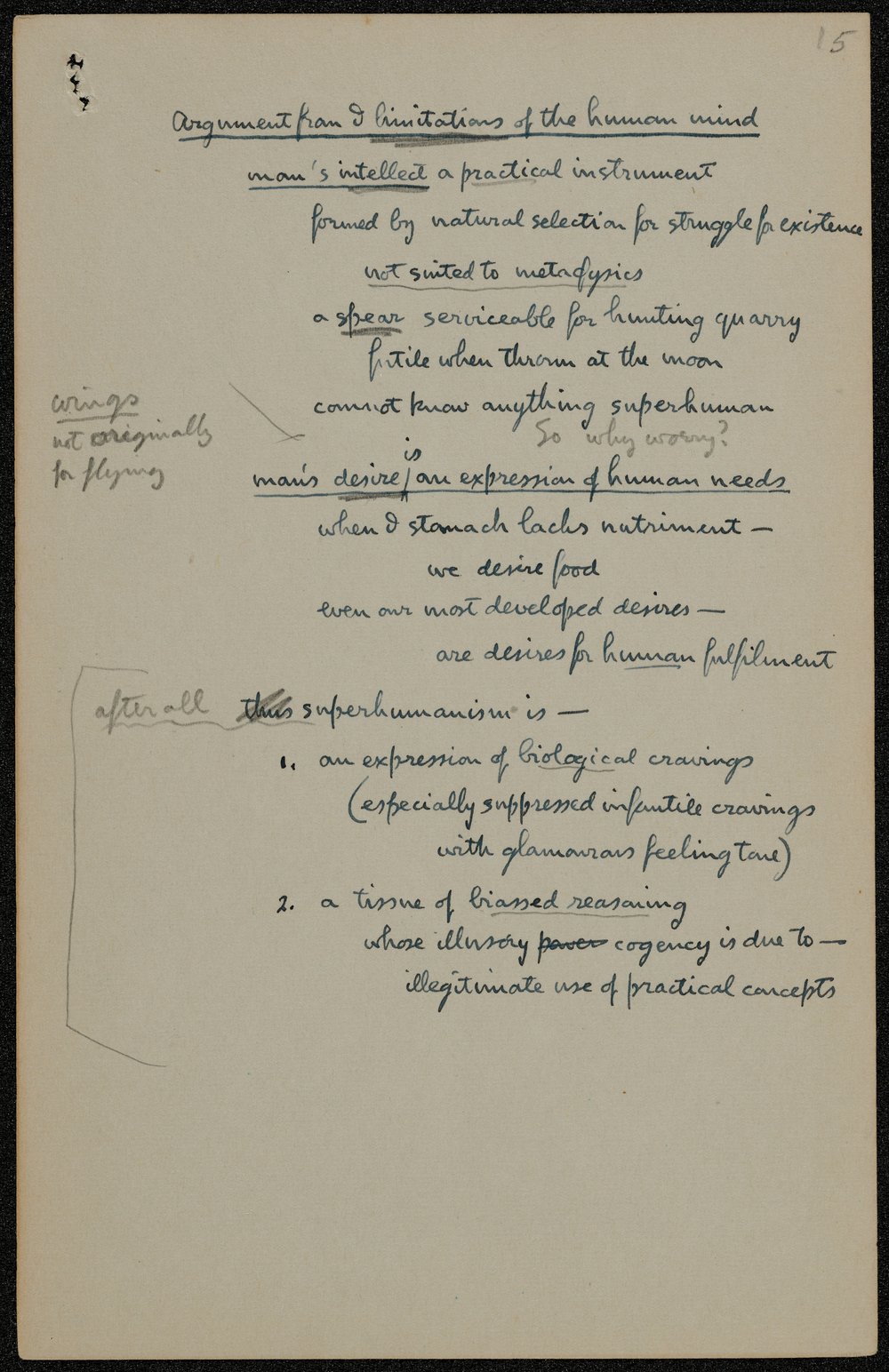
Argument from ð limitations of the human mind
man's intellect a practical instrument
formed by natural selection for struggle for existence
not suited to metaphysics
a spear serviceable for hunting quarry
futile when thrown at the moon
wingscannot know anything superhumanSo why worry?
not originally
for flyingman's desire is an expression of human needs
when ð stomach lacks nutriment —
we desire food
even our most developed desires —
are desires for human fulfilment
after allthus superhumanism is —
1. an expression of biological cravings
(especially suppressed infantile cravings
with glamourous feeling tone.)
2. a tissue of biassed reasoning
whose illusory power cogency is due to —
illegitimate use of practical concepts
Original manuscript — sheet 19
scan sheet 19
Transcription
5
argument from ð limitations of human intellect
Original manuscript — sheet 20
scan sheet 20
Transcription
16
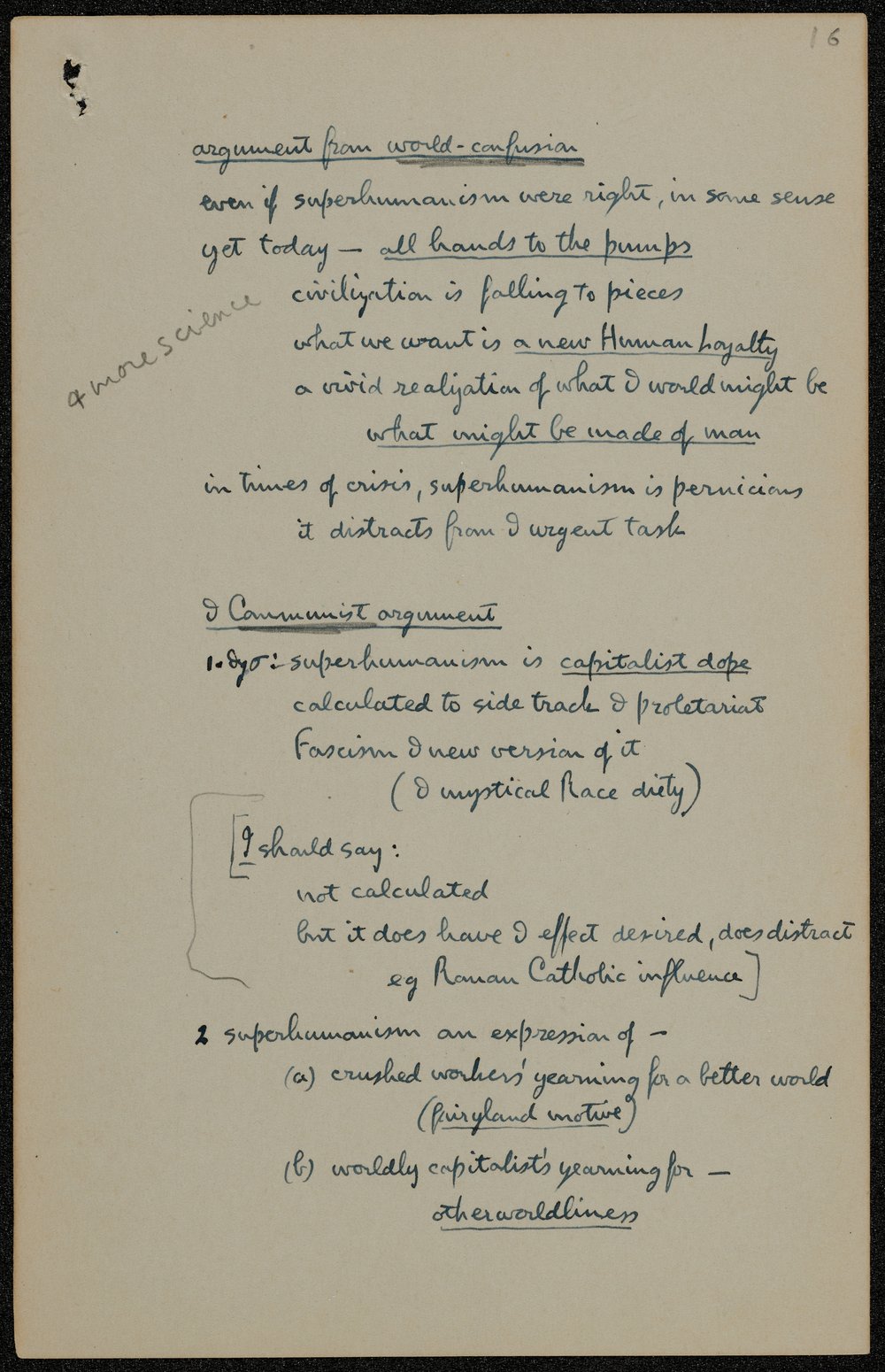
argument from world-confusion
even if superhumanism were right, in some sense
yet today — all hands to the pumps
& more sciencecivilization is falling to pieces
what we want is a new Human Loyalty
a vivid realization of what ð world might be
what might be made of man
in times of crisis, superhumanism is pernicious
it distracts from ð urgent task
ð Communist argument
1. Obj:- superhumanism is capitalist dope
calculated to side track ð proletariat
Fascism ð new version of it
(ð mystical Race deity)
[I should say:
not calculated
but it does have ð effect desired, does distract
e.g Roman Catholic influence]
2 superhumanism an expression of -
(a) crushed workers' yearning for a better world
(fairyland motive)
(b) worldly capitalist's yearning for -
otherworldliness
Original manuscript — sheet 21
scan sheet 21
Transcription
17
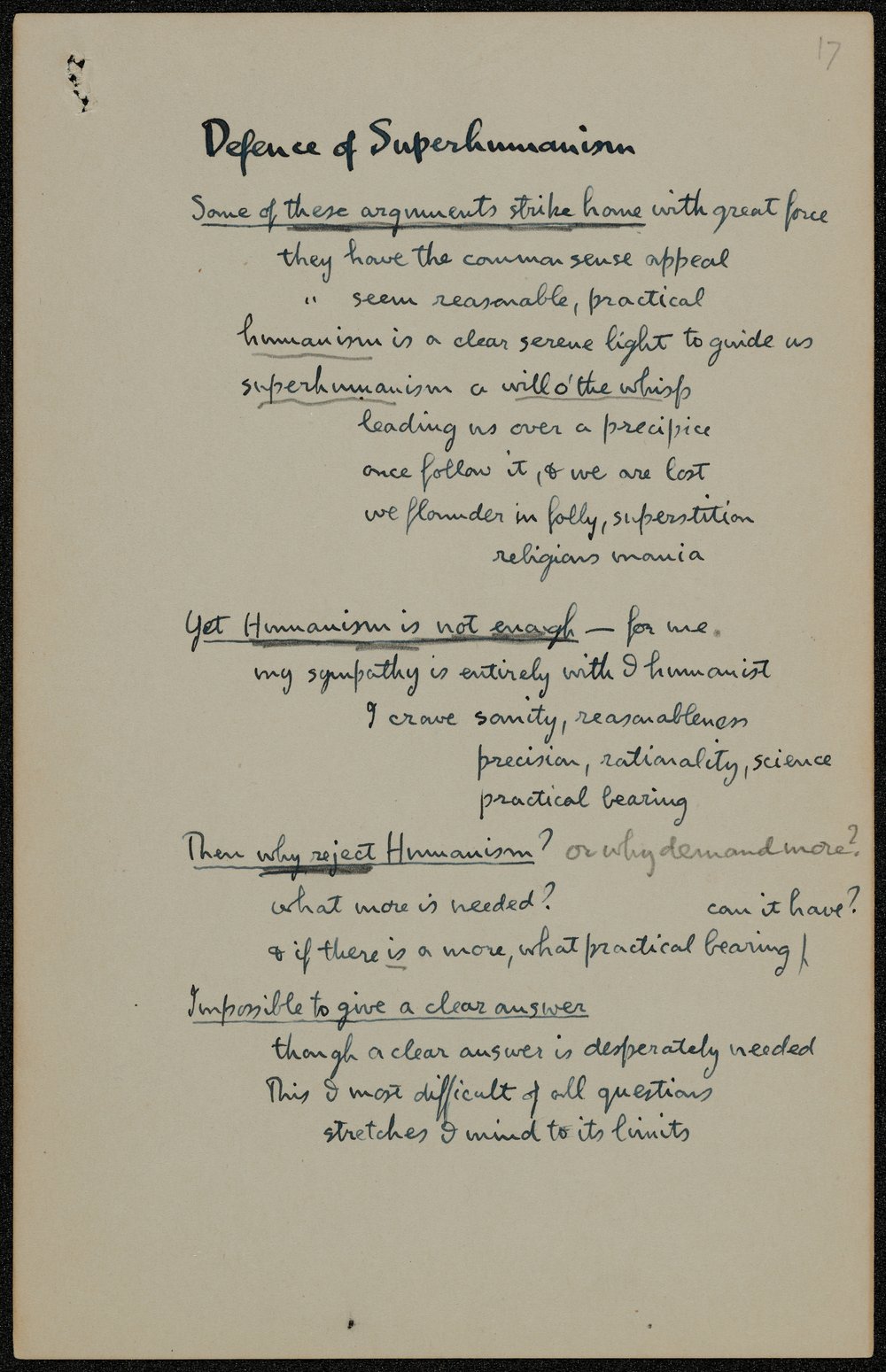
Defence of Superhumanism
Some of these arguments strike home with great force
they have the common sense appeal
" seem reasonable, practical
humanism is a clear serene light to guide us
superhumanism a will o'the whisp
leading us over a precipice
once follow it, & we are lost
we flounder in folly, superstition
religious mania
Yet Humanism is not enough — for me.
my sympathy is entirely with ð humanist
I crave sanity, reasonableness
precision, rationality, science
practical bearing
Then why reject Humanism? or why demand more?
what more is needed? can it have?
& if there is a more, what practical bearing
Impossible to give a clear answer
though a clear answer is desperately needed
This ð most difficult of all questions
stretches ð mind to its limits
Original manuscript — sheet 22
scan sheet 22
Transcription
18
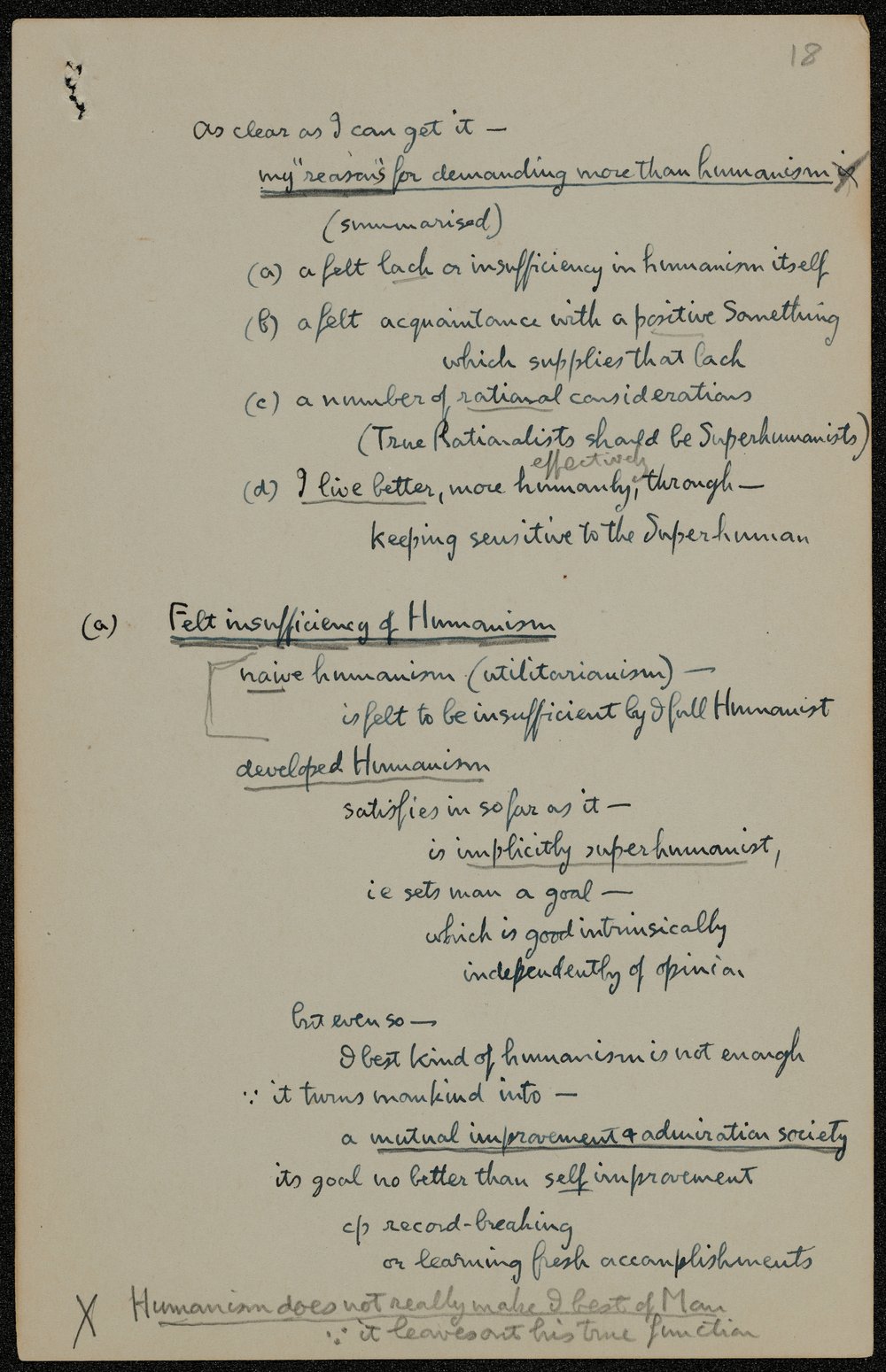
As clear as I can get it —
my "reasons" for demanding more than humanism. X
(summarised)
(a) a felt lack or insufficiency in humanism itself
(b) a felt acquaintance with a positive Something
which supplies that lack
(c) a number of rational considerations
(True Rationalists should be Superhumanists)
(d) I live better, more humanly, effectively through —
keeping sensitive to the Superhuman
(a) Felt insufficiency of Humanism
naive humanism. (utilitarianism) →
is felt to be insufficient by ð full Humanist
developed Humanism
satisfies in so far as it —
is implicitly superhumanist,
i e sets man a goal —
which is good intrinsically
independently of opinion.
But even so →
ð best kind of humanism is not enough
∵ it turns mankind into —
a mutual improvement + admiration society
its goal no better than self improvement
c/f record-breaking
or learning fresh accomplishments
X Humanism does not really make ϑ best of Man
∵ it leaves out his true function
Original manuscript — sheet 23
scan sheet 23
Transcription
19
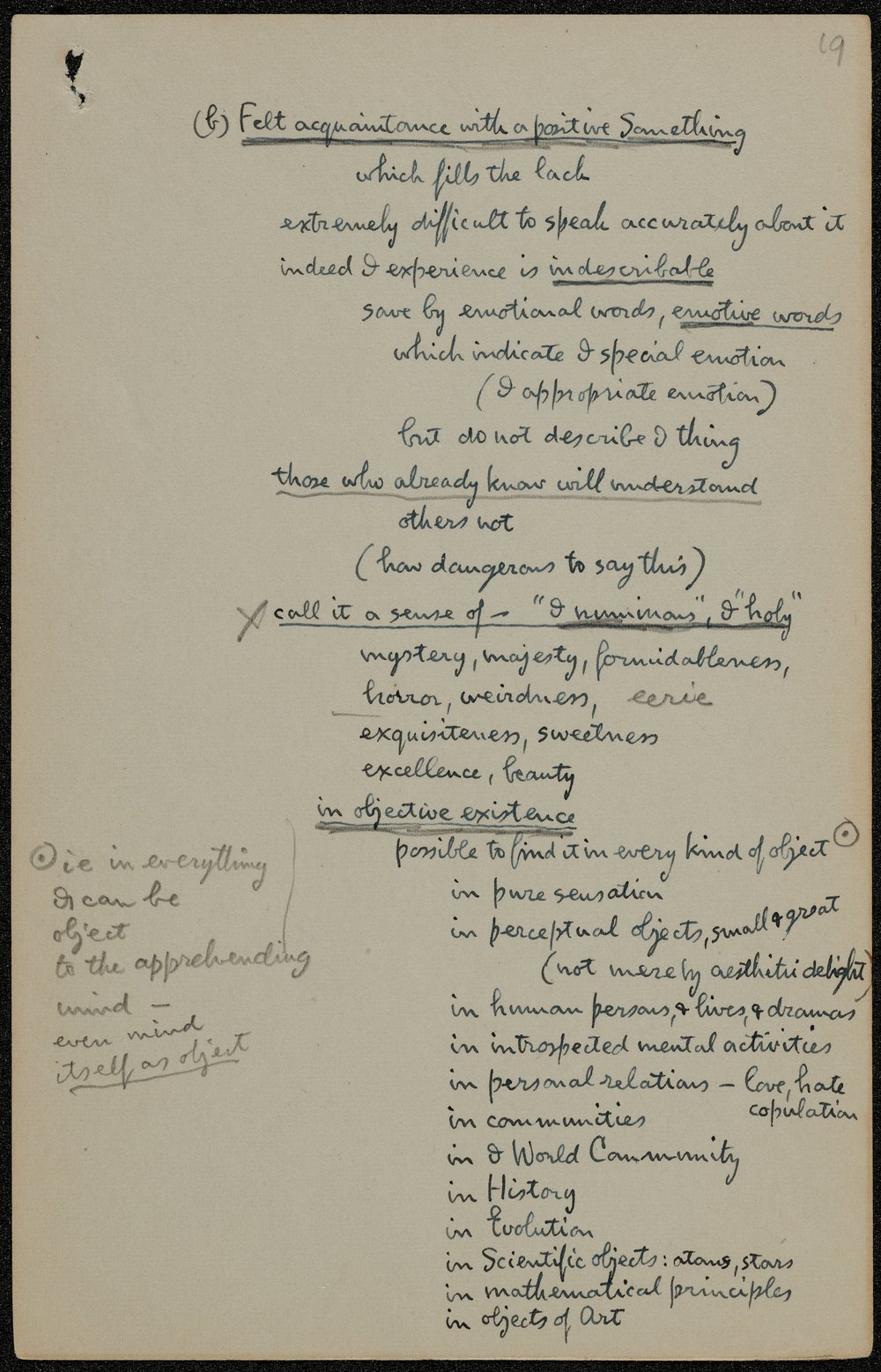
(b) Felt acquaintance with a positive Something
which fills the lack
extremely difficult to speak accurately about it
indeed ð experience is indescribable
save by emotional words, emotive words
which indicate ð special emotion
(ð appropriate emotion)
but do not describe ð thing
those who already know will understand
others not
(how dangerous to say this)
Xcall it a sense of - “ð numinous”, ð “holy”
mystery, majesty, formidableness,
horror, weirdness, eerie
exquisiteness, sweetness
excellence, beauty
in objective existence
⊙ i.e in everythingpossible to find it in every kind of object ⊙
ð can bein pure sensation
objectin perceptual objects, small & great
to the apprehending(not merely aesthetic delight)
mind -in human persons, & lives, & dramas
even mindin introspected mental activities
itself as objectin personal relations – love, hate copulation
in communities
in ð World Community
in History
in Evolution
in Scientific objects: atoms, stars
in mathematical principles
in objects of Art
Original manuscript — sheet 24
scan sheet 24
Transcription
20
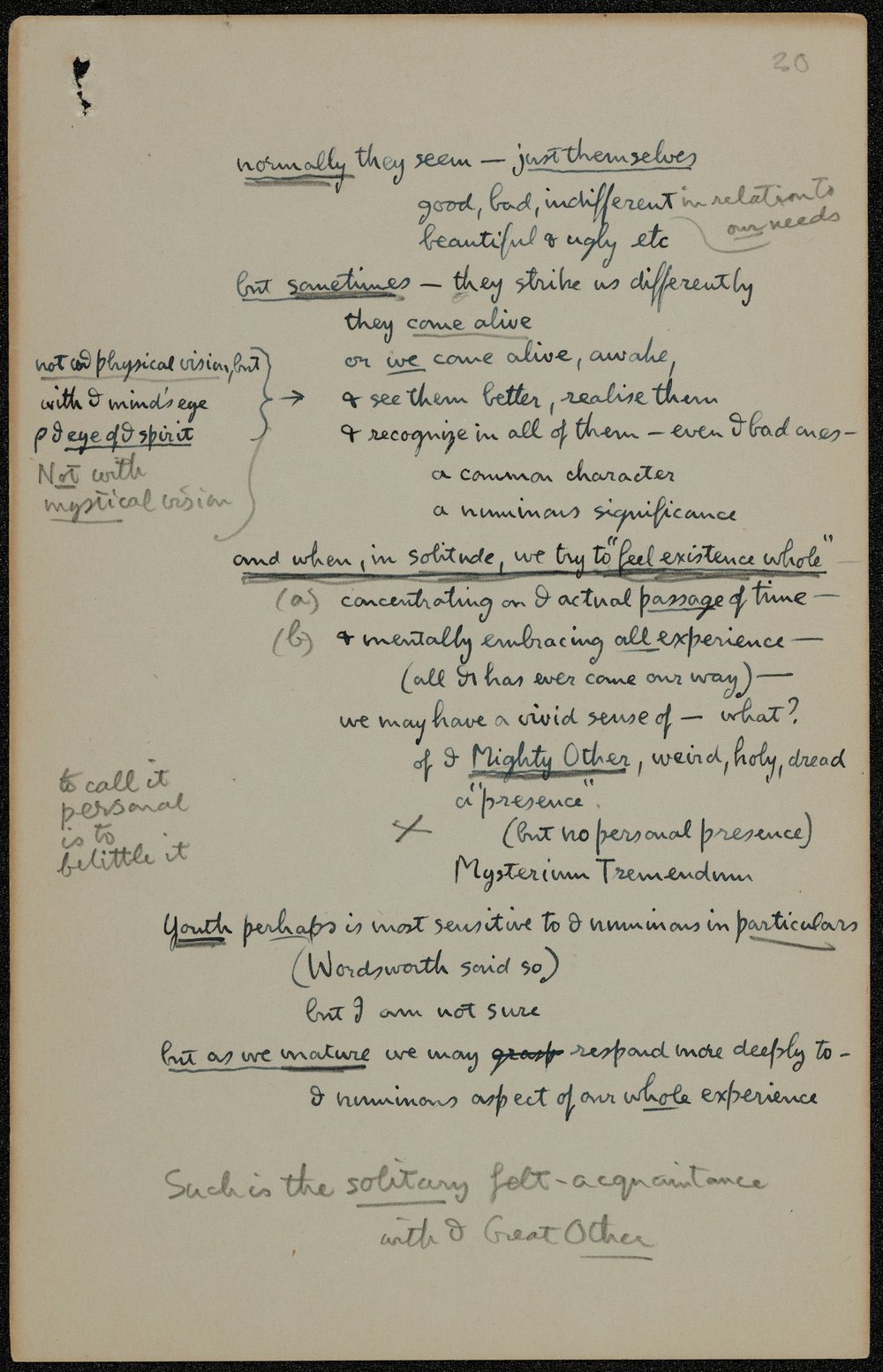
normally they seem — just themselves
good, bad, indifferent in relation to
beautiful & ugly, etc our needs
but sometimes — they strike us differently
they come alive
not wð physical vision, but or we come alive, awake,
with ð mind's eye → & see them better, realise them
or ð eye of ð spirit & recognize in all of them — even ð bad ones —
Not with a common character
mystical vision a numinous significance
and when, in solitude, we try to "feel existence whole"
(a) concentrating on ð actual passage of time —
(b) & mentally embracing all experience —
(all ðt has ever come our way) —
we may have a vivid sense of — what?
to call it of ð Mighty Other, weird, holy, dread
personal a "presence".
is to ×        (but no personal presence)
belittle it Mysterium Tremendum
Youth perhaps is most sensitive to ð numinous in particulars
(Wordsworth said so)
but I am not sure
but as we mature we may grasp respond more deeply to —
ð numinous aspect of our whole experience
Such is the solitary felt-acquaintance
with ð Great Other
Original manuscript — sheet 25
scan sheet 25
Transcription
20A
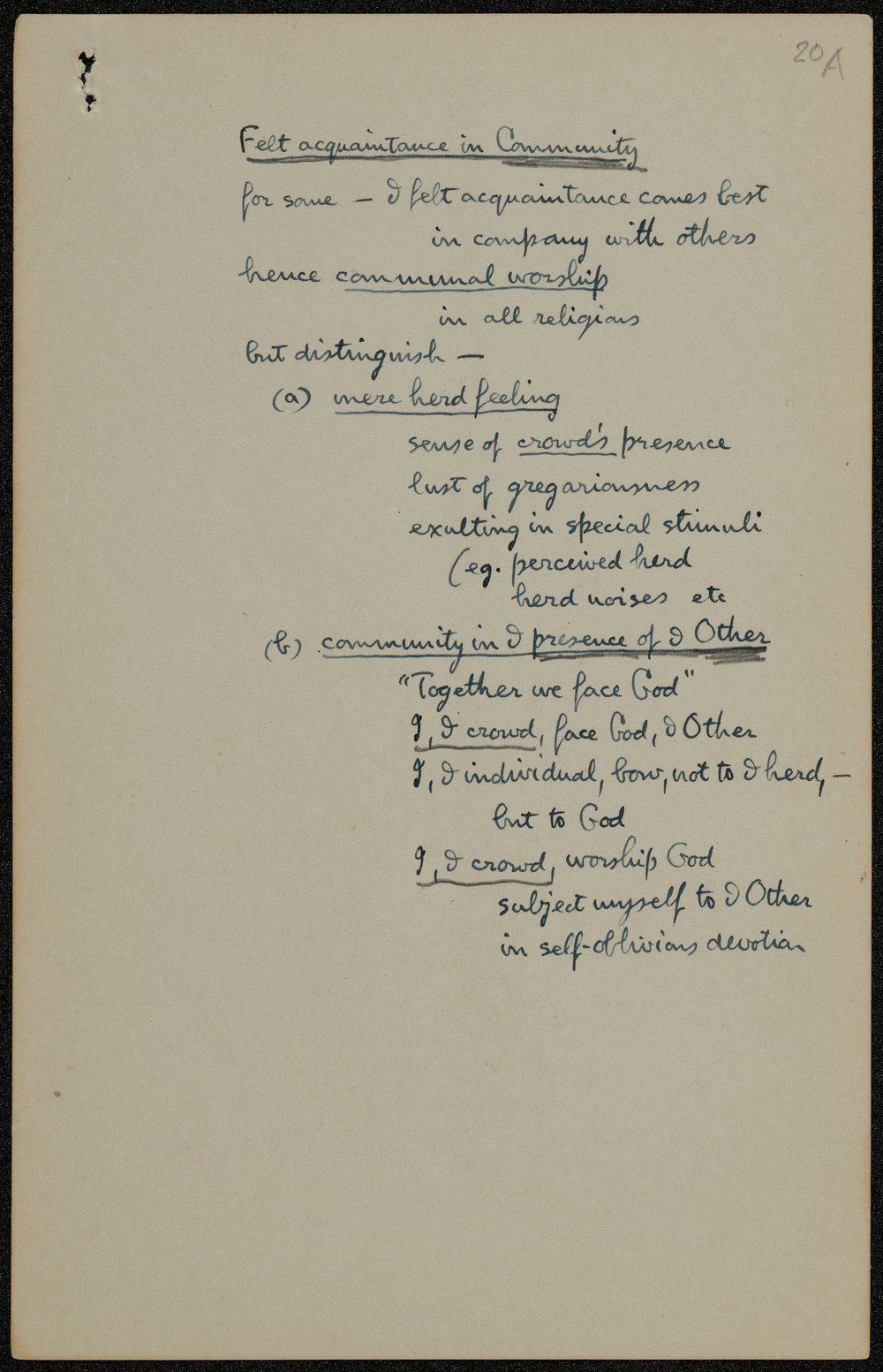
Felt acquaintance in Community
for some — ð felt acquaintance comes best
in company with others
hence communal worship
in all religions
but distinguish —
(a) mere herd feeling
sense of crowd’s presence
lust of gregariousness
exulting in special stimuli
(eg. perceived herd
herd noises etc
(b). community in ð presence of ð Other
“Together we face God”
I, ð crowd, face God, ð Other
I, ð individual, bow, not to ð herd, —
but to God
I, ð crowd, worship God
subject myself to ð Other
in self-oblivious devotion
Original manuscript — sheet 26
scan sheet 26
Transcription
21
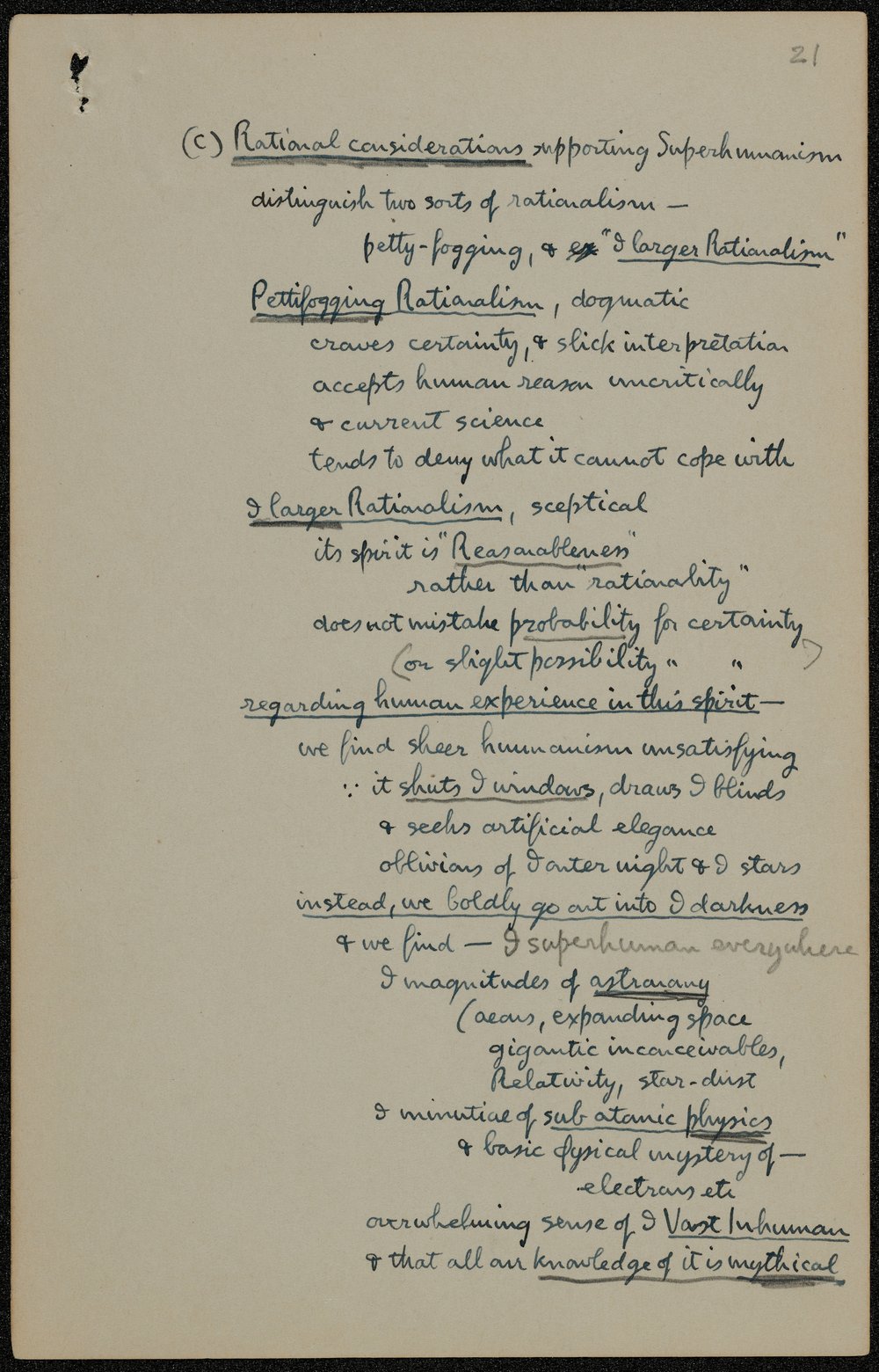
(c) Rational considerations supporting Superhumanism
distinguish two sorts of rationalism —
petty-fogging, & ex “ð larger Rationalism”
Pettifogging Rationalism, dogmatic
craves certainty, & slick interpretation
accepts human reason uncritically
& current science
tends to deny what it cannot cope with
ð larger Rationalism, sceptical
its spirit is “Reasonableness”
rather than “rationality”
does not mistake probability for certainty
(or slight possibility “     “
regarding human experience in this spirit —
we find sheer humanism unsatisfying
∵ it shuts ð windows, draws ð blinds
& seeks artificial elegance
oblivious of ð outer night & ð stars
instead, we boldly go out into ð darkness
& we find — ð superhuman everywhere
ð magnitudes of astranomy
(aeons, expanding space
gigantic inconceivables,
Relativity, star-dust
ð minutiae of sub atomic physics
& basic physical mystery of —
-electrons etc
overwhelming sense of ð Vast Inhuman
& that all our knowledge of it is mythical
Original manuscript — sheet 27
scan sheet 27
Transcription
21A
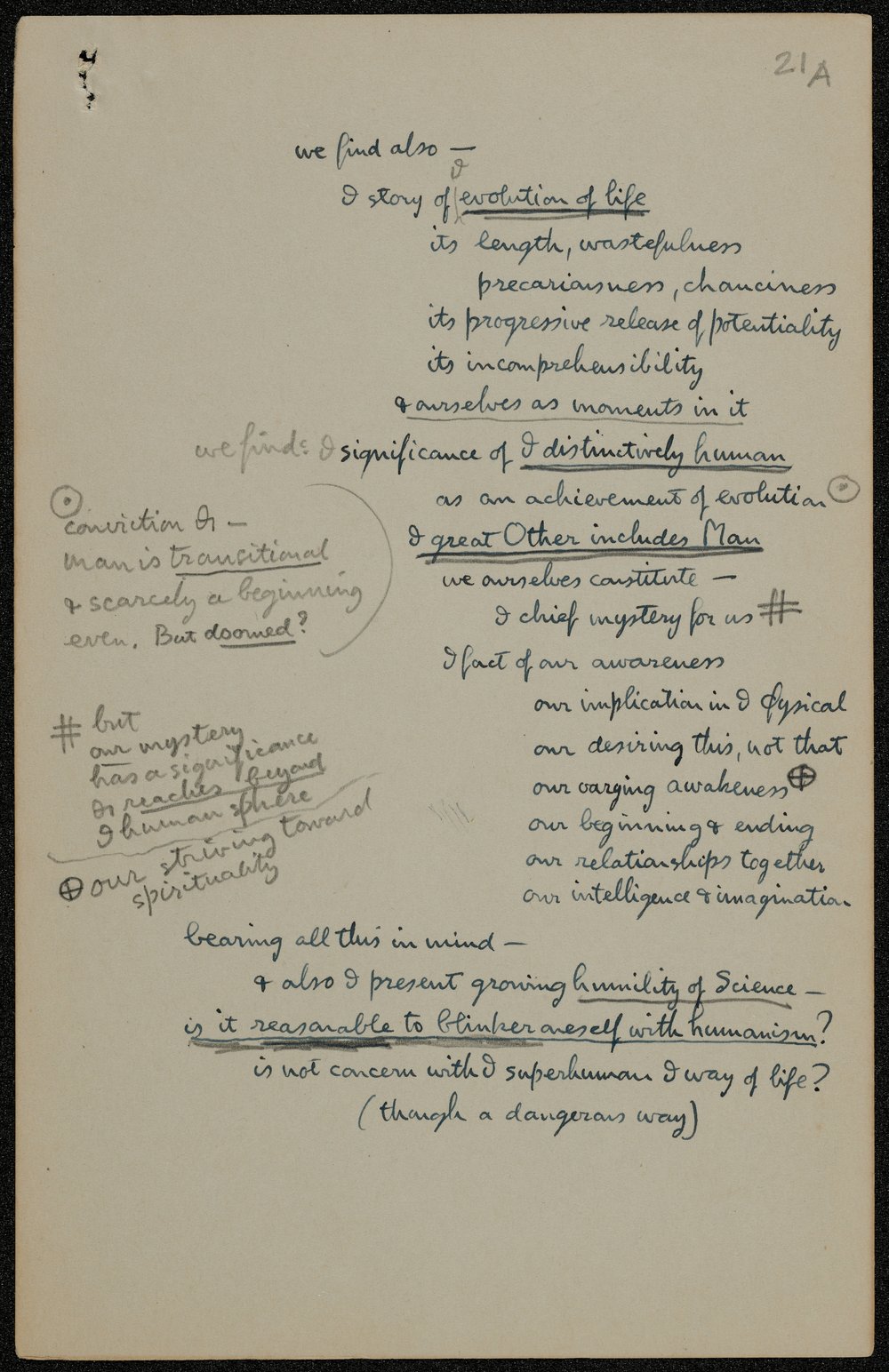
we find also —
θ story of θ evolution of life
its length, wastefulness
precariousness, chanciness
its progressive release of potentiality
its incomprehensibility
& ourselves as moments in it
we find: θ significance of θ distinctively human
⊙ conviction θ —as an achievement of evolution ⊙
man is transitionalθ great Other includes Man
& scarcely a beginningwe ourselves constitute —
even, But doomed?θ chief mystery for us #
θ fact of our awareness
# butour implication in θ physical
our mysteryour desiring this, not that
has a significanceour varying awakeness ⊕
θ reaches beyondour beginning & ending
θ human sphereour relationships together
⊕ our striving towardour intelligence & imagination.
spiritualitybearing all this in mind —
& also θ present growing humility of Science —
is it reasonable to blinker oneself with humanism?
is not concern with θ superhuman θ way of life?
( though a dangerous way)
Original manuscript — sheet 28
scan sheet 28
Transcription
21
  B
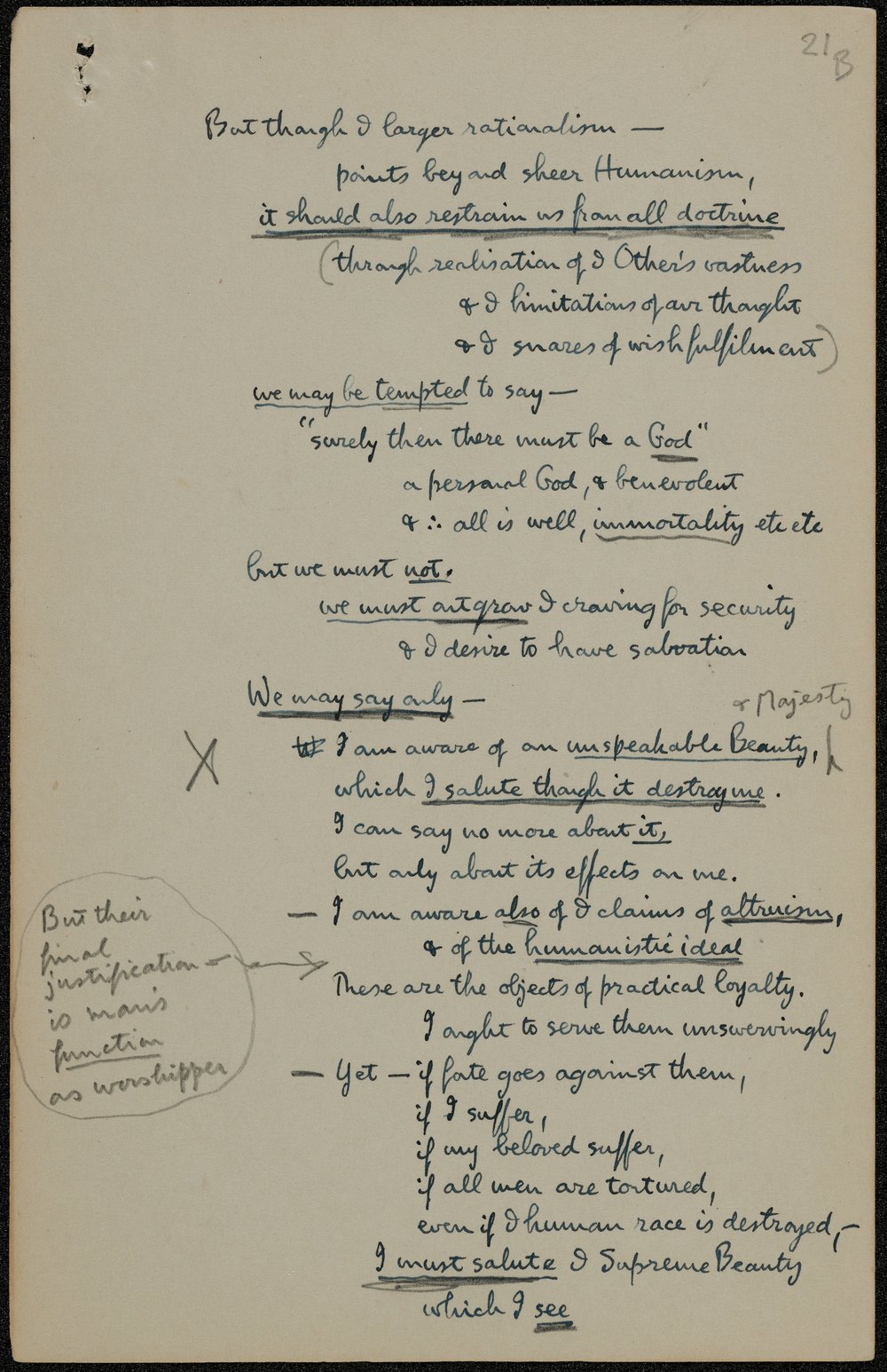
But though ð larger rationalism —
points beyond sheer Humanism,
it should also restrain us from all doctrine
(through realisation of ð Other's vastness
& ð limitations of our thought
& ð snares of wish fulfilment)
we may be tempted to say—
“surely then there must be a God”
a personal God, & benevolent
& ∴ all is well, immortality etc etc
but we must not.
we must outgrow ð craving for security
& ð desire to have salvation
We may say only —
Xthat I am aware of an unspeakable Beauty,& Majesty
which I salute though it destroy me.
I can say no more about it,
but only about its effects on me.
— I am aware also of ð claims of altruism,
& of the humanistic ideal
But their
final
justification
is man's
function
as worshipper
→These are the objects of practical loyalty.
I ought to serve them unswervingly
— Yet — if fate goes against them,
if I suffer,
if my beloved suffer,
if all men are tortured,
even if ð human race is destroyed,—
I must salute ð Supreme Beauty
which I see
Original manuscript — sheet 29
scan sheet 29
Transcription
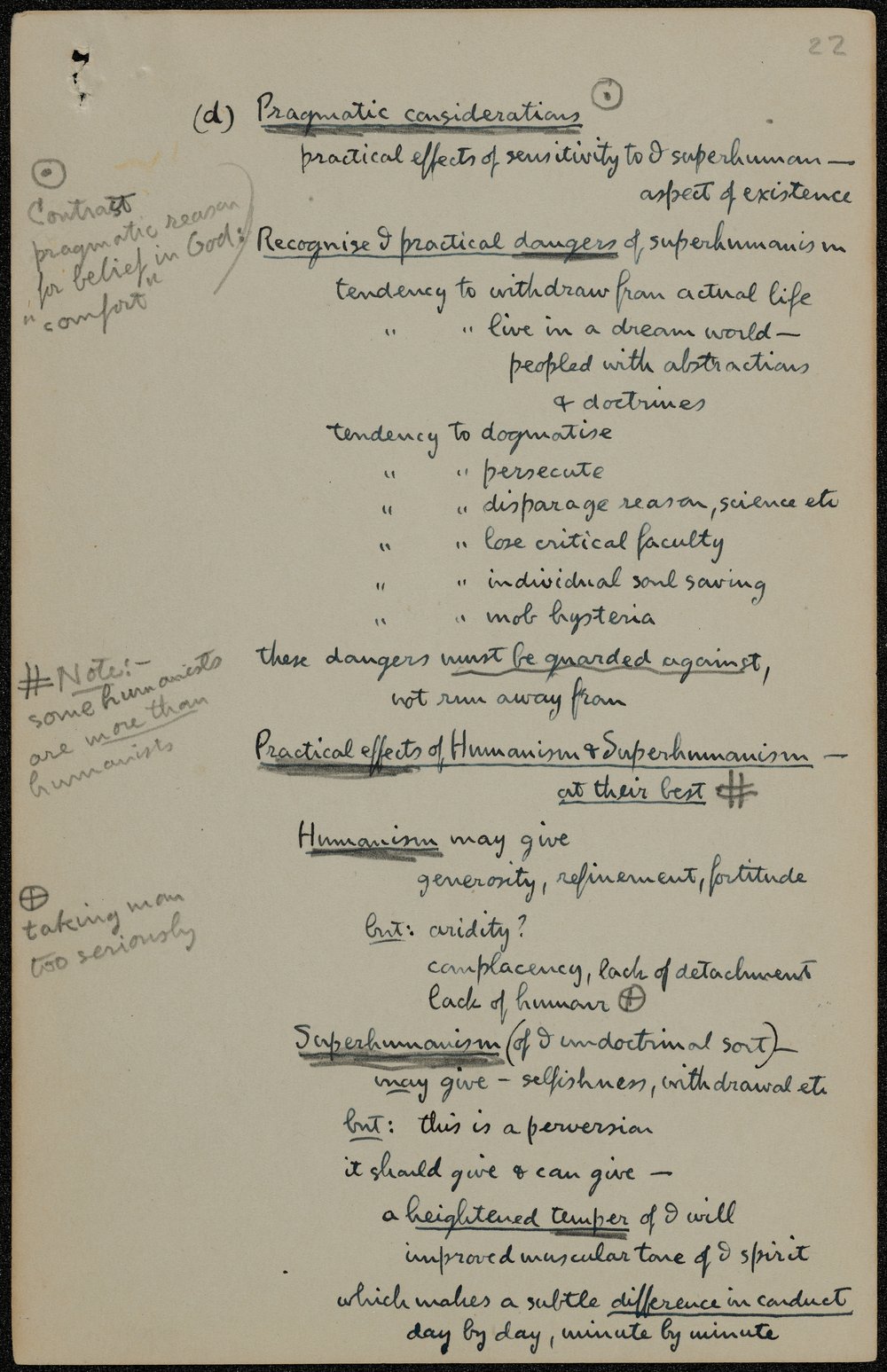
22
(d) Pragmatic considerations ⊙
⊙practical effects of sensitivity to θ superhuman —
Contrastaspect of existence
pragmatic reasonRecognise θ practical dangers of superhumanism
for belief in God,tendency to withdraw from actual life
“comfort”“    ” live in a dream world —
peopled with abstractions
& doctrines
tendency to dogmatise
“    ” persecute
“    ” disparage reason, science etc
“    ” lose critical faculty
“    ” individual soul saving
“    ” mob hysteria
# Note:—these dangers must be guarded against,
some humanistsnot run away from
are more thanPractical effects of Humanism & Superhumanism —
humanistsat their best #
Humanism may give
⊕generosity, refinement, fortitude
taking manbut: aridity?
too seriouslycomplacency, lack of detachment
lack of humour ⊕
Superhumanism (of θ undoctrinal sort)—
may give - selfishness, withdrawal etc
but: this is a perversion
it should give & can give —
a heightened temper of θ will
improved muscular tone of θ spirit
which makes a subtle difference in conduct
day by day, minute by minute
Original manuscript — sheet 30
scan sheet 30
Transcription
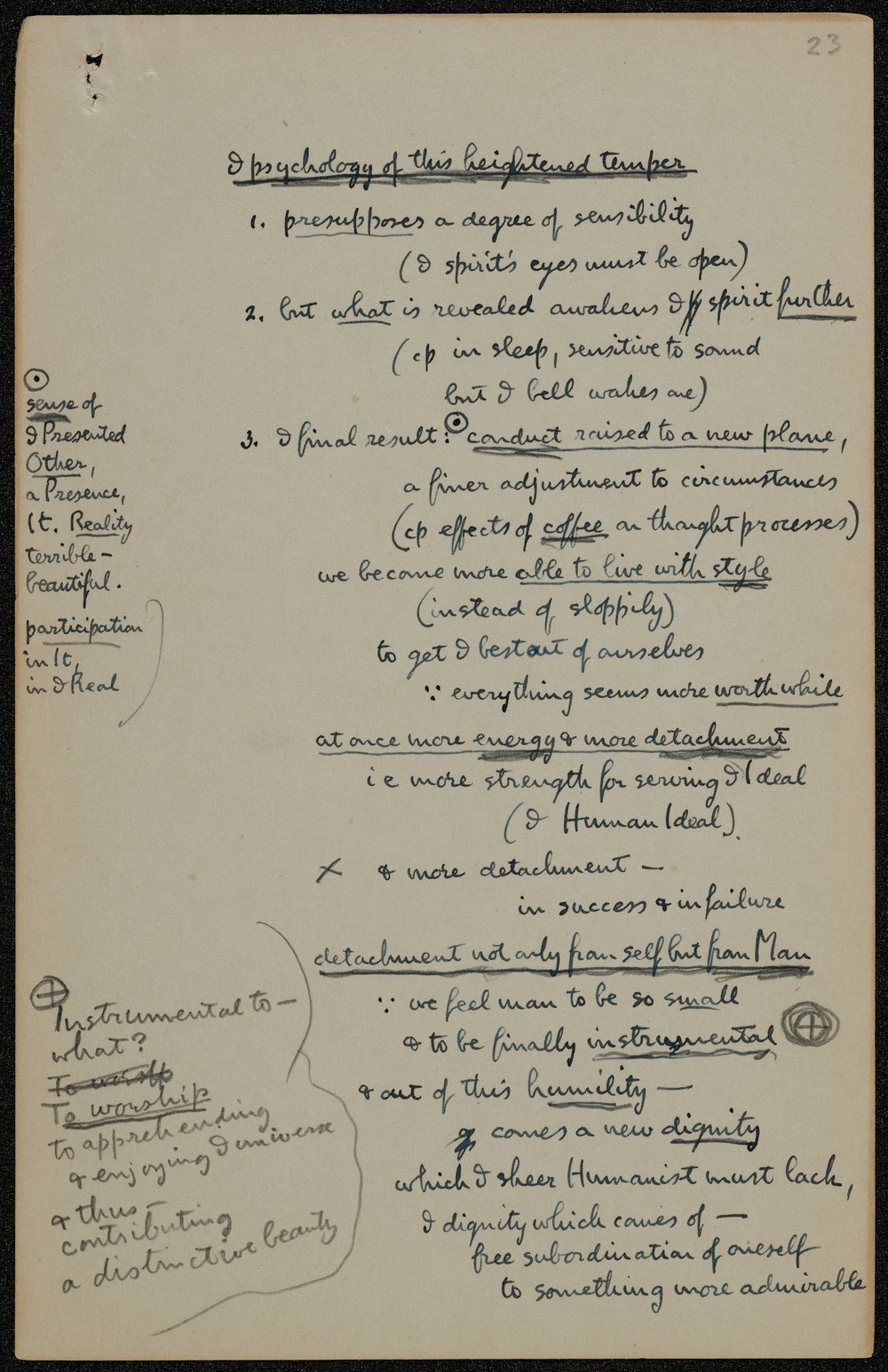
23
θ psychology of this heightened temper
1. presupposes a degree of sensibility
(θ spirit’s eyes must be open)
2. but what is revealed awakens θ ff spirit further
(cp in sleep, sensitive to sound
⊙
sense ofbut θ bell wakes one)
θ Presented3. θ final result: ⊙ conduct raised to a new plane,
Other,
a Presence,a finer adjustment to circumstances
It. Reality(cp effects of coffee on thought processes)
terrible -
we become more able to live with style
beautiful.(instead of sloppily)
participation
in It,to get θ best out of ourselves
in θ Real∴ everything seems more worth while
at once more energy & more detachment
i e more strength for serving θ Ideal
(θ Human Ideal).
× & more detachment —
in success & in failure
detachment not only from self but from Man
⊕∴ we feel man to be so small
Instrumental to —
what?& to be finally instrumental, ⊕
To worship& out of this humility —
To worship& comes a new dignity
To apprehending,which θ sheer Humanist must lack,
& enjoying θ universeθ dignity which comes of —
& thus -free subordination of oneself
contributing?to something more admirable
a distinctive beauty
Original manuscript — sheet 31
scan sheet 31
Transcription
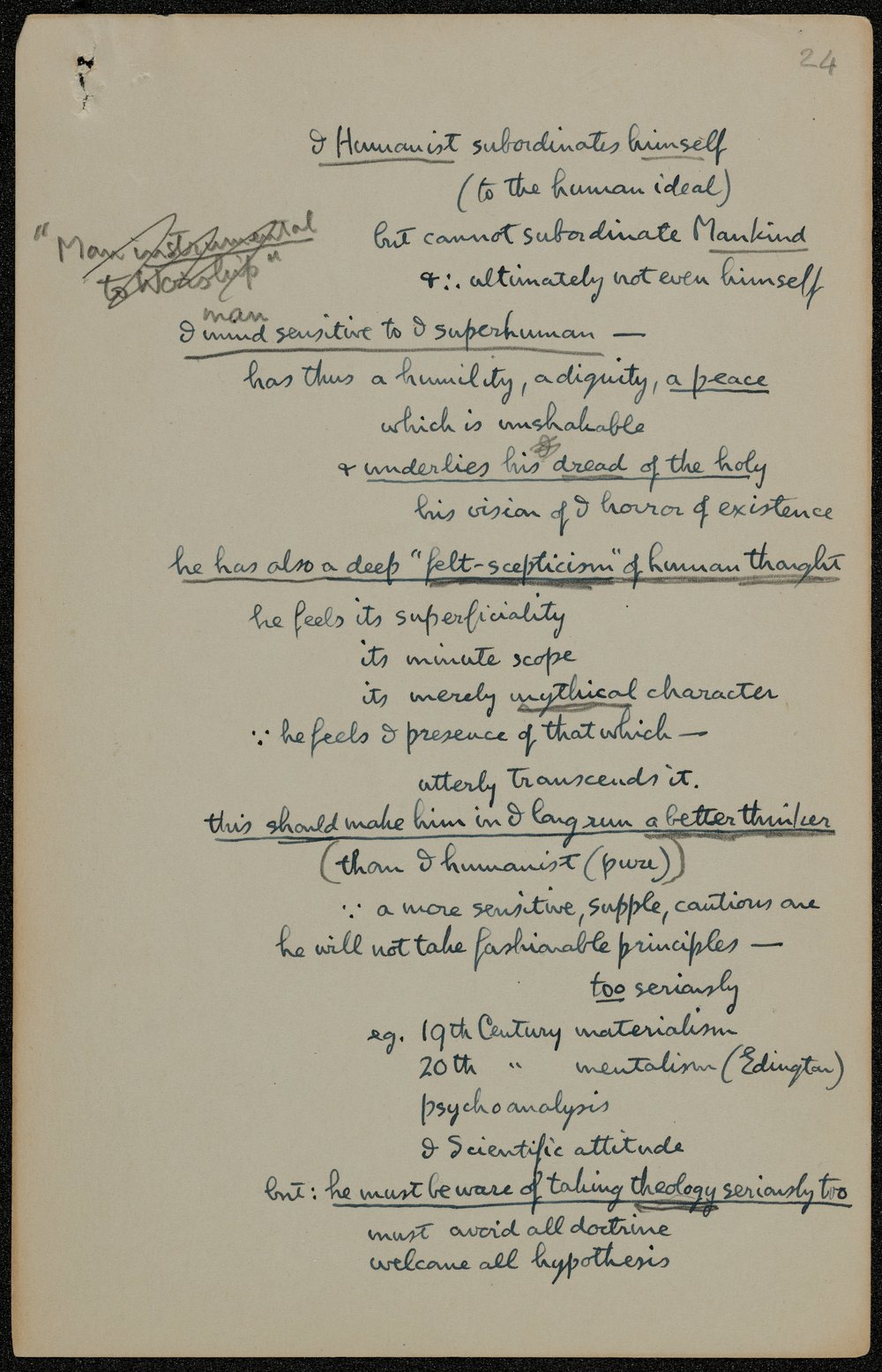
24
ð Humanist subordinates himself
(to the human ideal)
“Man instrumental
to Worship”
but cannot subordinate Mankind
& ∴ ultimately not even himself
ð man mind sensitive to ð superhuman —
has thus a humility, a dignity, a peace
which is unshakable
& underlies [illegible]his dread of the holy
his vision of ð horror of existence
he has also a deep “felt-scepticism” of human thought
he feels its superficiality
its minute scope

its merely mythical character
∵ he feels ð presence of that which —
utterly transcends it.
this should make him in ð long run a better thinker
(than ð humanist (pure))
∴ a more sensitive, supple, cautious one
he will not take fashionable principles —
too seriously
eg. 19th Century materialism
20th “ mentalism (Edington)
psychoanalysis
ð Scientific attitude
but: he must be ware of taking theology seriously too
must avoid all doctrine
welcome all hypothesis
Original manuscript — sheet 32
scan sheet 32
Transcription
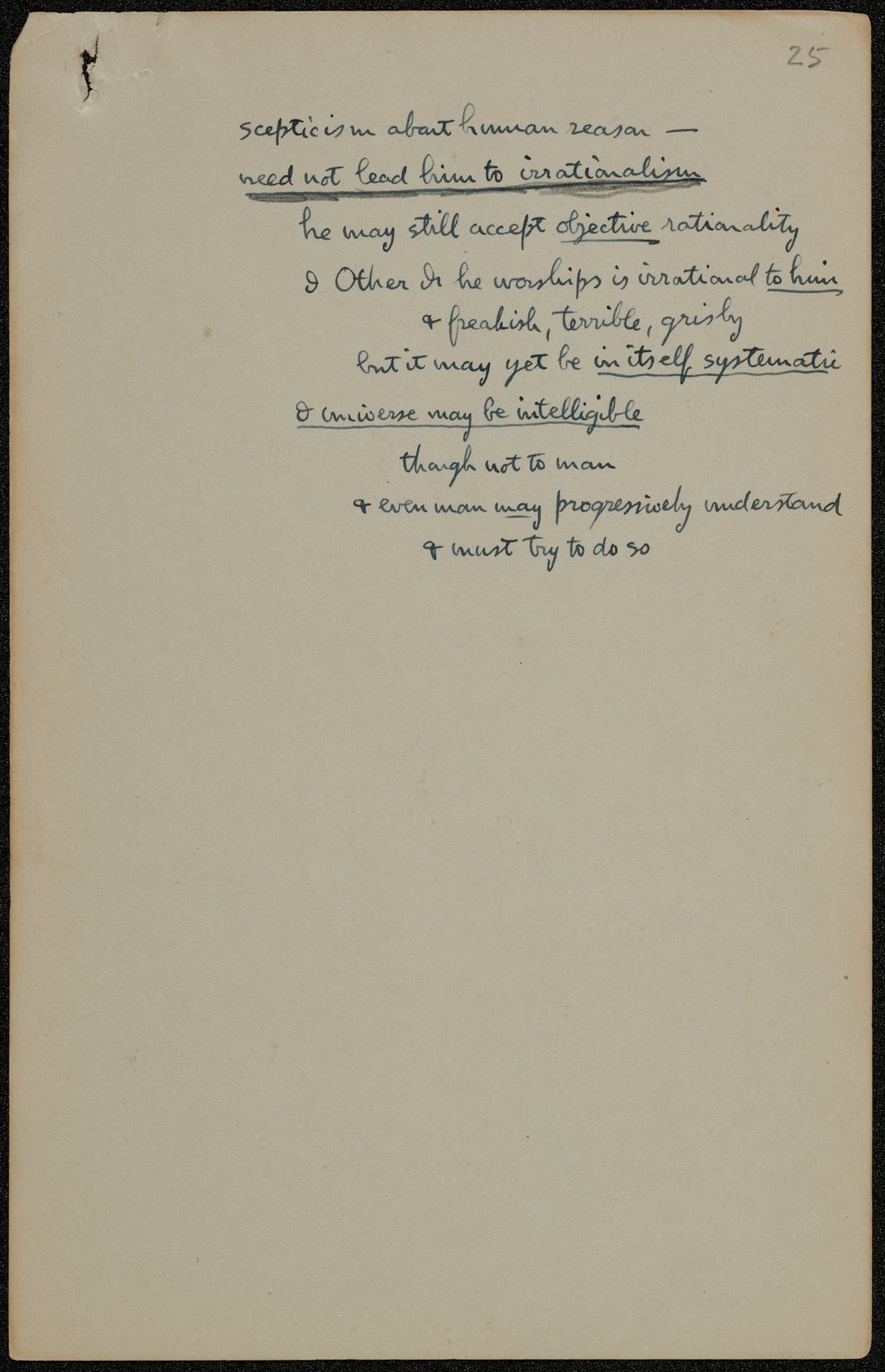
25
scepticism about human reason —
need not lead him to irrationalism
he may still accept objective rationality
θ Other ð he worships is irrational to him
& freakish, terrible, grisly
but it may yet be in itself systematic
θ universe may be intelligible
though not to man
& even man may progressively understand
& must try to do so
Original manuscript — sheet 33
scan sheet 33
Transcription
Original manuscript — sheet 34
scan sheet 34
Transcription


LIVERPOOL UNIVERSITY LIBRARY
STAP.
F11/4