← All lectures
Is Humanism Enough
Original manuscript — sheet 1
scan sheet 1
Transcription
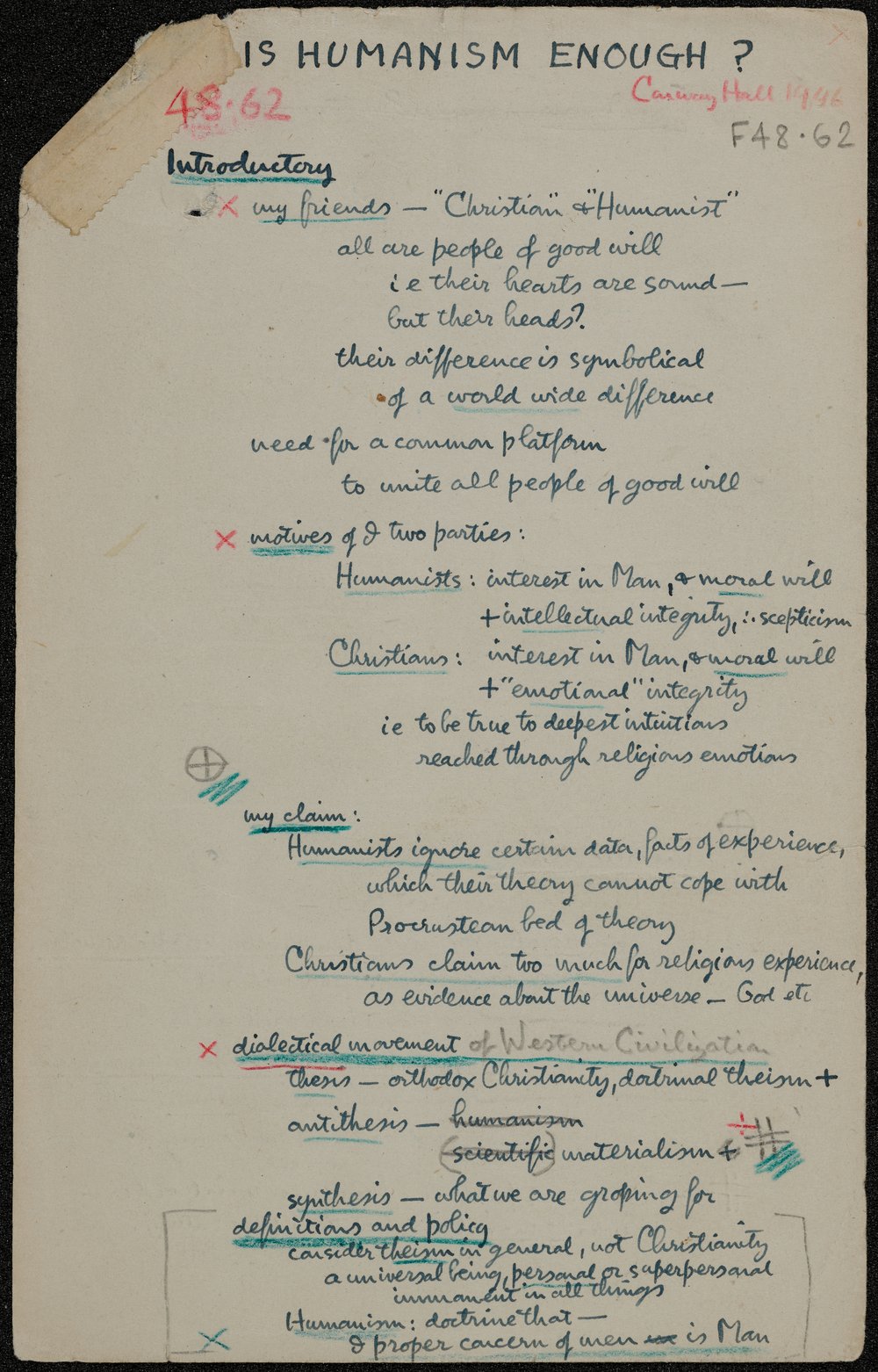
IS HUMANISM ENOUGH ? X
48·62Conway Hall 11/46
F48·62
Introductory
X my friends — “Christian” & “Humanist”
all are people of good will
i e their hearts are sound—
but their heads?
their difference is symbolical
·of a world wide difference
need ·for a common platform
to unite all people of good will
X motives of θ two parties:
Humanists: interest in Man, & moral will
+ intellectual integrity, ∴ scepticism
Christians: interest in Man, & moral will
+ “emotional” integrity
i e to be true to deepest intuitions
reached through religious emotions
⊕ ///my claim:
Humanists ignore certain data, facts of experience,
which their theory cannot cope with
Procrustean bed of theory
Christians claim too much for religious experience,
as evidence about the universe — God etc
X dialectical movement of Western Civilisation
thesis — orthodox Christianity, doctrinal theism +
antithesis — humanism
scientific materialism + + # ///
synthesis — what we are groping for
definitions and policy
consider theism in general, not Christianity,
a universal being, personal or superpersonal
immanent in all things
XHumanism: doctrine that —
θ proper concern of men are is Man
Original manuscript — sheet 2
scan sheet 2
Transcription
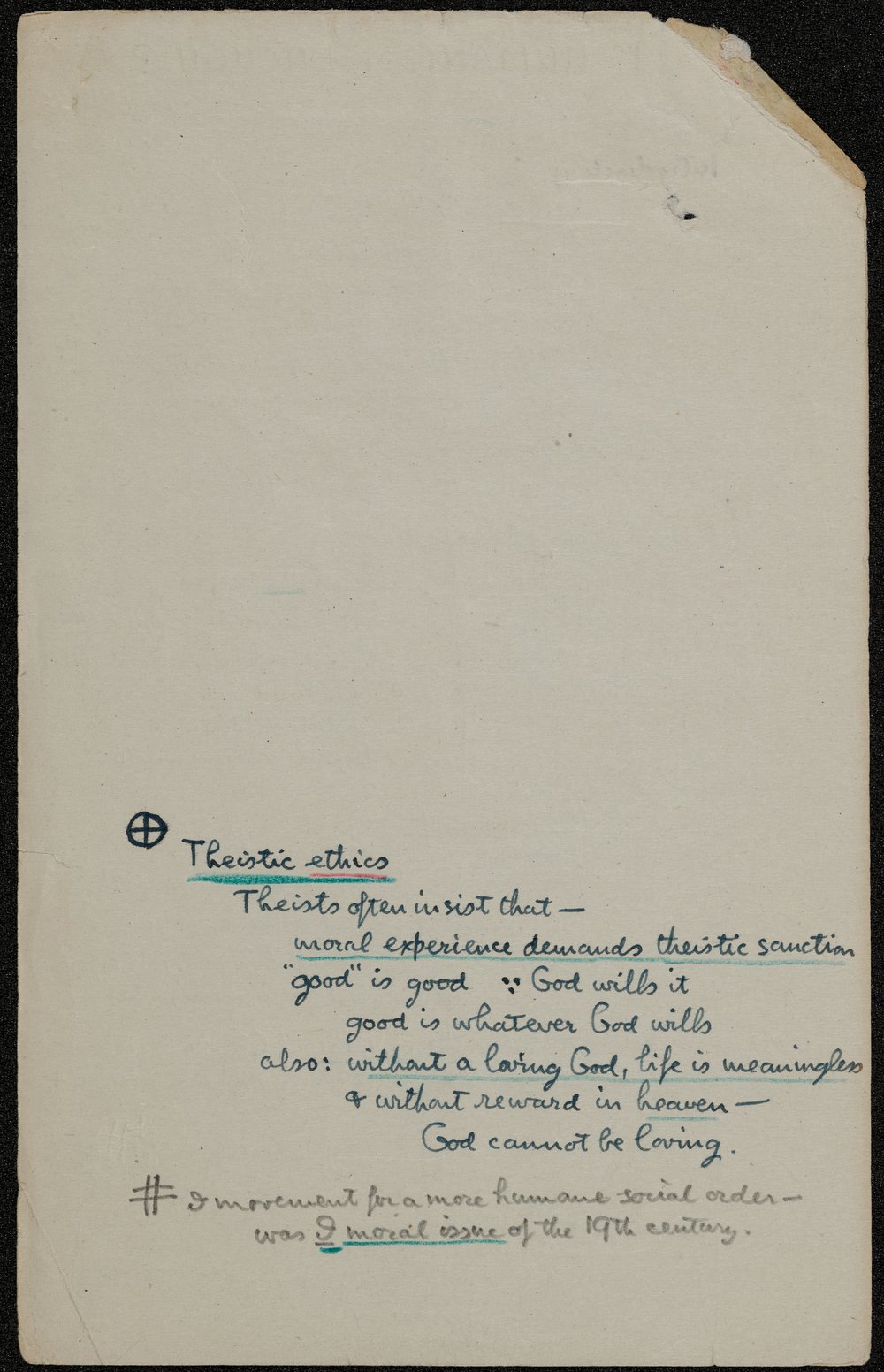
⊕ Theistic ethics
Theists often insist that —
moral experience demands theistic sanction
"good" is good ∵ God wills it
good is whatever God wills
also: without a loving God, life is meaningless
& without reward in heaven —
God cannot be loving.
# ð movement for a more humane social order —
was ð moral issue of the 19th century.
Original manuscript — sheet 3
scan sheet 3
Transcription
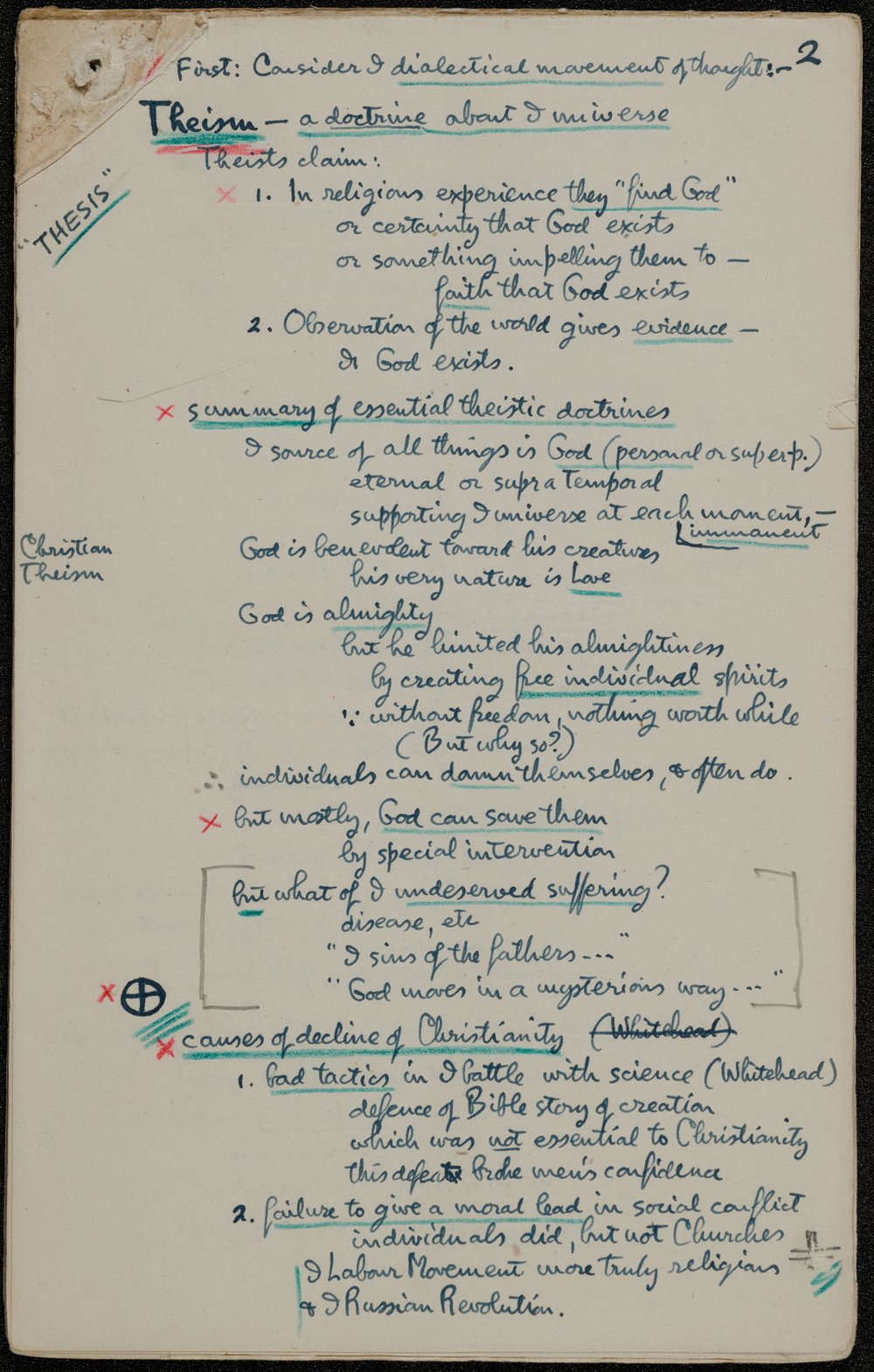
2
/First: Consider ð dialectical movement of thought:—
Theism — a doctrine about ð universe
Theists claim:
“THESIS”x  1. In religious experience they “find God”
or certainty that God exists
or something impelling them to —
faith that God exists
2. Observation of the world gives evidence —
ð God exists.
x  summary of essential theistic doctrines
ð source of all things is God (personal or superp.)
eternal or supra temporal
supporting ð universe at each moment,= immanent
ChristianGod is benevolent toward his creatures,
Theismhis very nature is Love
God is almighty
but he limited his almightiness
by creating free individual spirits,
∵ without freedom, nothing worth while
(But why so?)
∴ individuals can damn themselves, & often do.
x  but mostly, God can save them
by special intervention
but what of ð undeserved suffering?
disease, etc
“ð sins of the fathers ...”
x ⊕“God moves in a mysterious way ...”
//x  causes of decline of Christianity (Whitehead)
1. bad tactics in ð battle with science (Whitehead)
defence of Bible story of creation
which was not essential to Christianity
this defeats broke men’s confidence
2. failure to give a moral lead in social conflict
individuals did, but not Churches!!—
ð Labour Movement more truly religious///
& ð Russian Revolution.
Original manuscript — sheet 4
scan sheet 4
Transcription
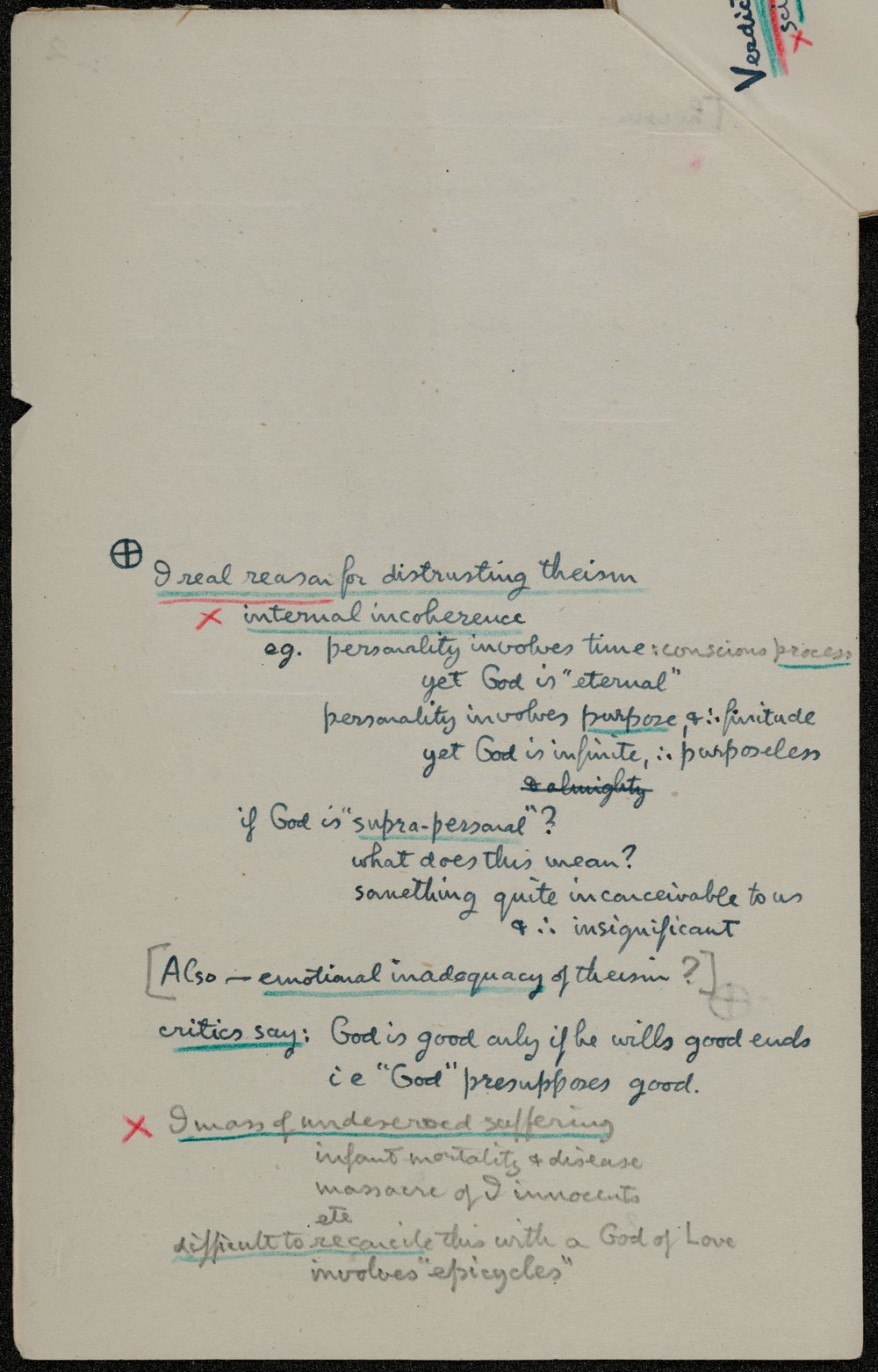
Verdict
Sci ×
⊕ ð real reason for distrusting theism
× internal incoherence
eg. personality involves time : conscious process
yet God is "eternal"
personality involves purpose & ∴ finitude
yet God is infinite, ∴ purposeless
& almighty
if God is "supra-personal"?
what does this mean?
something quite inconceivable to us
& ∴ insignificant
Also — emotional inadequacy of theism ?⊕
critics say: God is good only if he wills good ends
i e "God" presupposes good.
× ð mass of undeserved suffering
infant mortality + disease
massacre of ð innocents
etc
difficult to reconcile this with a God of Love
involves "epicycles"
Original manuscript — sheet 5
scan sheet 5
Transcription
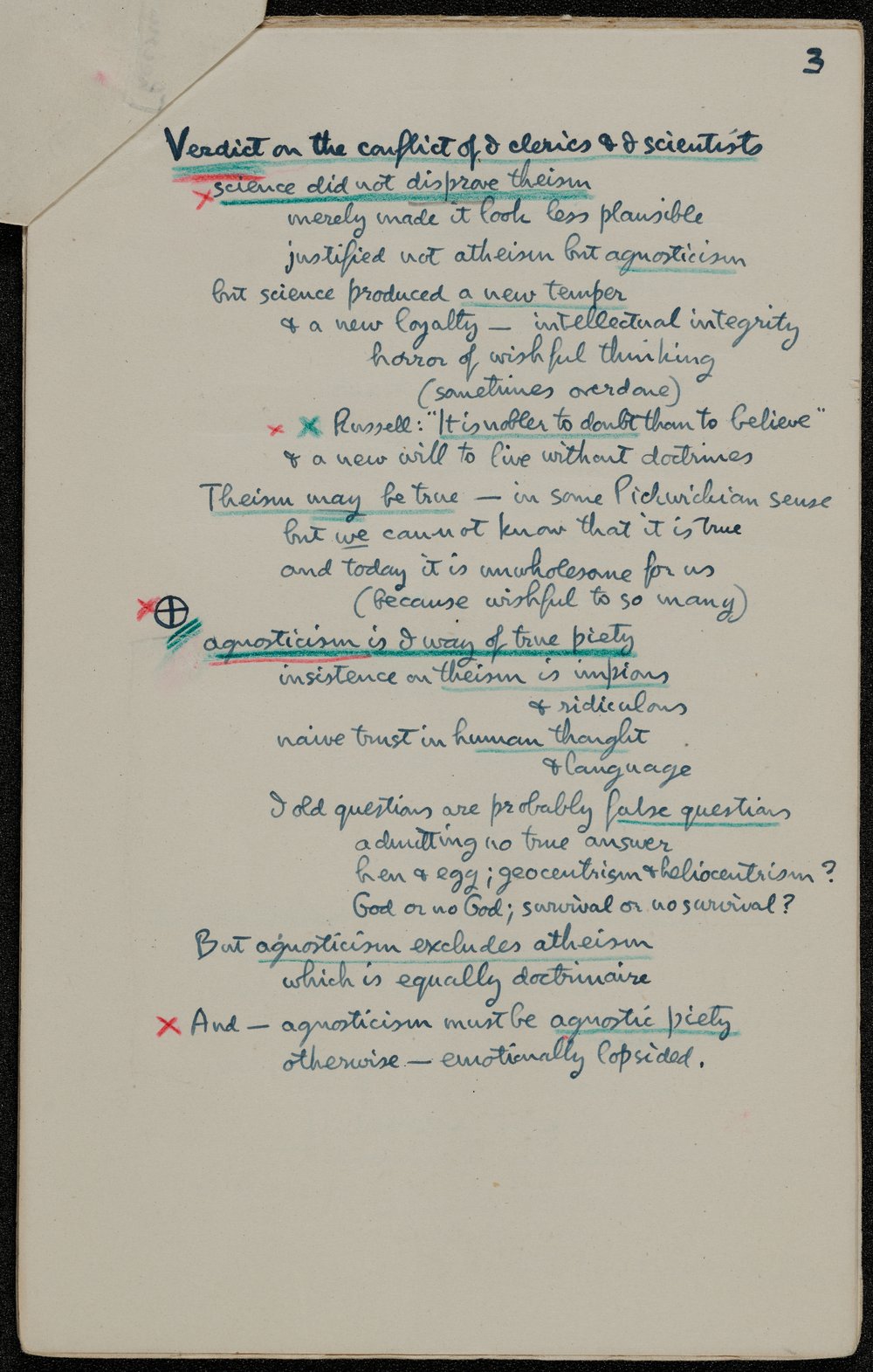
3
Verdict on the conflict of ð clerics & ð scientists
× science did not disprove theism
merely made it look less plausible
justified not atheism but agnosticism
but science produced a new temper
& a new loyalty — intellectual integrity
horror of wishful thinking
(sometimes overdone)
× × Russell: "It is nobler to doubt than to believe"
& a new will to live without doctrines
Theism may be true — in some Pickwickian sense
but we cannot know that it is true
and today it is unwholesome for us
(Because wishful to so many)
× ⊕ /// agnosticism is ð way of true piety
insistence on theism is impious
& ridiculous
naive trust in human thought
& language
ð old questions are probably false questions
admitting no true answer
hen & egg; geocentrism & heliocentrism ?
God or no God; survival or no survival?
But agnosticism excludes atheism
which is equally doctrinaire
× And — agnosticism must be agnostic piety
otherwise — emotionally lopsided.
Original manuscript — sheet 6
scan sheet 6
Transcription
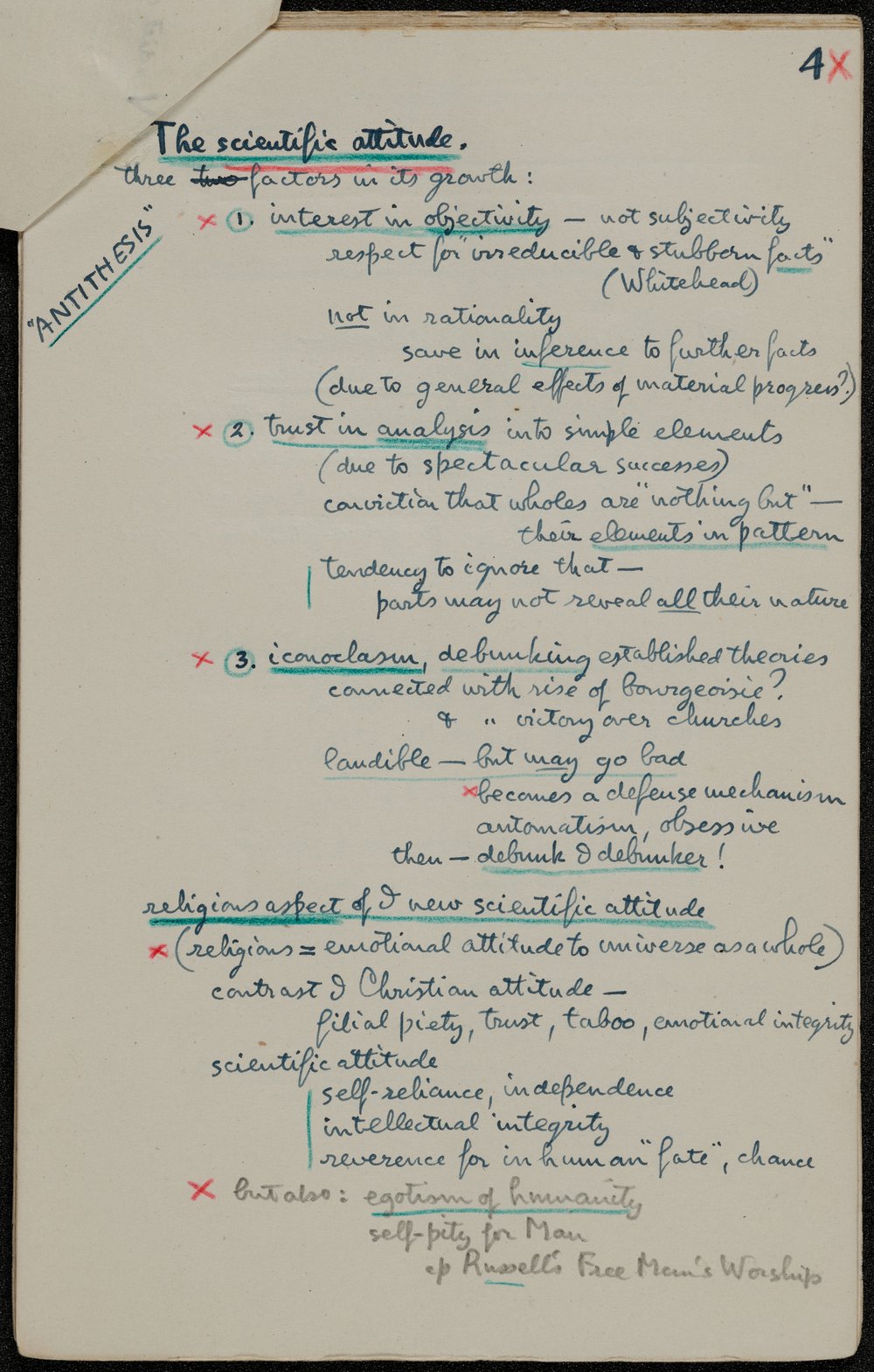
4X
The scientific attitude.
three two factors in its growth :
"ANTITHESIS"x 1. interest in objectivity — not subjectivity
respect for "irreducible & stubborn facts"
(Whitehead)
not in rationality
save in inference to further facts
(due to general effects of material progress?)
x 2. trust in analysis into simple elements
(due to spectacular successes)
conviction that wholes are "nothing but" —
their elements in pattern
tendency to ignore that —
parts may not reveal all their nature
x 3. iconoclasm, debunking established theories
connected with rise of bourgeoisie?
& " victory over churches
laudible — but may go bad
x becomes a defense mechanism
automatism, obsessive
then — debunk θ debunker!
religions aspect of θ new scientific attitude
x (religions = emotional attitude to universe as a whole)
contrast θ Christian attitude —
filial piety, trust, taboo, emotional integrity
scientific attitude
self-reliance, independence
intellectual integrity
reverence for inhuman "fate", chance
x but also: egotism of humanity
self-pity for Man
cf Russell's Free Man's Worship
Original manuscript — sheet 7
scan sheet 7
Transcription
4
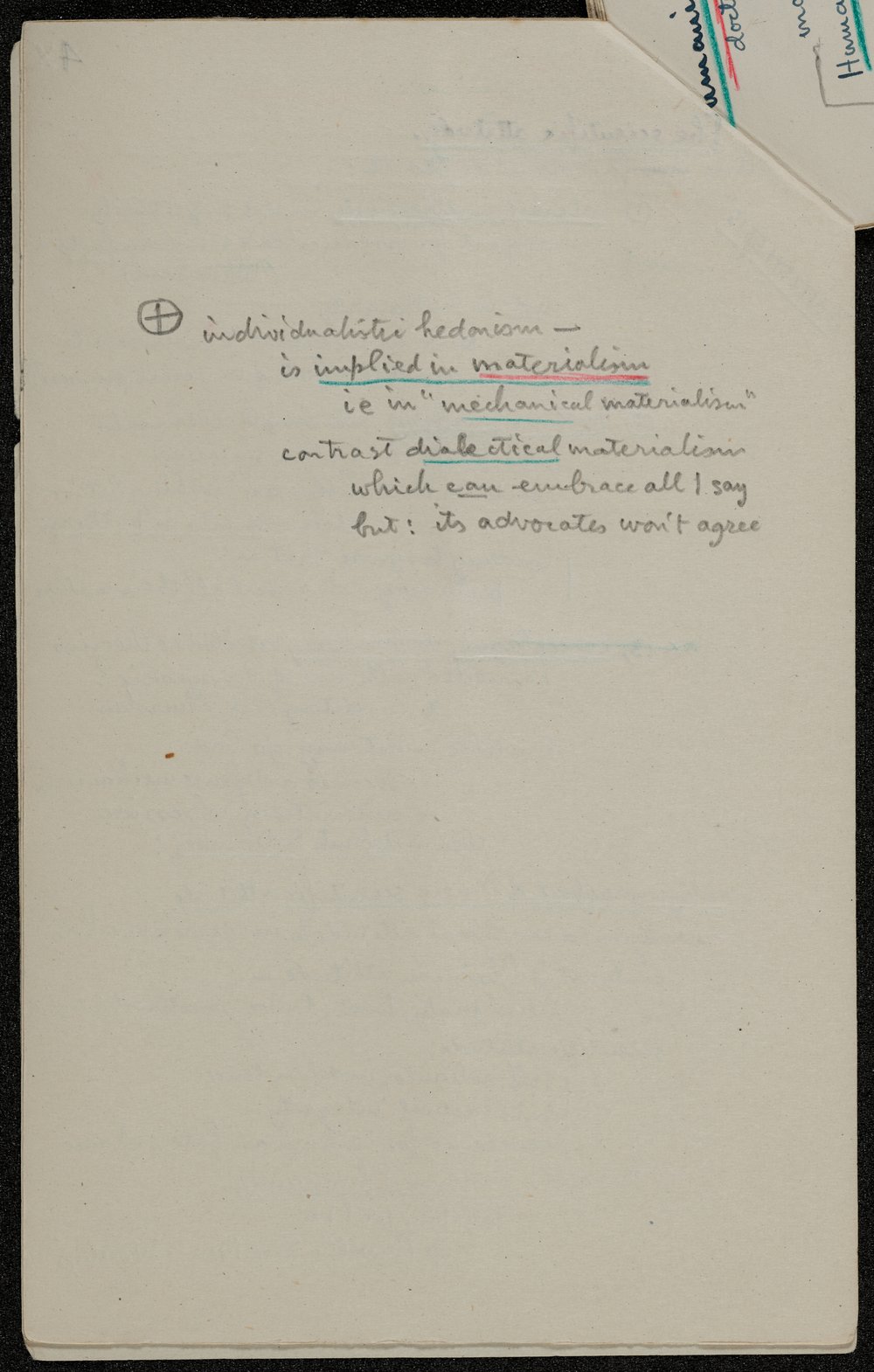
⊕individualistic hedonism →
is implied in materialism
i e in “mechanical materialism”
contrast dialectical materialism
which can embrace all I say
but: its advocates won't agree
Original manuscript — sheet 8
scan sheet 8
Transcription
5
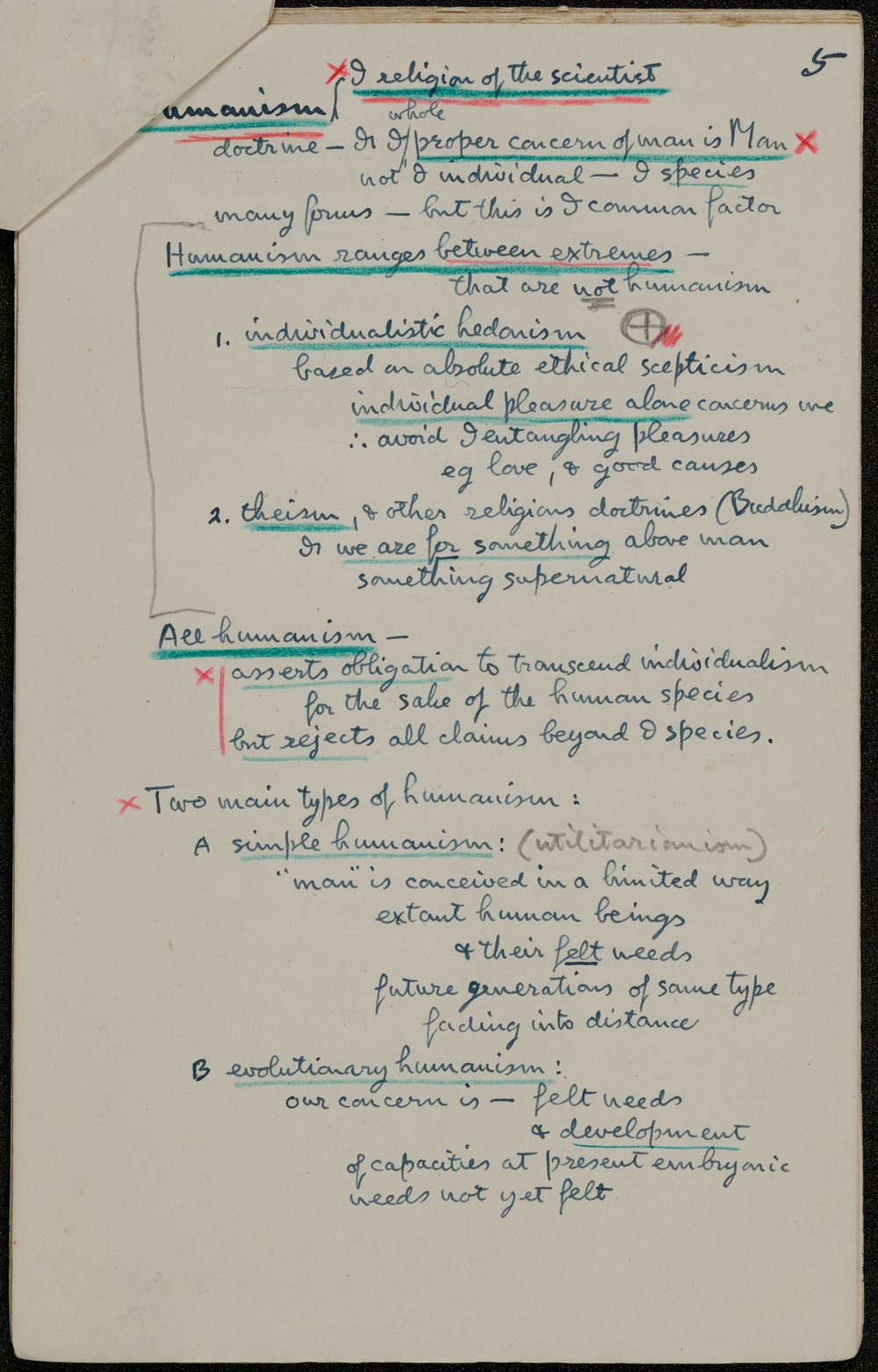
×θ religion of the scientist
humanism⟋
doctrine — ð θ whole proper concern of man is Man ×
not θ individual — θ species
many forms — but this is θ common factor
Humanism ranges between extremes —
that are not humanism.
1. individualistic hedonism ⊕ ///
based on absolute ethical scepticism
individual pleasure alone concerns me
∴ avoid θ entangling pleasures
eg love, & good causes
2. theism, & other religions doctrines (Buddhism)
ð we are for something above man
something supernatural
All humanism —
× asserts obligation to transcend individualism
for the sake of the human species
but rejects all claims beyond θ species.
× Two main types of humanism:
A   simple humanism: (utilitarianism)
“man” is conceived in a limited way
extant human beings
& their felt needs
future generations of same type
fading into distance
B   evolutionary humanism:
our concern is — felt needs
& development
of capacities at present embryonic
needs not yet felt
Original manuscript — sheet 9
scan sheet 9
Transcription
6
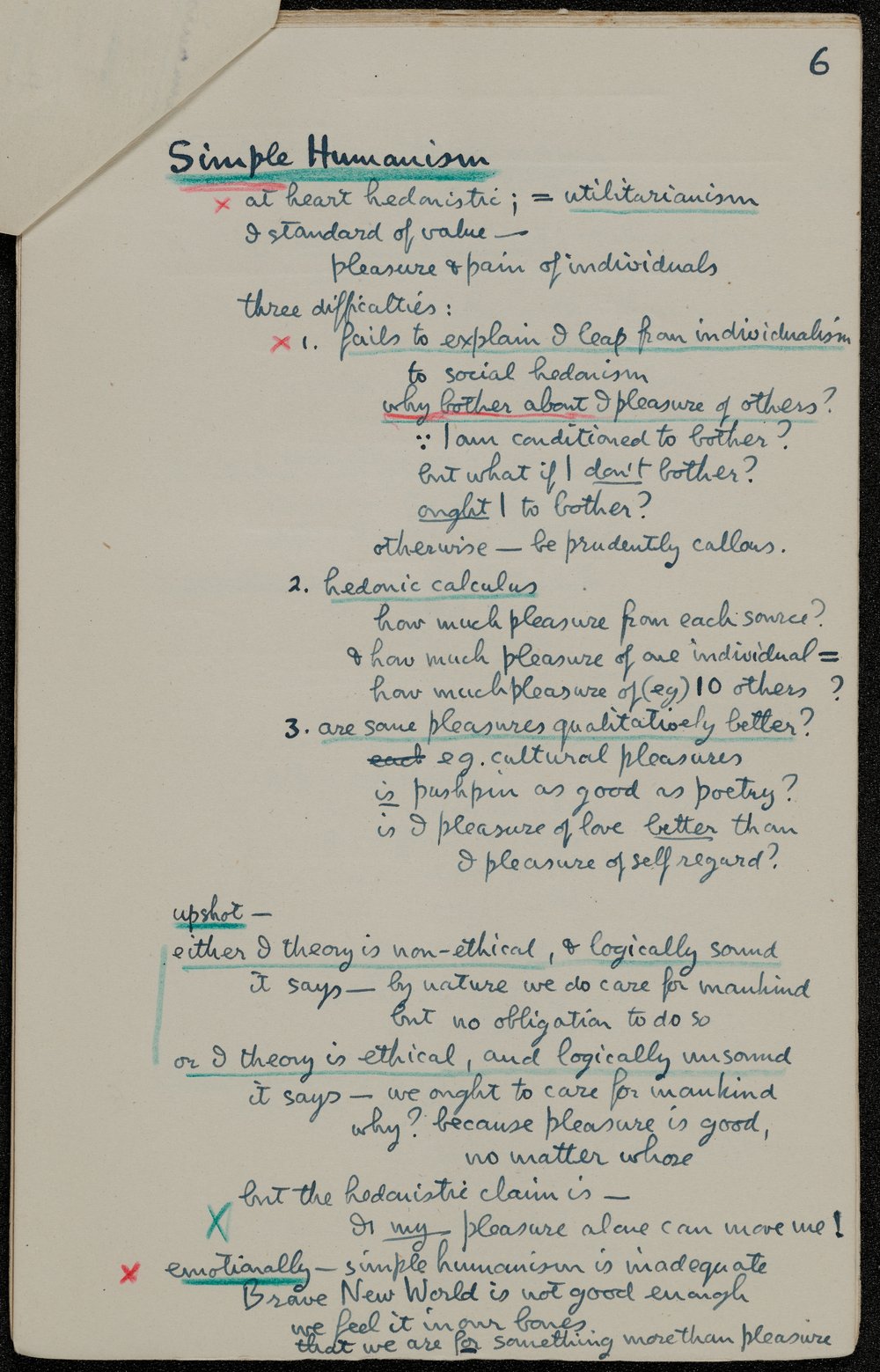
Simple Humanism
× at heart hedonistic; = utilitarianism
ð standard of value —
pleasure & pain of individuals
three difficulties:
× 1. fails to explain ð leap from individualism
to social hedonism
why bother about ð pleasure of others?
∵ I am conditioned to bother?
but what if I don't bother?
ought I to bother?
otherwise — be prudently callous.
2. hedonic calculus
how much pleasure from each source?
& how much pleasure of one individual =
how much pleasure of (eg) 10 others?
3. are some pleasures qualitatively better?
each eg. cultural pleasures
is pushpin as good as poetry?
is ð pleasure of love better than
ð pleasure of self regard?
upshot —
either ð theory is non-ethical, & logically sound
It says — by nature we do care for mankind
but no obligation to do so
or ð theory is ethical, and logically unsound
It says — we ought to care for mankind
why? because pleasure is good,
no matter whose
but the hedonistic claim is —
X ð my pleasure alone can move me!
× emotionally — simple humanism is inadequate
Brave New World is not good enough
we feel it in our bones.
that we are for something more than pleasure
Original manuscript — sheet 10
scan sheet 10
Transcription
7
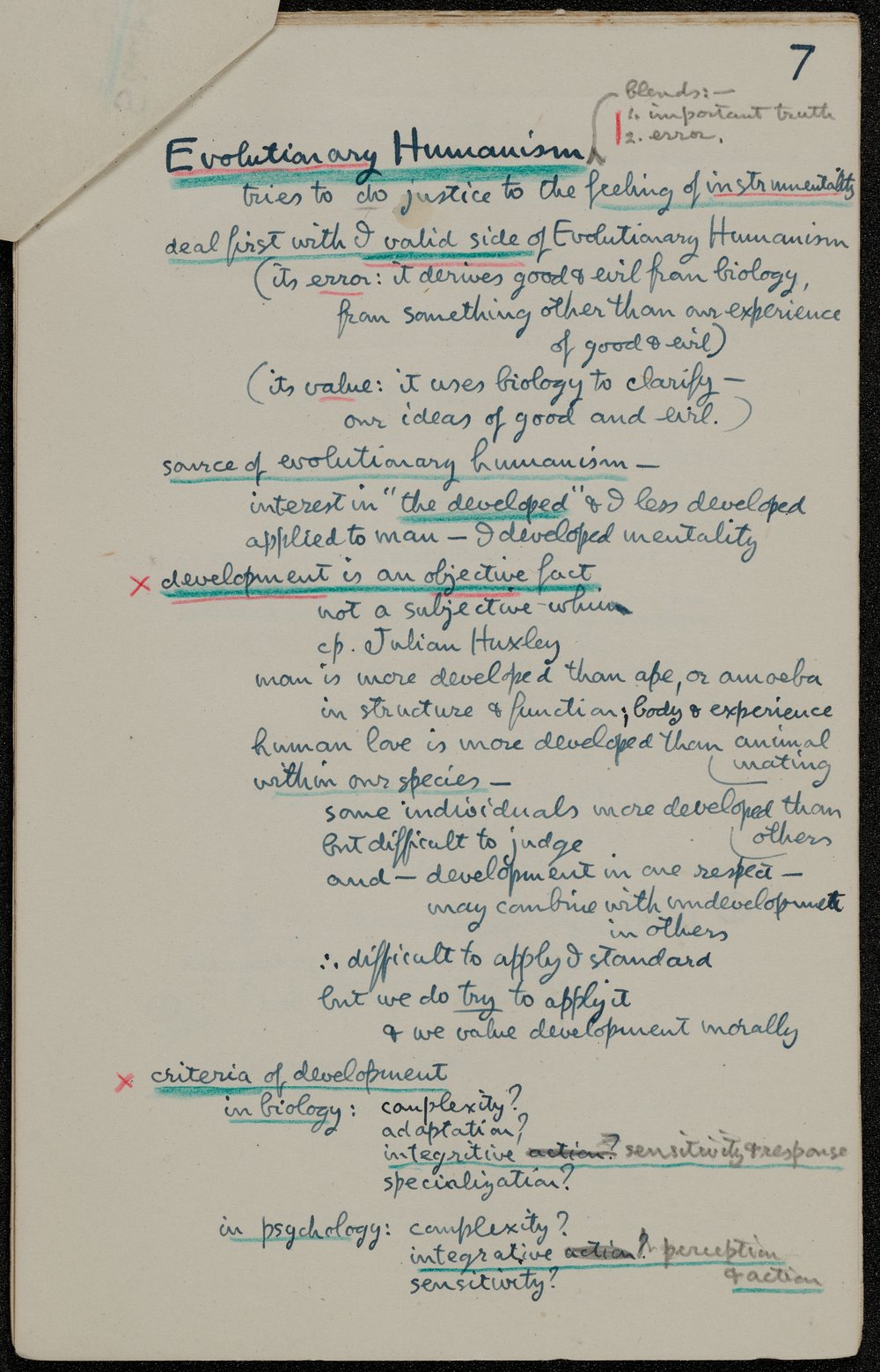
Blends:—
1. important truth
2. error.
Evolutionary Humanism
tries to do justice to the feeling of instrumentality
deal first with ð valid side of Evolutionary Humanism
(its error: it derives good & evil from biology,
from something other than our experience
of good & evil)
(its value: it uses biology to clarify —
our ideas of good and evil.)
source of evolutionary humanism —
interest in “the developed” & ð less developed
applied to man — ð developed mentality
x development is an objective fact
not a subjective whim
cp. Julian Huxley
man is more developed than ape, or amoeba
in structure & function; body & experience
human love is more developed than animal mating
within our species —
some individuals more developed than others
but difficult to judge
and — development in one respect —
may combine with undevelopment
in others
∴ difficult to apply ð standard
but we do try to apply it
& we value development morally
x criteria of development
in biology: complexity?
adaptation?
integrative action? sensitivity & response
specialization?
in psychology: complexity?
integrative action? perception
sensitivity? & action
Original manuscript — sheet 11
scan sheet 11
Transcription
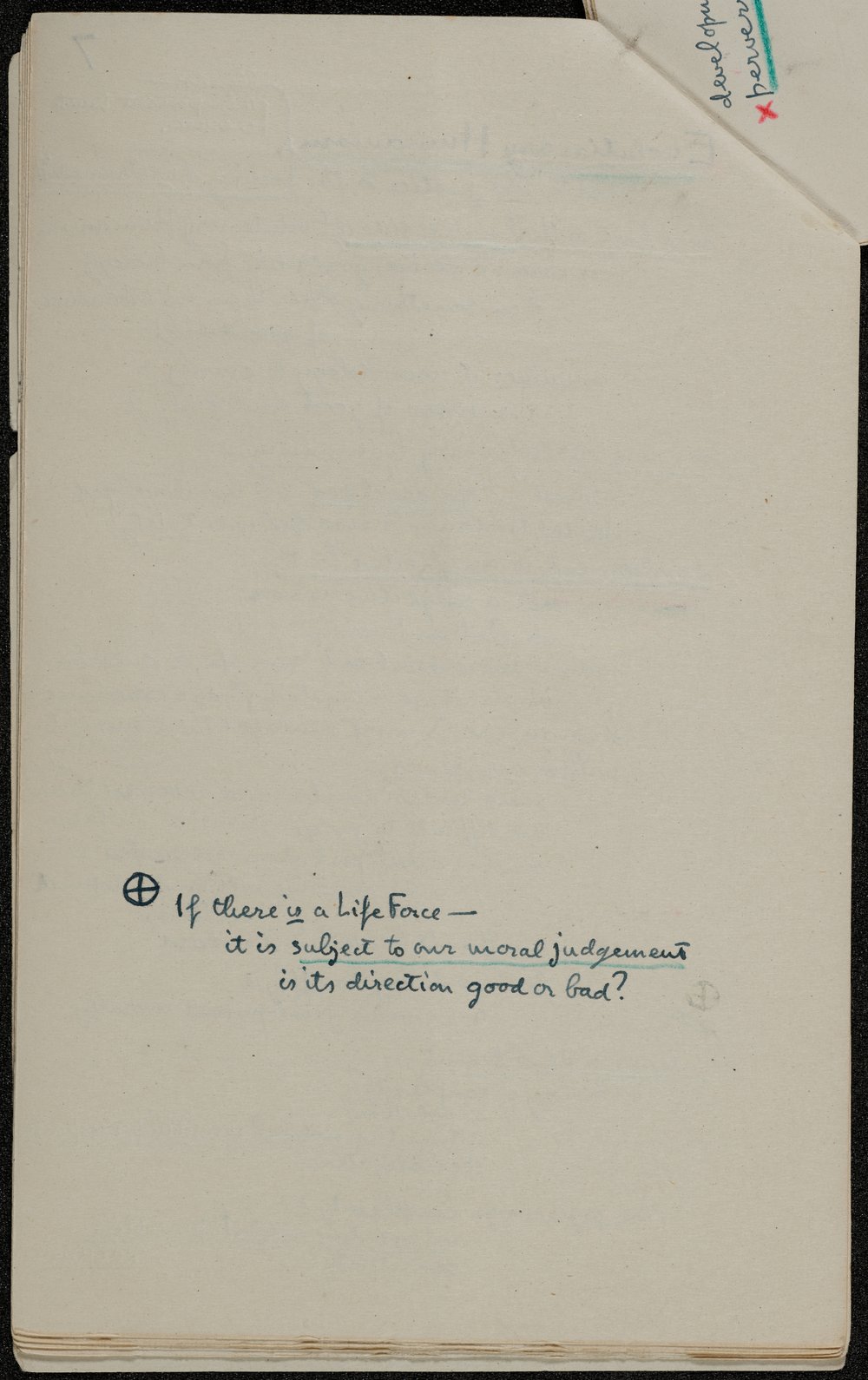
develop[illegible]
* pervers[illegible]
⊕  If there is a Life Force —
it is subject to our moral judgement
is its direction good or bad? ⊕
Original manuscript — sheet 12
scan sheet 12
Transcription
8
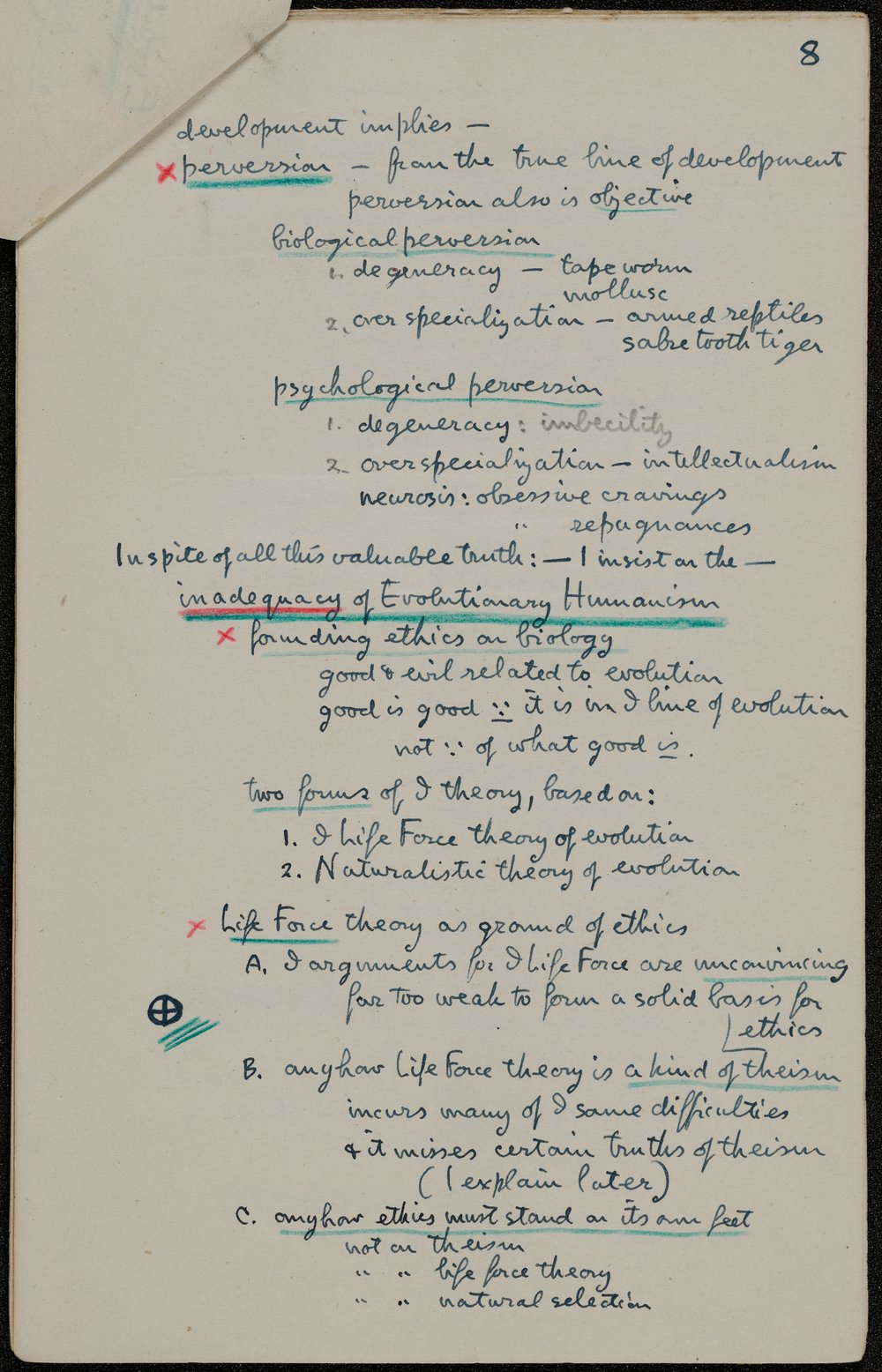
development implies —
xperversion — from the true line of development
perversion also is objective
biological perversion
1. degeneracy — tape worm
mollusc
2. over specialization — armed reptiles
sabre tooth tiger
psychological perversion
1. degeneracy: imbecility
2. over specialization — intellectualism
neurosis: obsessive cravings
″ repugnances
In spite of all this valuable truth: — I insist on the —
inadequacy of Evolutionary Humanism
xfounding ethics on biology
good & evil related to evolution
good is good ∵ it is in ð line of evolution
not ∵ of what good is.
two forms of ð theory, based on:
1. ð life Force theory of evolution
2. Naturalistic theory of evolution
xlife Force theory as ground of ethics
A. ð arguments for ð life Force are unconvincing
⊕far too weak to form a solid basis for
///ethics
B. anyhow life Force theory is a kind of theism
incurs many of ð same difficulties
& it misses certain truths of theism
(I explain later)
C. anyhow ethics must stand on its own feet
not on theism
″ ″ life force theory
″ ″ natural selection
Original manuscript — sheet 13
scan sheet 13
Transcription
9
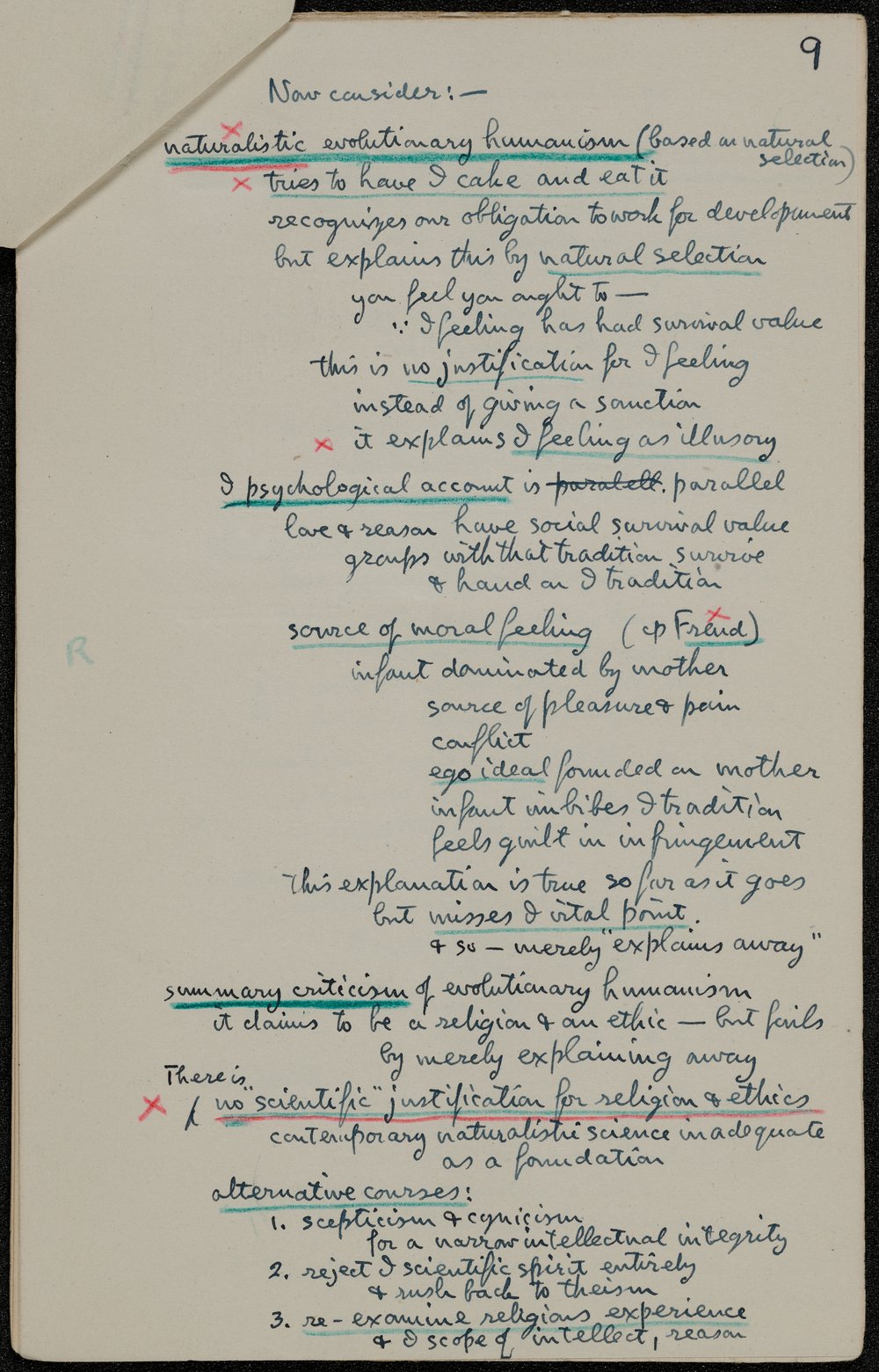
Now consider:—
× naturalistic evolutionary humanism (based on natural
selection)
× tries to have ð cake and eat it
recognizes our obligation to work for development
but explains this by natural selection
you feel you ought to —
∴ ð feeling has had survival value
this is no justification for ð feeling
instead of giving a sanction
× it explains ð feeling as illusory
ð psychological account is parallel, parallel
love & reason have social survival value
groups with that tradition survive
& hand on ð tradition
Rsource of moral feeling (cp ×Freud)
infant dominated by mother
source of pleasure & pain
conflict
ego ideal founded on mother
infant imbibes ð tradition
feels guilt in infringement
This explanation is true so far as it goes
but misses ð vital point.
& so — merely "explains away"
summary criticism of evolutionary humanism
it claims to be a religion & an ethic — but fails.
by merely explaining away
× There is. ∧ no "scientific" justification for religion & ethics
contemporary naturalistic science inadequate
as a foundation
alternative courses:
1. scepticism & cynicism
for a narrow intellectual integrity
2. reject ð scientific spirit entirely
& rush back to theism
3. re-examine religious experience
& ð scope of intellect, reason
Original manuscript — sheet 14
scan sheet 14
Transcription
10×
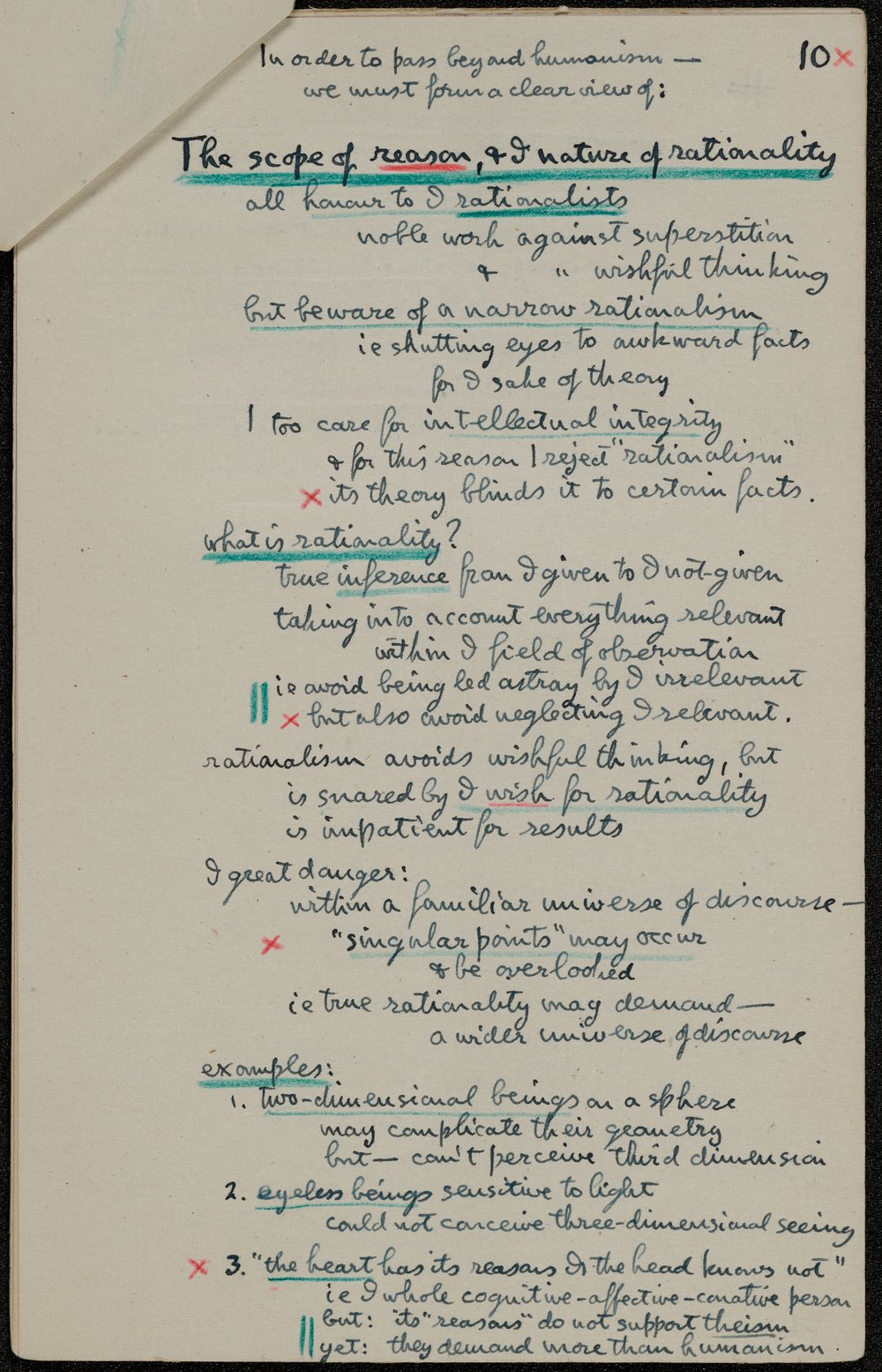
In order to pass beyond humanism —
we must form a clear view of:
The scope of reason, & ð nature of rationality
all honour to ð rationalists
noble work against superstition
&   "   wishful thinking
but beware of a narrow rationalism
i e shutting eyes to awkward facts
for ð sake of theory
I too care for intellectual integrity
& for this reason I reject "rationalism"
× its theory blinds it to certain facts.
what is rationality?
true inference from ð given to ð not-given
taking into account everything relevant
within ð field of observation
i e avoid being led astray by ð irrelevant
× but also avoid neglecting ð relevant.
rationalism avoids wishful thinking, but
is snared by ð wish for rationality
is impatient for results
ð great danger:
within a familiar universe of discourse —
× "singular points" may occur
& be overlooked
i e true rationality may demand —
a wider universe of discourse
examples:
1. two-dimensional beings on a sphere
may complicate their geometry
but — can't perceive third dimension
2. eyeless beings sensitive to light
could not conceive three-dimensional seeing
× 3. "the heart has its reasons ð the head knows not"
i e ð whole cognitive-affective-conative person
but: "its reasons" do not support theism
yet: they demand more than humanism.
Original manuscript — sheet 15
scan sheet 15
Transcription
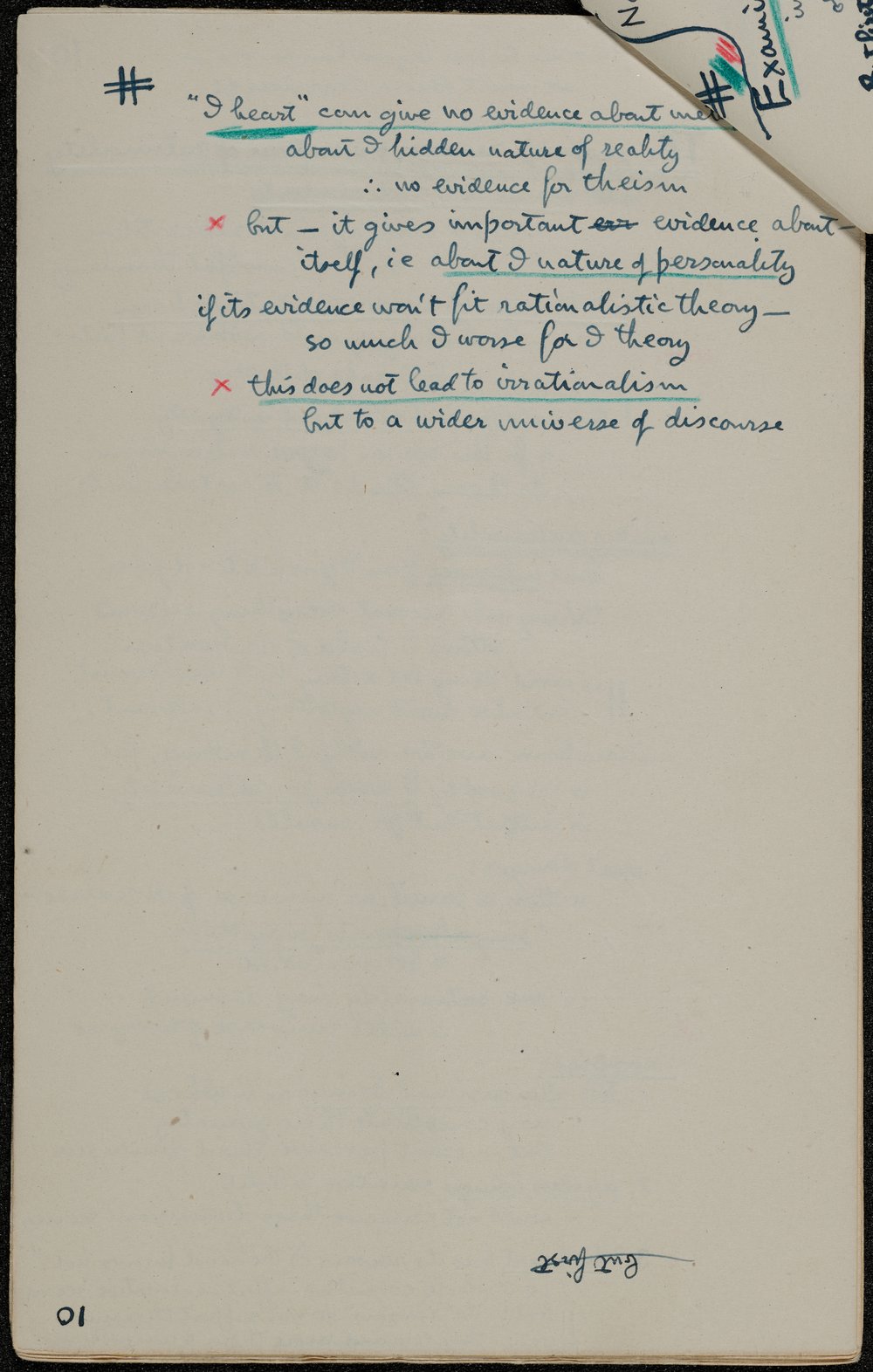
#Examin
# “ð heart” can give no evidence about world
about ð hidden nature of reality
∴ no evidence for theism
x but — it gives important ev evidence about—
itself, i.e about ð nature of personality
if its evidence won't fit rationalistic theory—
so much ð worse for ð theory
x this does not lead to irrationalism
but to a wider universe of discourse
End first
01
Original manuscript — sheet 16
scan sheet 16
Transcription
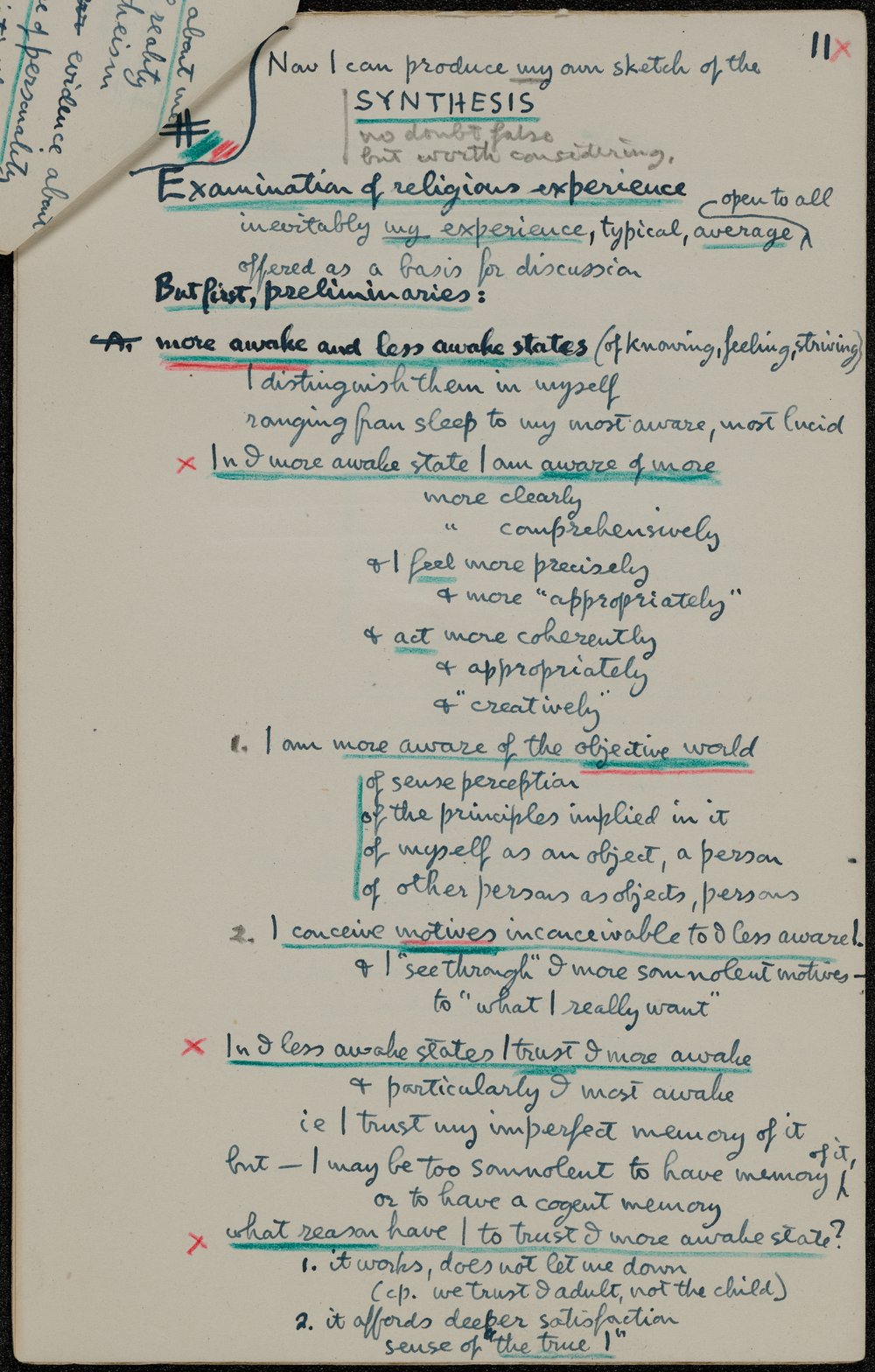
11×
[illegible] about me
reality
theism
evidence about [illegible]
of personality
Now I can produce my own sketch of the
SYNTHESIS
#
//
no doubt false
but worth considering,
Examination of religious experienceopen to all
inevitably my experience, typical, average ∧
offered as a basis for discussion
But first, preliminaries:
A.more awake and less awake states (of knowing, feeling, striving)
I distinguish them in myself
ranging from sleep to my most aware, most lucid
× In ð more awake state I am aware of more
more clearly
"   comprehensively
& I feel more precisely
& more "appropriately"
& act more coherently
& appropriately
& "creatively"
1. I am more aware of the objective world
of sense perception
of the principles implied in it
of myself as an object, a person
of other persons as objects, persons
2. I conceive motives inconceivable to ð less aware I.
& I "see through" ð more somnolent motives —
to "what I really want"
× In ð less awake states I trust ð more awake
& particularly ð most awake
ie I trust my imperfect memory of it
but — I may be too somnolent to have memory ∧of it,
or to have a cogent memory
× what reason have I to trust ð more awake state?
1. it works, does not let me down
(c.p. we trust ð adult, not the child)
2. it affords deeper satisfaction
sense of "the true I"
Original manuscript — sheet 17
scan sheet 17
Transcription
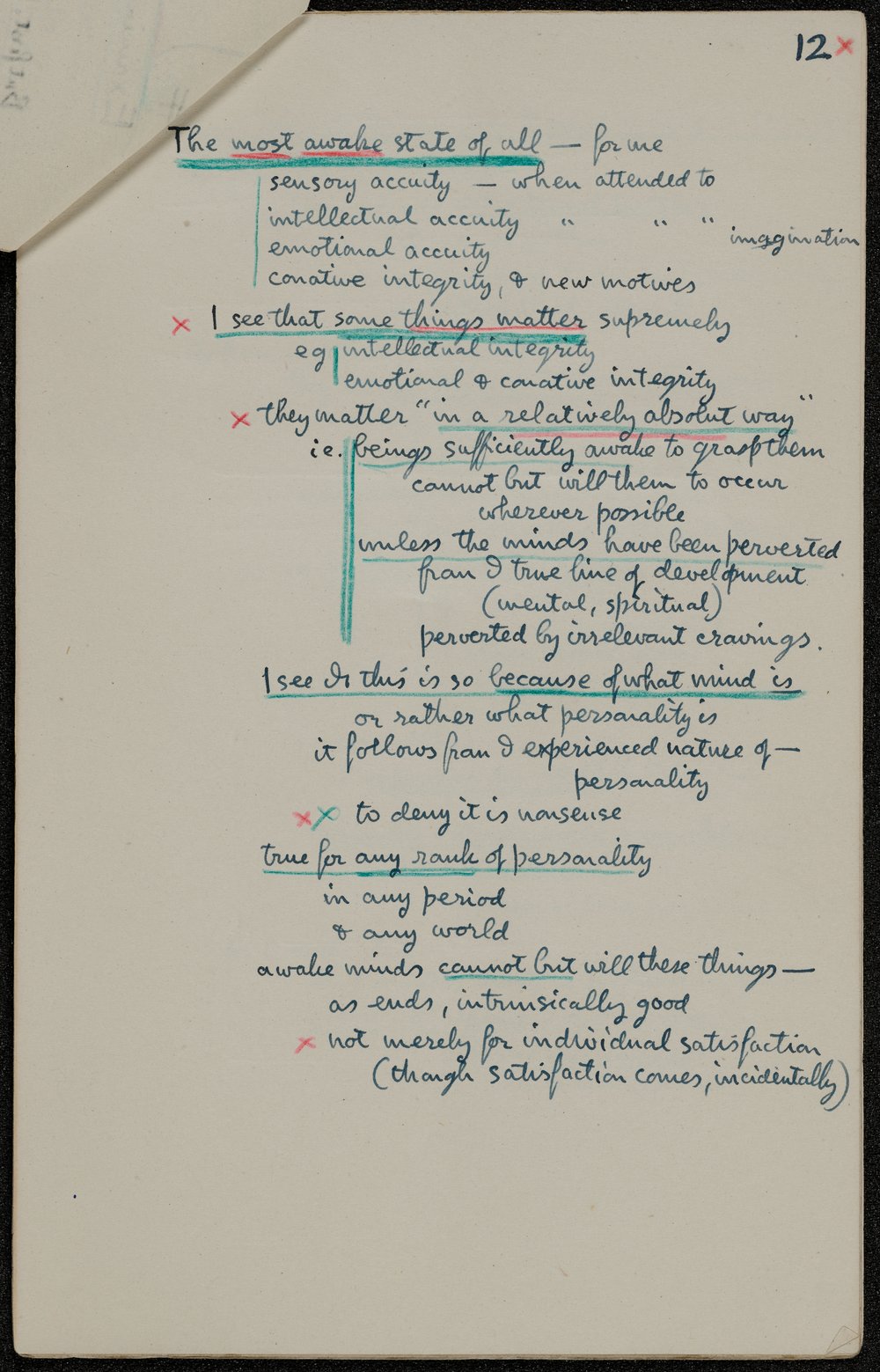
[illegible]12 ×
The most awake state of all — for me
sensory accuity — when attended to
intellectual accuity " " " imagination
emotional accuity
conative integrity, & new motives
× I see that some things matter supremely
eg intellectual integrity
emotional & conative integrity
× they matter “in a relatively absolut way”
i.e. beings sufficiently awake to grasp them
cannot but will them to occur
wherever possible
unless the minds have been perverted
from θ true line of development
(mental, spiritual)
perverted by irrelevant cravings.
I see θ this is so because of what mind is
or rather what personality is
it follows from θ experienced nature of —
personality
×× to deny it is nonsense
true for any rank of personality
in any period
& any world
awake minds cannot but will these things —
as ends, intrinsically good
× not merely for individual satisfaction
(though satisfaction comes, incidentally)
Original manuscript — sheet 18
scan sheet 18
Transcription
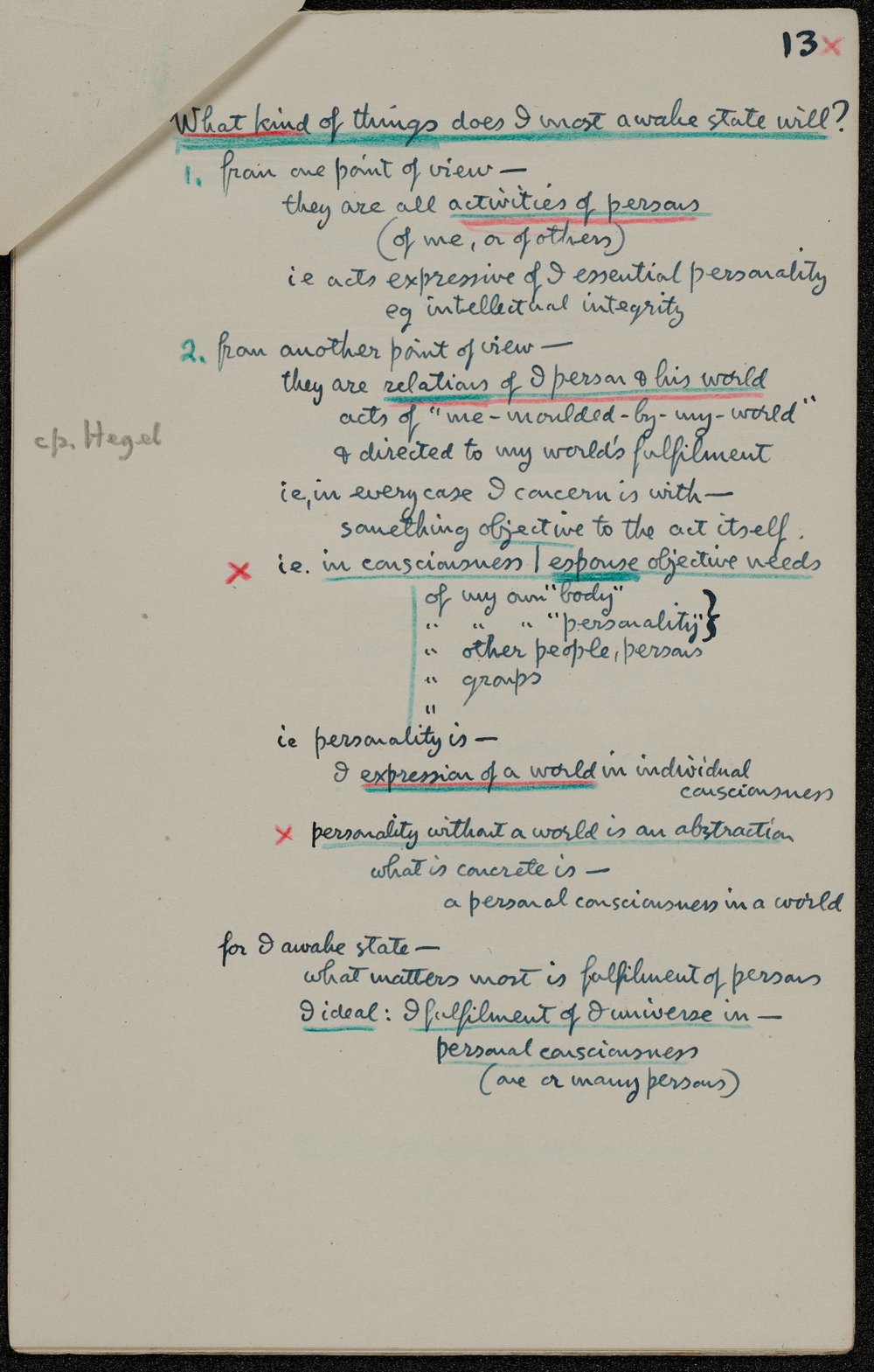
13×
What kind of things does ϑ most awake state will?
1. from one point of view—
they are all activities of persons
(of me, or of others)
i e acts expressive of ϑ essential personality
eg intellectual integrity
2. from another point of view—
they are relations of ϑ person & his world
c/p. Hegelacts of “me-moulded-by-my-world”
& directed to my world's fulfilment
i.e. in every case ϑ concern is with—
something objective to the act itself.
×i.e. in consciousness I espouse objective needs
of my own “body”
″ ″ ″ “personality”
″ other people, persons
″ groups
″
ie personality is—
ϑ expression of a world in individual
consciousness
×personality without a world is an abstraction
what is concrete is—
a personal consciousness in a world
for ϑ awake state—
what matters most is fulfilment of persons
ϑ ideal: ϑ fulfilment of ϑ universe in—
personal consciousness
(one or many persons)
Original manuscript — sheet 19
scan sheet 19
Transcription
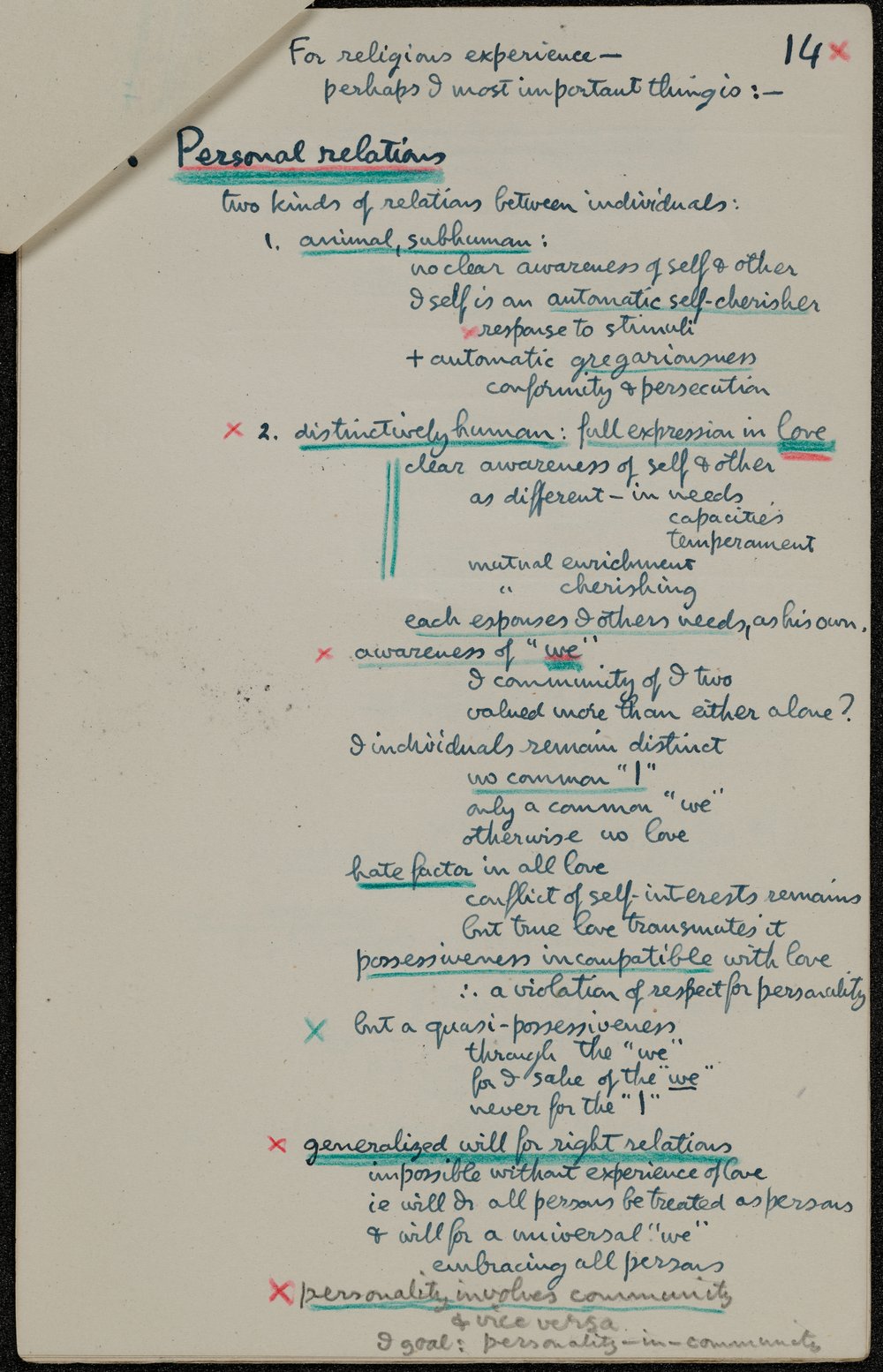
14 x
For religious experience—
perhaps ð most important thing is :—
• Personal relations
two kinds of relations between individuals:
1. animal, subhuman :
no clear awareness of self & other
ð self is an automatic self-cherisher
x response to stimuli
+ automatic gregariousness
conformity & persecution
x 2. distinctively human: full expression in love
clear awareness of self & other
as different—in needs
capacities
temperament
mutual enrichment
“ cherishing
each espouses ð other’s needs, as his own.
x awareness of “we”
ð community of ð two
valued more than either alone?
ð individuals remain distinct
no common “I”
only a common “we”
otherwise no love
hate factor in all love
conflict of self-interests remains
but true love transmutes it
possessiveness incompatible with love
∴ a violation of respect for personality
X but a quasi-possessiveness
through the “we”
for ð sake of the “we”
never for the “I”
x generalized will for right relations
impossible without experience of love
ie. will ð all persons be treated as persons
+ will for a universal “we”
embracing all persons
X personality involves community
& vice versa.
ð goal: personality-in-community
Original manuscript — sheet 20
scan sheet 20
Transcription
5
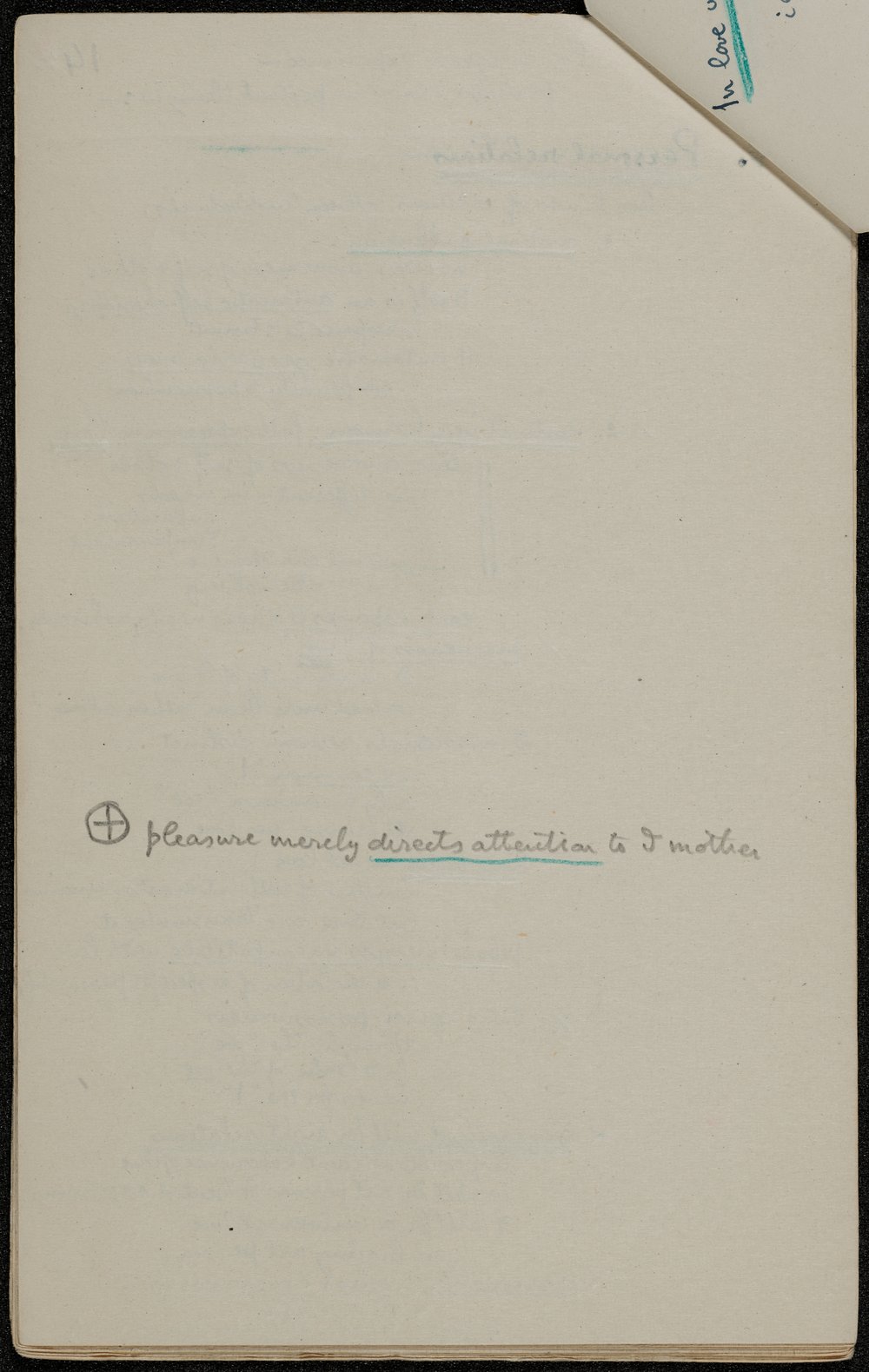
In love
⊕ pleasure merely directs attention to ð mother
Original manuscript — sheet 21
scan sheet 21
Transcription
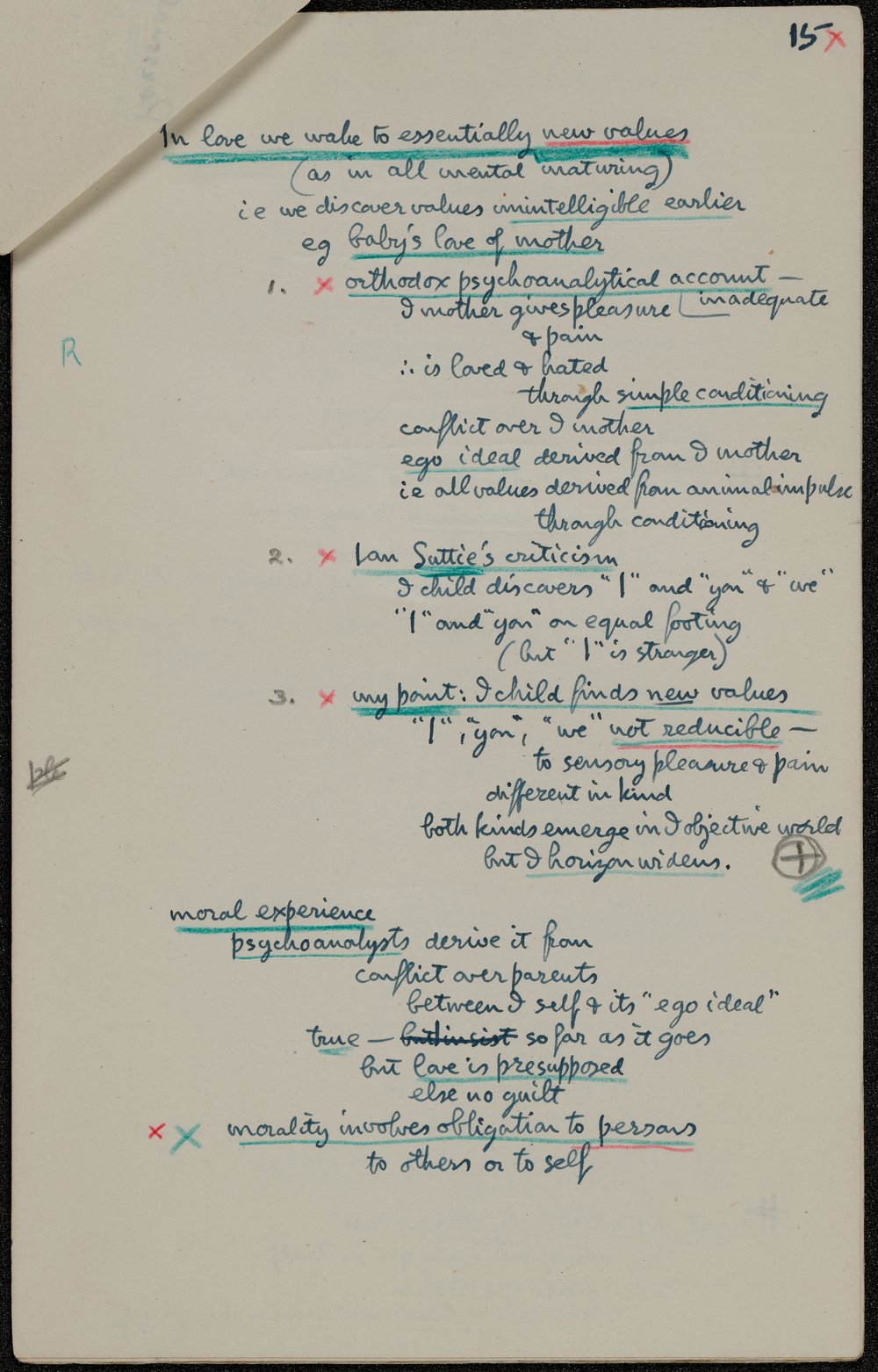
15 ×
In love we wake to essentially new values
(as in all mental maturing)
i e we discover values unintelligible earlier
eg baby’s love of mother
1. × orthodox psychoanalytical account —
ð mother gives pleasure inadequate
R& pain
∴ is loved & hated
through simple conditioning
conflict over ð mother
ego ideal derived from ð mother
i e all values derived from animal impulse
through conditioning
2. × Ian Suttie’s criticism
ð child discovers “I” and “you” & “we”
“I” and “you” on equal footing
(but “I” is stronger)
3. × my point: ð child finds new values
“I”, “you”, “we” not reducible —
bleto sensory pleasure & pain
different in kind
both kinds emerge in ð objective world
but ð horizon widens. ⊕
≡
moral experience
psychoanalysts derive it from
conflict over parents
between ð self & its “ego ideal”
true — but insist so far as it goes
but love is presupposed
else no guilt
× × morality involves obligation to persons
to others or to self
Original manuscript — sheet 22
scan sheet 22
Transcription
Reli
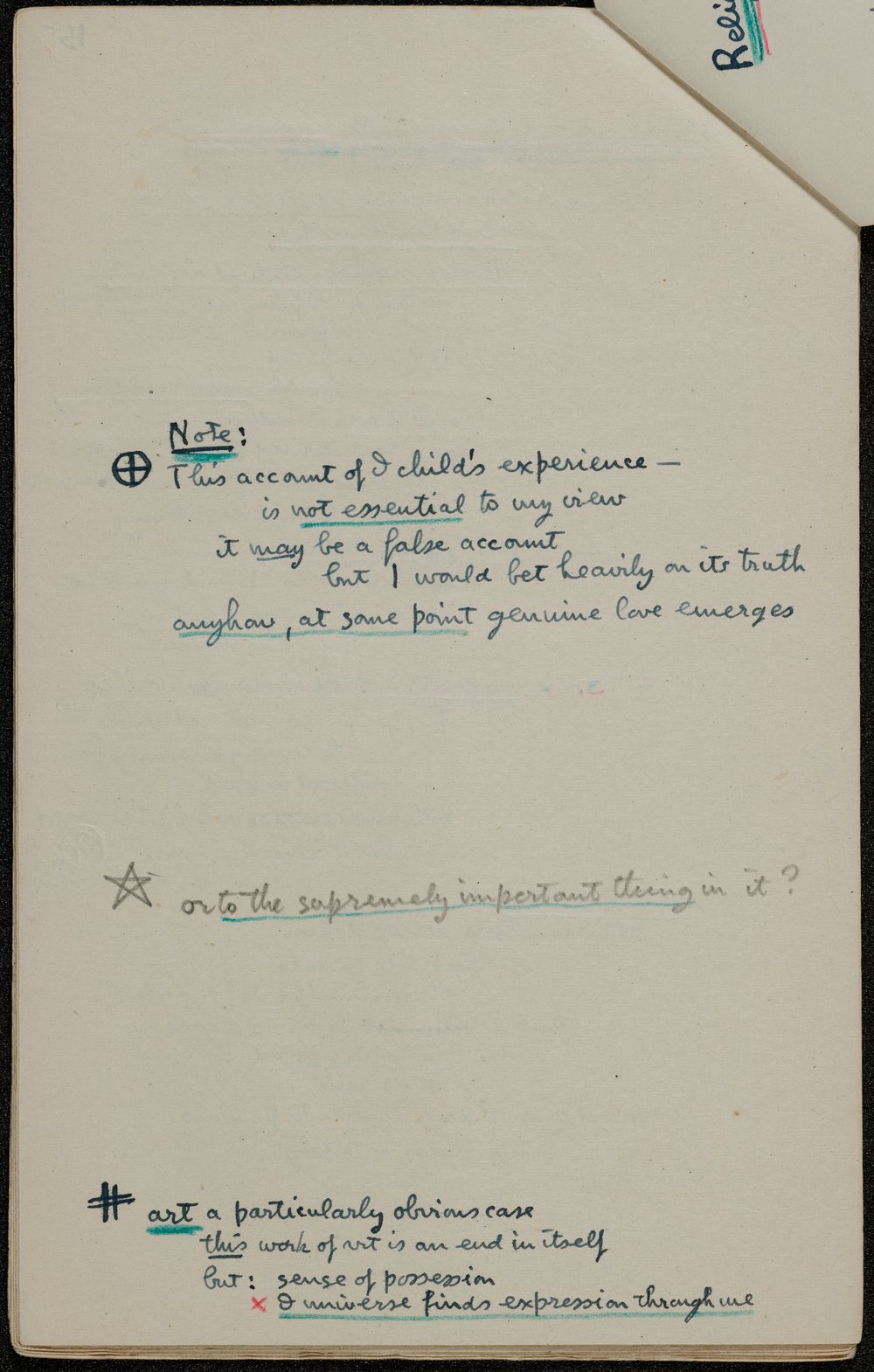
Note!
⊕ This account of θ child's experience —
is not essential to my view
it may be a false account
but I would bet heavily on its truth
anyhow, at some point genuine love emerges
☆ or to the supremely important thing in it ?
# art a particularly obvious case
this work of art is an end in itself
but: sense of possession
x θ universe finds expression through me
Original manuscript — sheet 23
scan sheet 23
Transcription
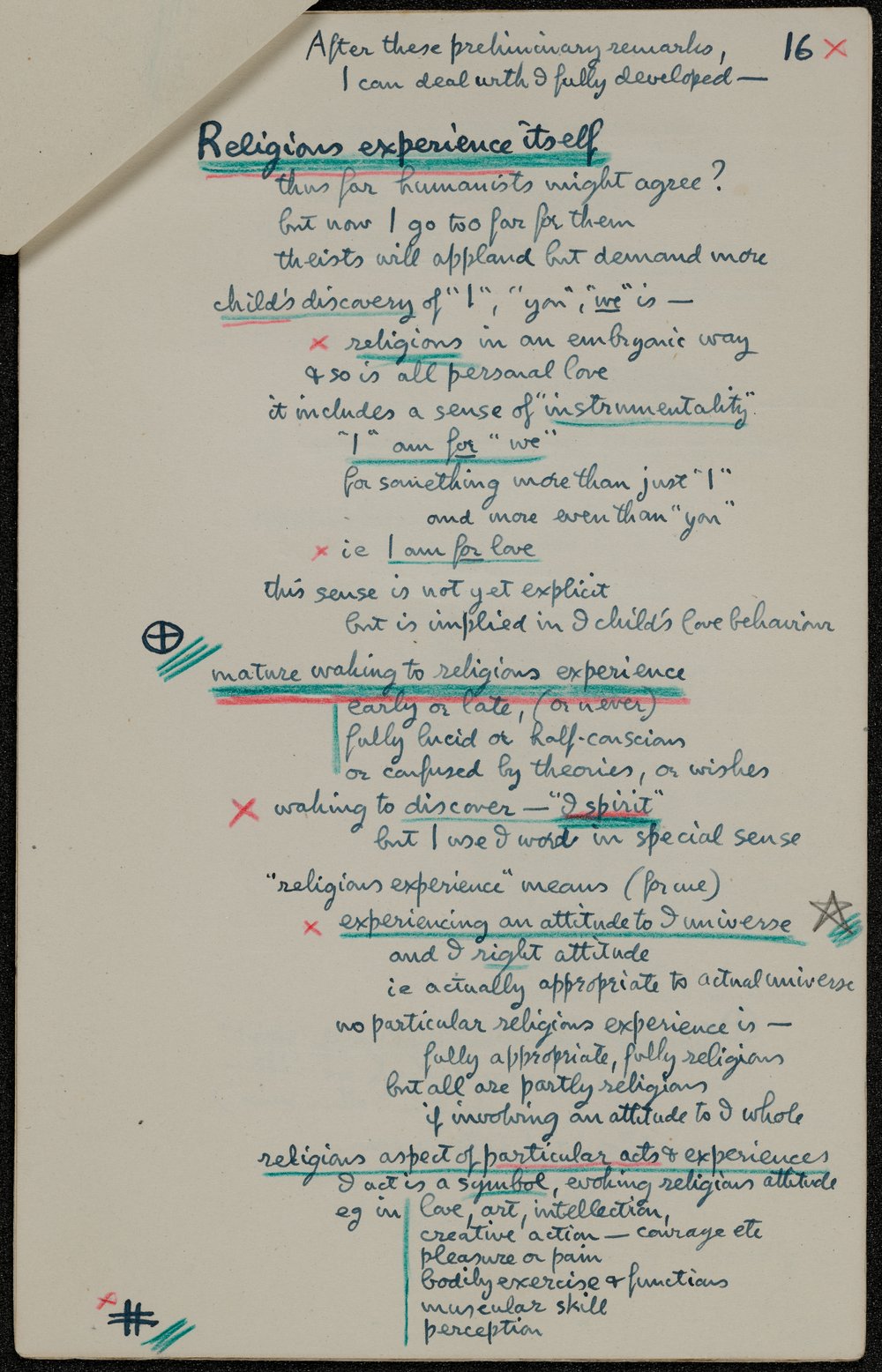
After these preliminary remarks, 16 x
I can deal with θ fully developed—
Religious experience itself
thus far humanists might agree?
but now I go too far for them
theists will applaud but demand more
child's discovery of "I", "you", "we" is —
x religious in an embryonic way
& so is all personal love
it includes a sense of "instrumentality".
"I" am for "we"
for something more than just "I"
and more even than "you"
x ie I am for love
this sense is not yet explicit
but is implied in θ child's love behaviour.
⊕ /// mature waking to religious experience
early or late, (or never)
fully lucid or half-conscious
or confused by theories, or wishes
x waking to discover — "θ spirit"
but I use θ word in special sense
"religious experience" means (for me)
x experiencing an attitude to θ universe ☆ ///
and θ right attitude
ie actually appropriate to actual universe
no particular religious experience is —
fully appropriate, fully religious
but all are partly religious
if involving an attitude to θ whole
religious aspect of particular acts & experiences
θ act is a symbol, evoking religious attitude
eg in love, art, intellection,
creative action—courage etc
pleasure or pain
bodily exercise & functions
muscular skill
perception
x # ///
Original manuscript — sheet 24
scan sheet 24
Transcription
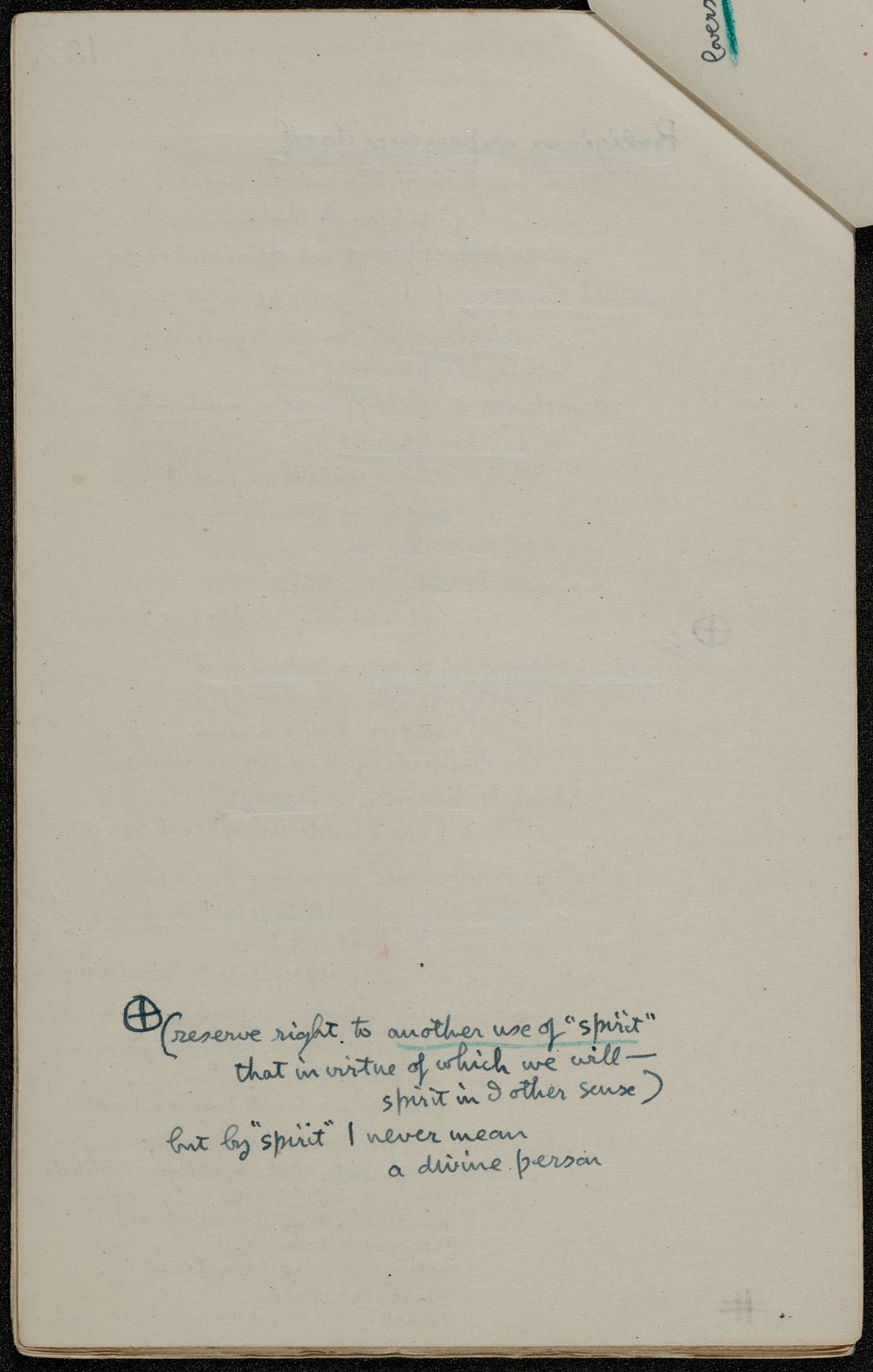
Covers
⊕ (reserve right. to another use of "spirit"
that in virtue of which we will—
spirit in ð other sense)
but by "spirit" I never mean
a divine. person
Original manuscript — sheet 25
scan sheet 25
Transcription
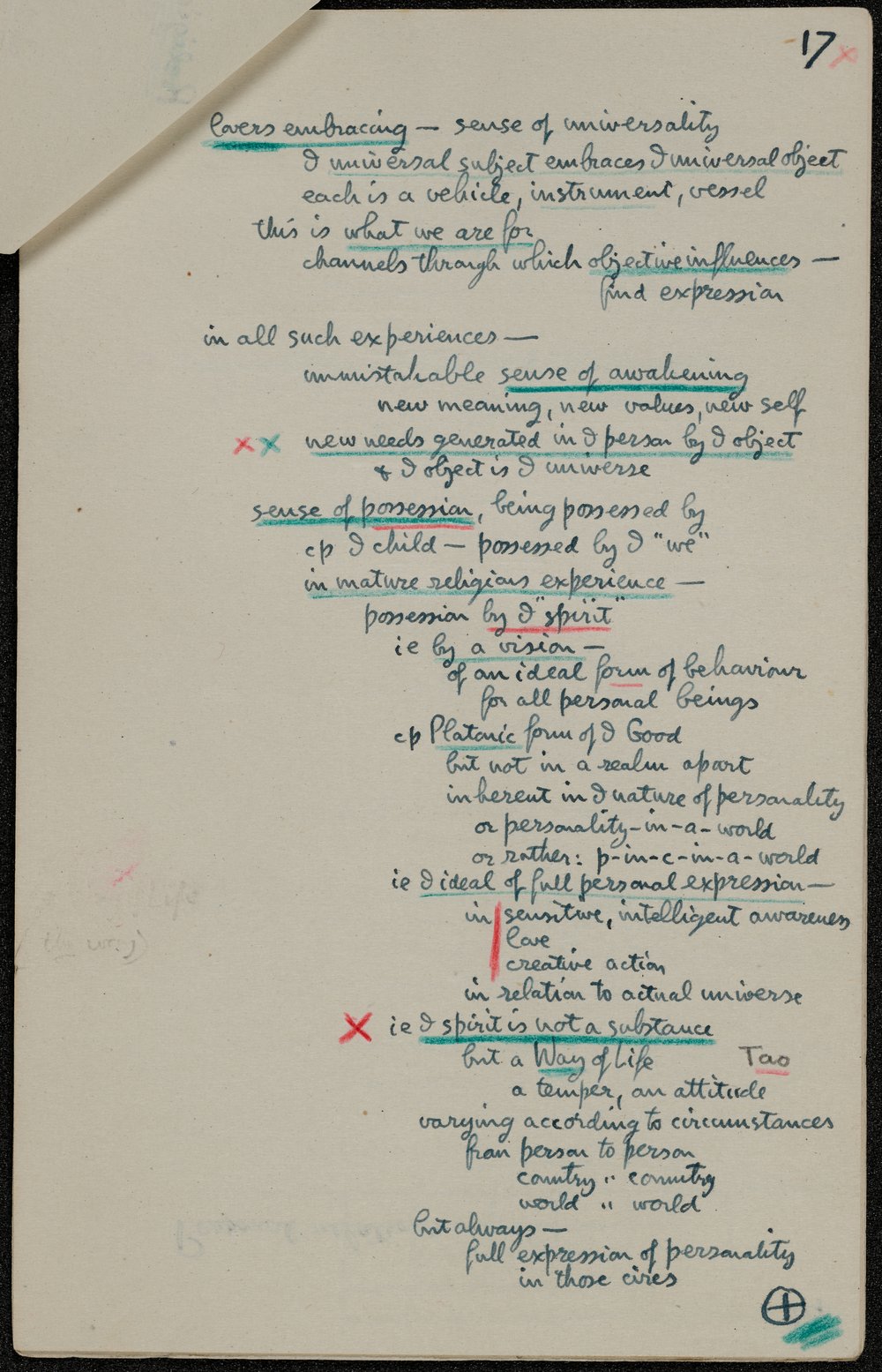
-17×
lovers embracing — sense of universality
ð universal subject embraces ð universal object
each is a vehicle, instrument, vessel
this is what we are for
channels through which objective influences —
find expression
in all such experiences —
unmistakable sense of awakening
new meaning, new values, new self
× × new needs generated in ð person by ð object
& ð object is ð universe
sense of possession, being possessed by
cp ð child — possessed by ð “we”
in mature religious experience —
possession by ð “spirit”
ie by a vision —
of an ideal form of behaviour
for all personal beings
cp Platonic form of ð Good
but not in a realm apart
inherent in ð nature of personality
or personality-in-a-world
or rather: p-in-c-in-a-world
/ ie ð ideal of full personal expression —
in sensitive, intelligent awareness
love
creative action
in relation to actual universe
× ie ð spirit is not a substance
but a Way of life Tao
a temper, an attitude
varying according to circumstances
from person to person
country " country
world " world.
but always —
full expression of personality
in those circs
⊕
≋
Original manuscript — sheet 26
scan sheet 26
Transcription
14
Personal relations
of religion
Original manuscript — sheet 27
scan sheet 27
Transcription
18 X
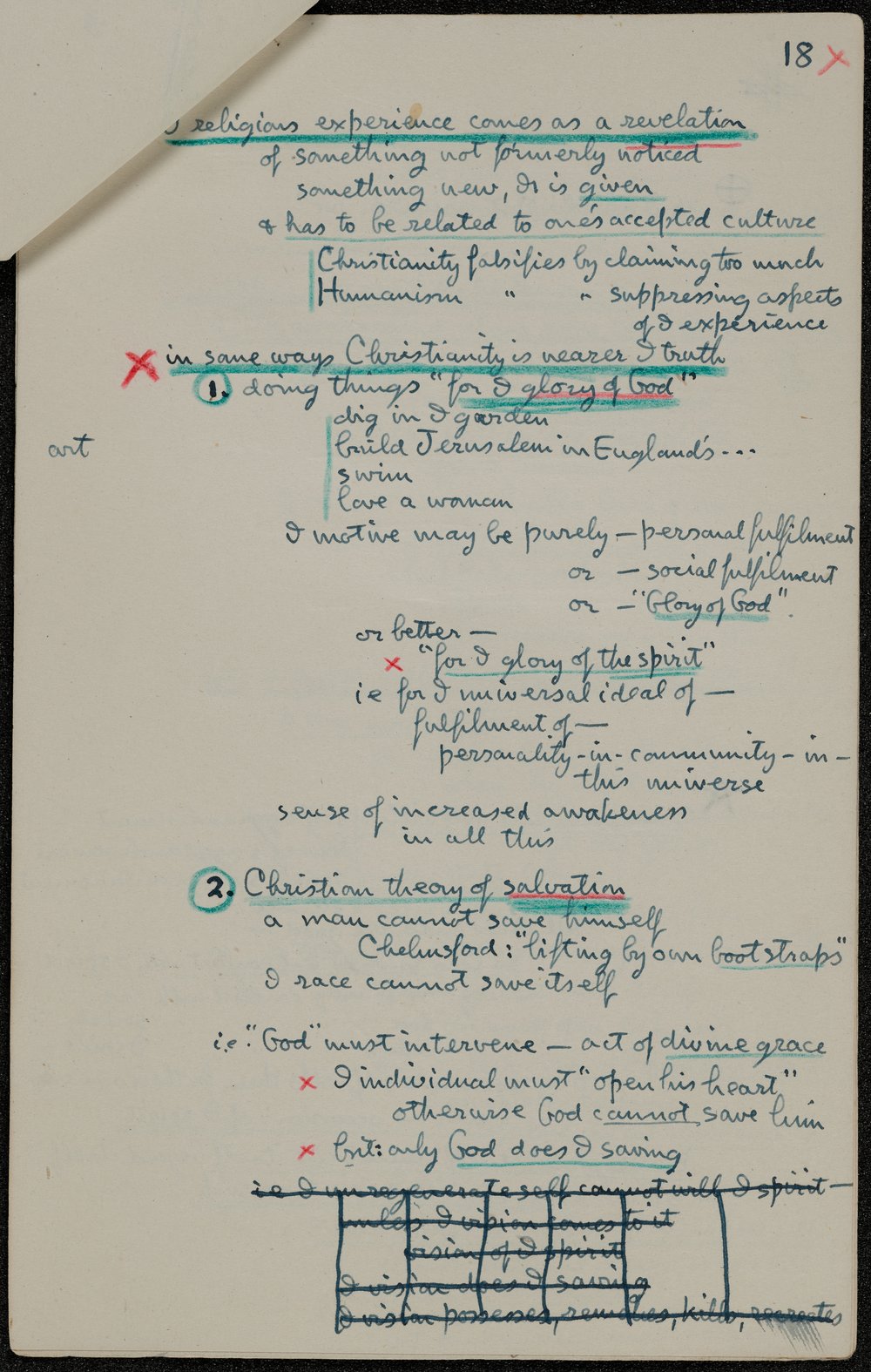
A religious experience comes as a revelation
of Something not formerly noticed
something new, It is given
& has to be related to ones accepted culture
Christianity falsifies by claiming too much
Humanism  "    "  suppressing aspects
of ð experience
X in some ways Christianity is nearer ð truth
1. doing things "for ð glory of God"
dig in ð garden
artbuild Jerusalem in England's -...
swim
love a woman
ð motive may be purely — personal fulfilment
or  — social fulfilment
or  — "Glory of God".
or better —
x "for ð glory of the spirit"
i.e for ð universal ideal of —
fulfilment of —
personality - in - community - in -
this universe
sense of increased awakeness
in all this
2. Christian theory of salvation
a man cannot save himself
Chelmsford : "lifting by own boot straps"
ð race cannot save itself
i.e. "God" must intervene — act of divine grace
x ð individual must "open his heart"
otherwise God cannot save him
x but: only God does ð saving
i.e ð unregenerate self cannot will ð spirit —
unless ð vision comes to it
vision of ð spirit
ð vision does ð saving
ð vision possesses, remakes, kills, recreates
Original manuscript — sheet 28
scan sheet 28
Transcription
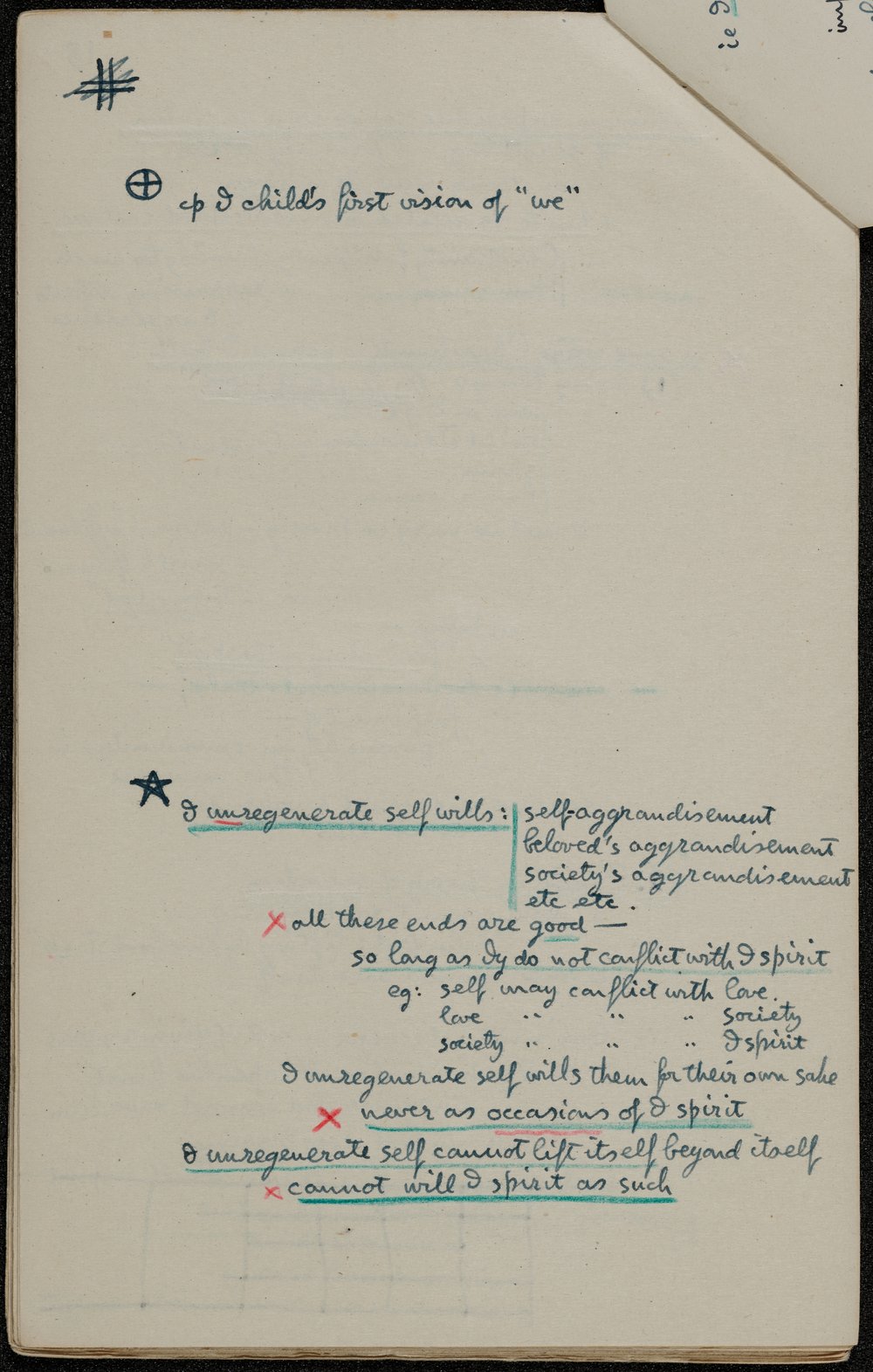
#
 
 
⊕  cp θ child's first vision of "we"


☆  θ unregenerate self wills :self-aggrandisement
beloved's aggrandisement
society's aggrandisement
etc. etc.
× all these ends are good —
so long as θy do not conflict with θ spirit
eg: self may conflict with love.
love       "       "       "    society
society    "       "       "    θ spirit
θ unregenerate self wills them for their own sake
× never as occasions of θ spirit
θ unregenerate self cannot lift itself beyond itself
× cannot will θ spirit as such
Original manuscript — sheet 29
scan sheet 29
Transcription
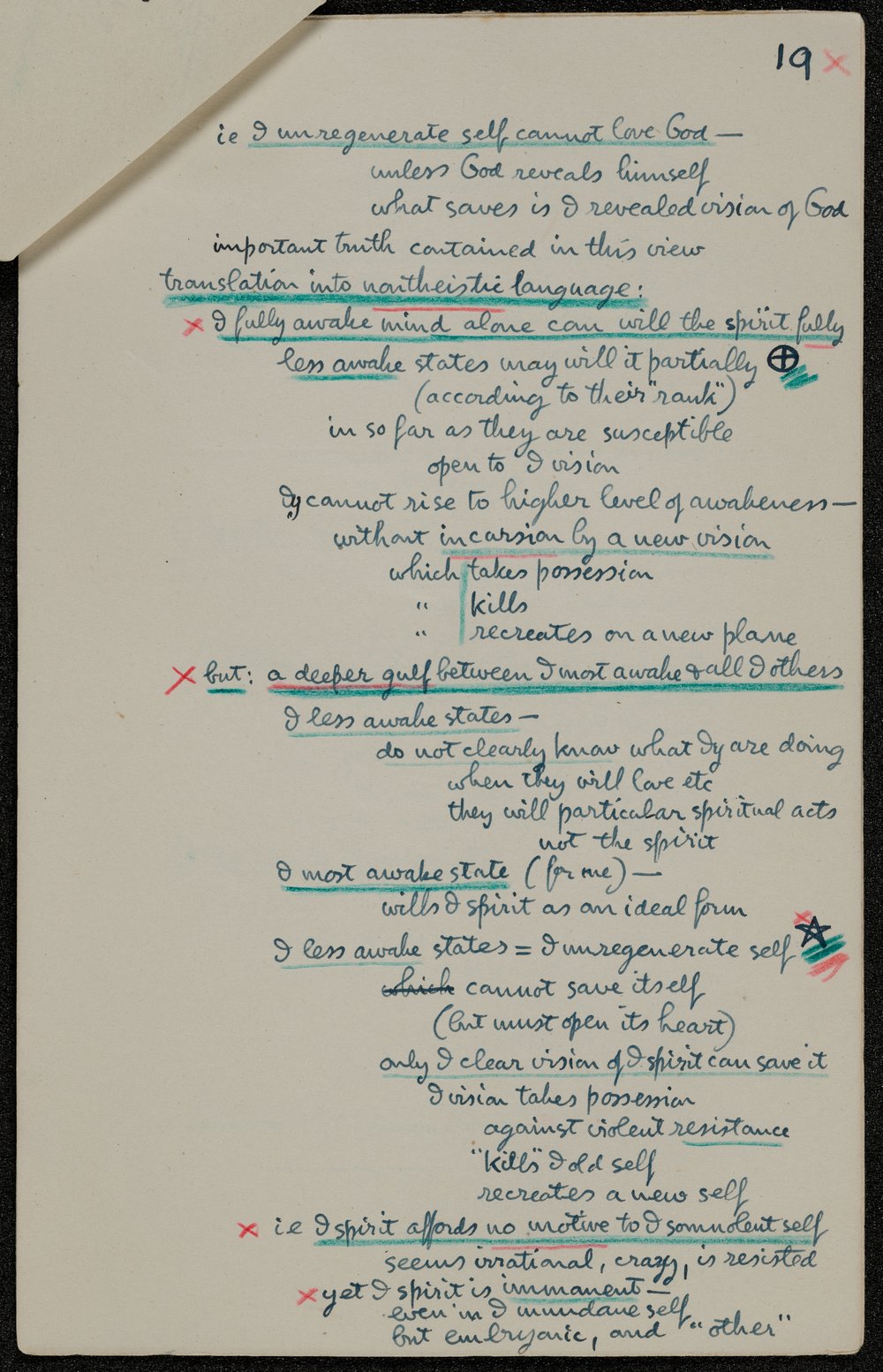
19 ×
ie ð unregenerate self cannot love God —
unless God reveals himself
what saves is ð revealed vision of God
important truth contained in this view
translation into nontheistic language:
× ð fully awake mind alone can will the spirit fully
less awake states may will it partially ⊕ ///
(according to their “rank”)
in so far as they are susceptible
open to ð vision
ðy cannot rise to higher level of awakeness —
without incursion by a new vision
which takes possession
“    kills
“    recreates on a new plane
× but: a deeper gulf between ð most awake & all ð others
ð less awake states —
do not clearly know what ðy are doing
when they will love etc
they will particular spiritual acts
not the spirit
ð most awake state (for me) —
wills ð spirit as an ideal form
ð less awake states = ð unregenerate self × ☆ /// //
which cannot save itself
(but must open its heart)
only ð clear vision of ð spirit can save it
ð vision takes possession
against violent resistance
“kills” ð old self
recreates a new self
× ie ð spirit affords no motive to ð somnolent self
seems irrational, crazy, is resisted
× yet ð spirit is immanent —
even in ð mundane self
but embryonic, and / “other”
Original manuscript — sheet 30
scan sheet 30
Transcription
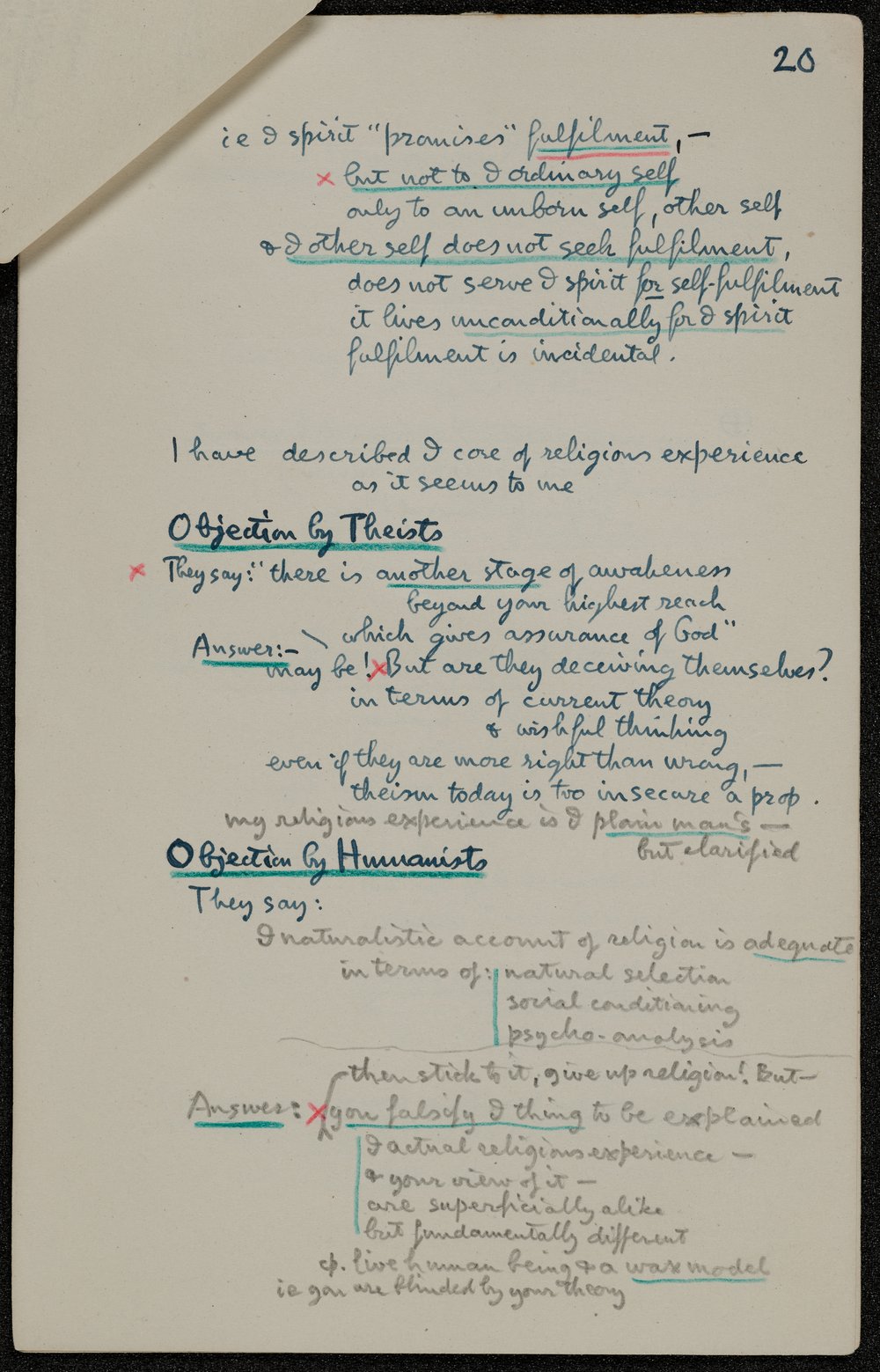
20
i e θ spirit “promises” fulfilment,—
× but not to θ ordinary self
only to an unborn self, other self
& θ other self does not seek fulfilment,
does not serve θ spirit fr self-fulfilment
it lives unconditionally fr θ spirit
fulfilment is incidental.
I have described θ core of religious experience
as it seems to me
Objection by Theists
× They say: “there is another stage of awakeness
beyond your highest reach
which gives assurance of God”
Answer:—
may be! × But are they deceiving themselves?
in terms of current theory
& wishful thinking
even if they are more right than wrong,—
theism today is too insecure a prop.
my religious experience is θ plain man's—
but clarified
Objection by Humanists
They say:
θ naturalistic account of religion is adequate
in terms of: natural selection
social conditioning
psycho-analysis
then stick to it; give up religion! But—
Answer: × you falsify θ thing to be explained
θ actual religious experience—
+ your view of it—
are superficially alike
but fundamentally different
cf. live human being + a wax model
i e you are blinded by your theory
Original manuscript — sheet 31
scan sheet 31
Transcription
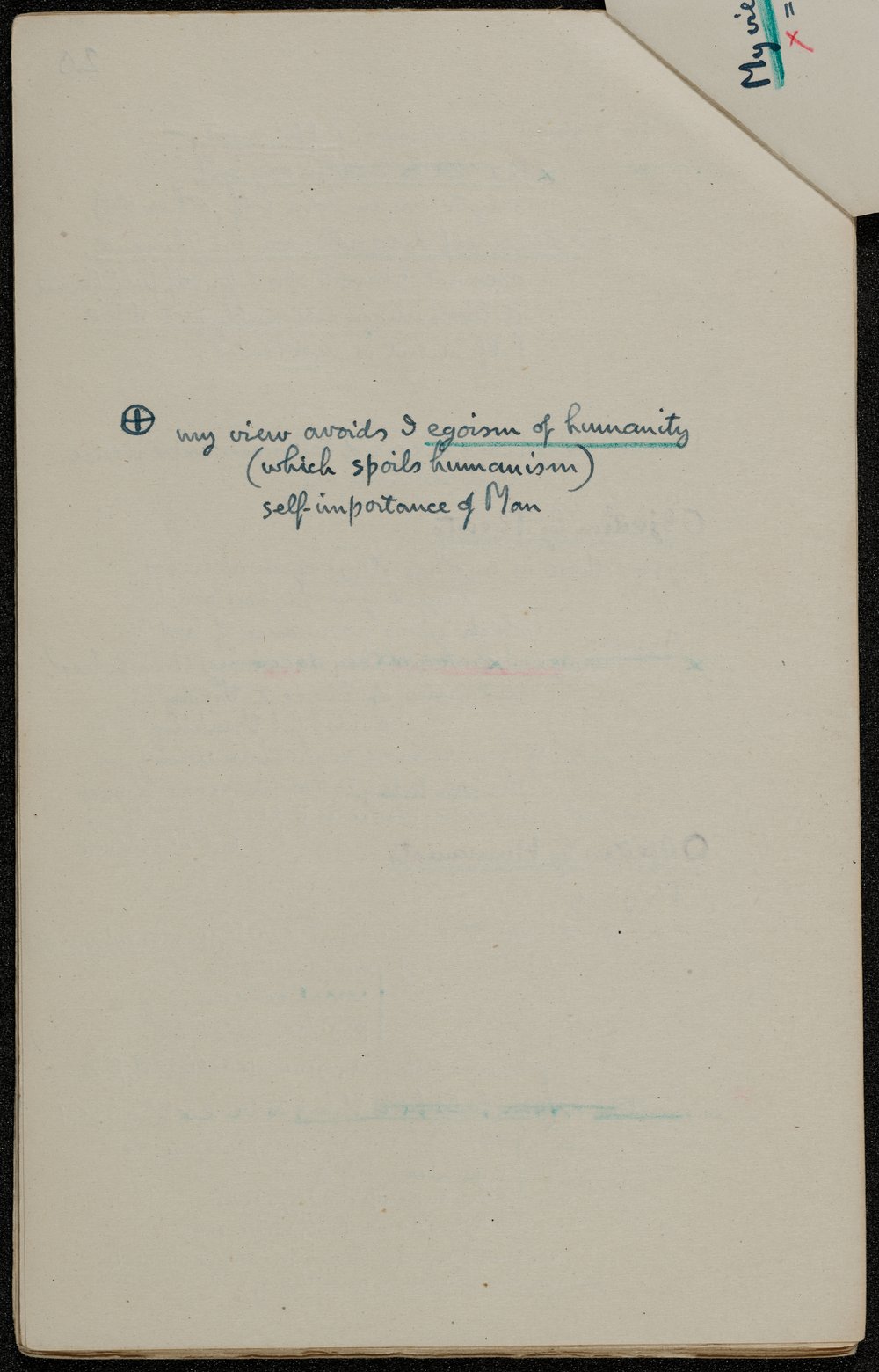
26My view = x


⊕my view avoids ð egoism of humanity
(which spoils humanism)
self-importance of Man
Original manuscript — sheet 32
scan sheet 32
Transcription
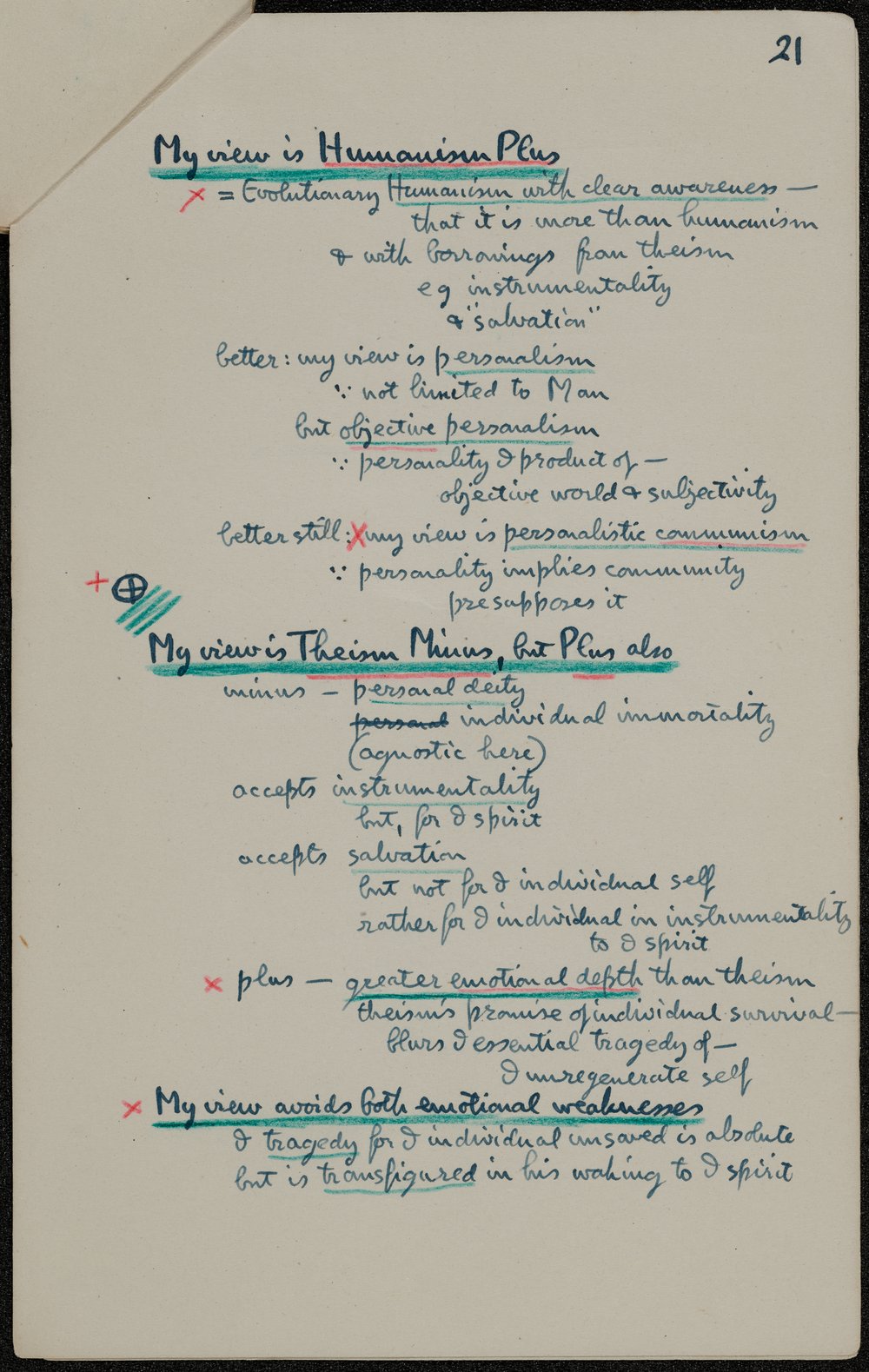
21
My view is Humanism Plus
× = Evolutionary Humanism with clear awareness —
that it is more than humanism
& with borrowings from theism
e g instrumentality
& “salvation”
better: my view is personalism
∵ not limited to Man
but objective personalism
∵ personality ð product of —
objective world + subjectivity
better still: × my view is personalistic communism
∵ personality implies community
presupposes it
+ ⊕ ╱╱╱╱My view is Theism Minus, but Plus also
minus — personal deity
personal individual immortality
(agnostic here)
accepts instrumentality
but, for ð spirit
accepts salvation
but not for ð individual self
rather for ð individual in instrumentality
to ð spirit
× plus — greater emotional depth than theism
theism's promise of individual survival —
blurs ð essential tragedy of —
ð unregenerate self
× My view avoids both emotional weaknesses
ð tragedy for ð individual unsaved is absolute
but is transfigured in his waking to ð spirit
Original manuscript — sheet 33
scan sheet 33
Transcription
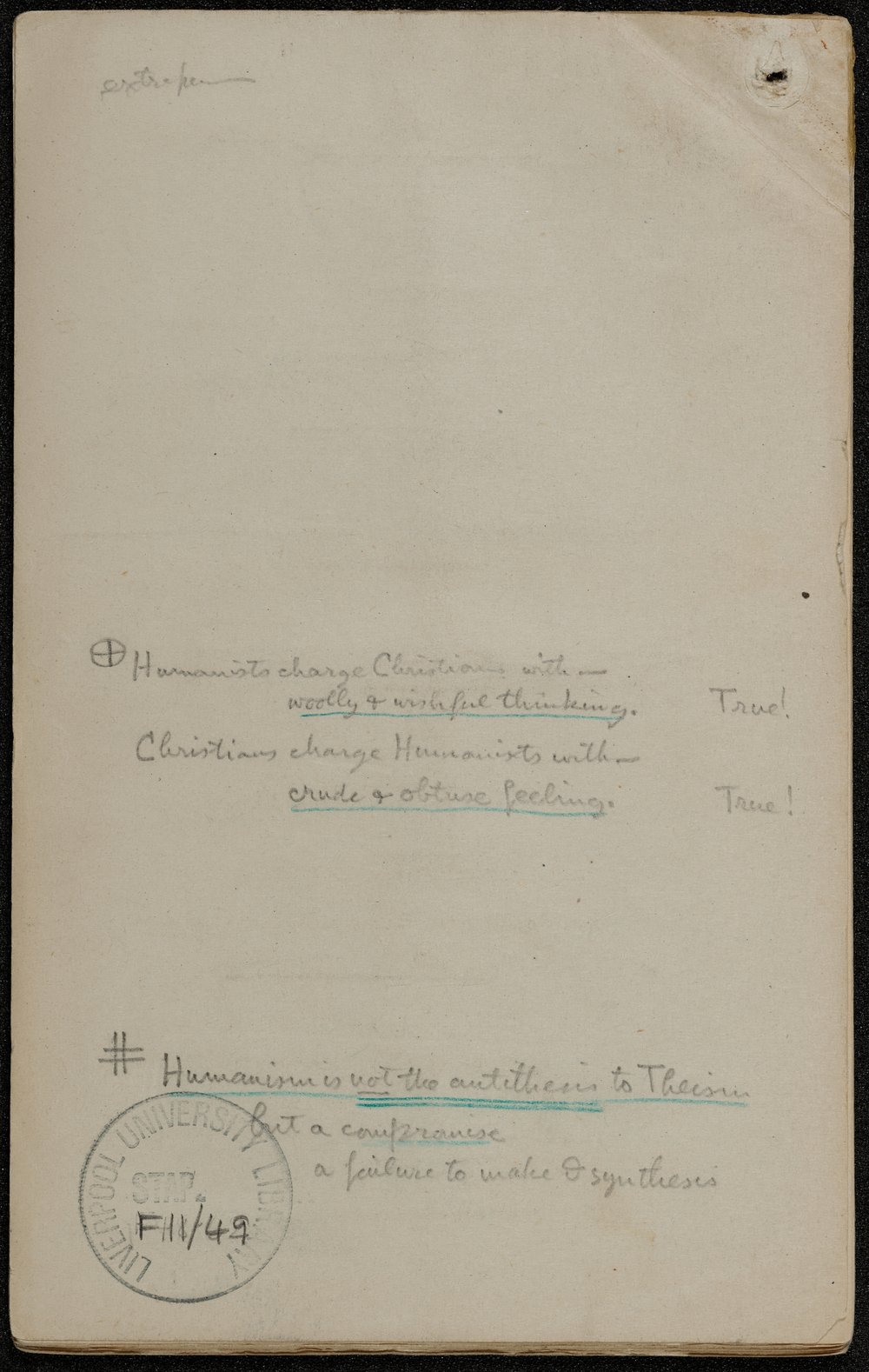
extra fine
⊕Humanists charge Christians with —
woolly & wishful thinking. True!
Christians charge Humanists with —
crude & obtuse feeling. True!
#Humanism is not the antithesis to Theism
LIVERPOOL UNIVERSITY LIBRARY · STAP. · F11/49but a compromise
a failure to make θ synthesis
Original manuscript — sheet 34
scan sheet 34
Transcription
[Alternative Summary Over Leaf]
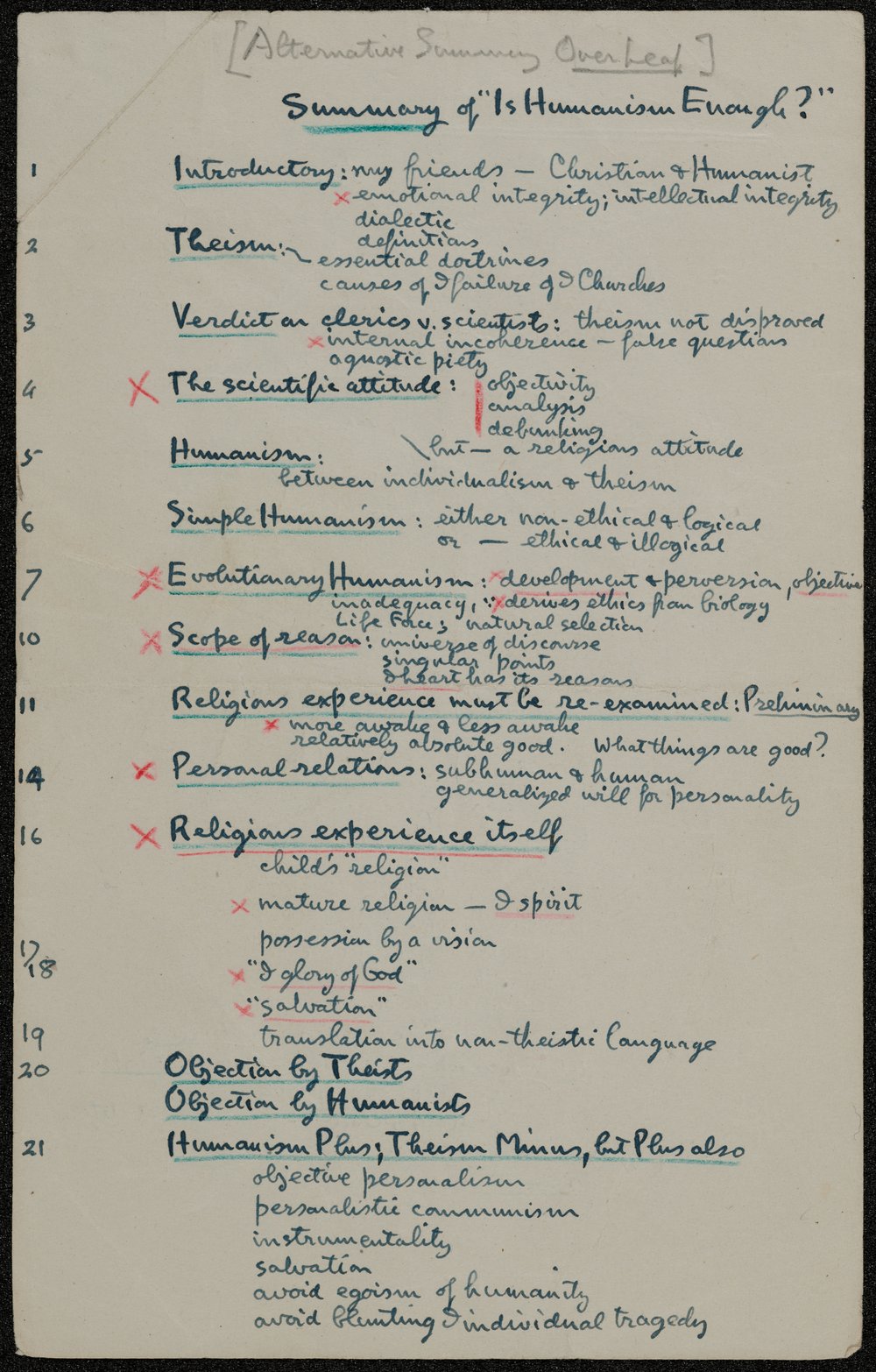
Summary of "Is Humanism Enough?"
1 Introductory: my friends — Christian & Humanist
× emotional integrity; intellectual integrity
dialectic
2 Theism:— definitions
essential doctrines
causes of ð failure of ð Churches
3 Verdict on clerics v. scientists: theism not disproved
× internal incoherence — false questions
agnostic piety
4 × The scientific attitude:
objectivity
analysis
debunking.
5- Humanism: but — a religious attitude
between individualism & theism
6 Simple Humanism: either non-ethical & logical
or — ethical & illogical
7 × Evolutionary Humanism: × development & perversion, objective
inadequacy! ∵ × derives ethics from biology
Life Force; natural selection
10 × Scope of reason: universe of discourse
singular points
ð heart has its reasons
11 Religious experience must be re-examined! Preliminary
× more awake & less awake
relatively absolute good.What things are good?
14 × Personal relations: subhuman & human
generalized will for personality
16 × Religious experience itself
child's "religion"
× mature religion — ð spirit
17 possession by a vision
18 × "ð glory of God"
× "salvation"
19 translation into non-theistic language
20 Objection by Theists
Objection by Humanists
21 Humanism Plus; Theism Minus, but Plus also
objective personalism
personalistic communism
instrumentality
salvation
avoid egoism of humanity
avoid blunting ð individual tragedy
Original manuscript — sheet 35
scan sheet 35
Transcription
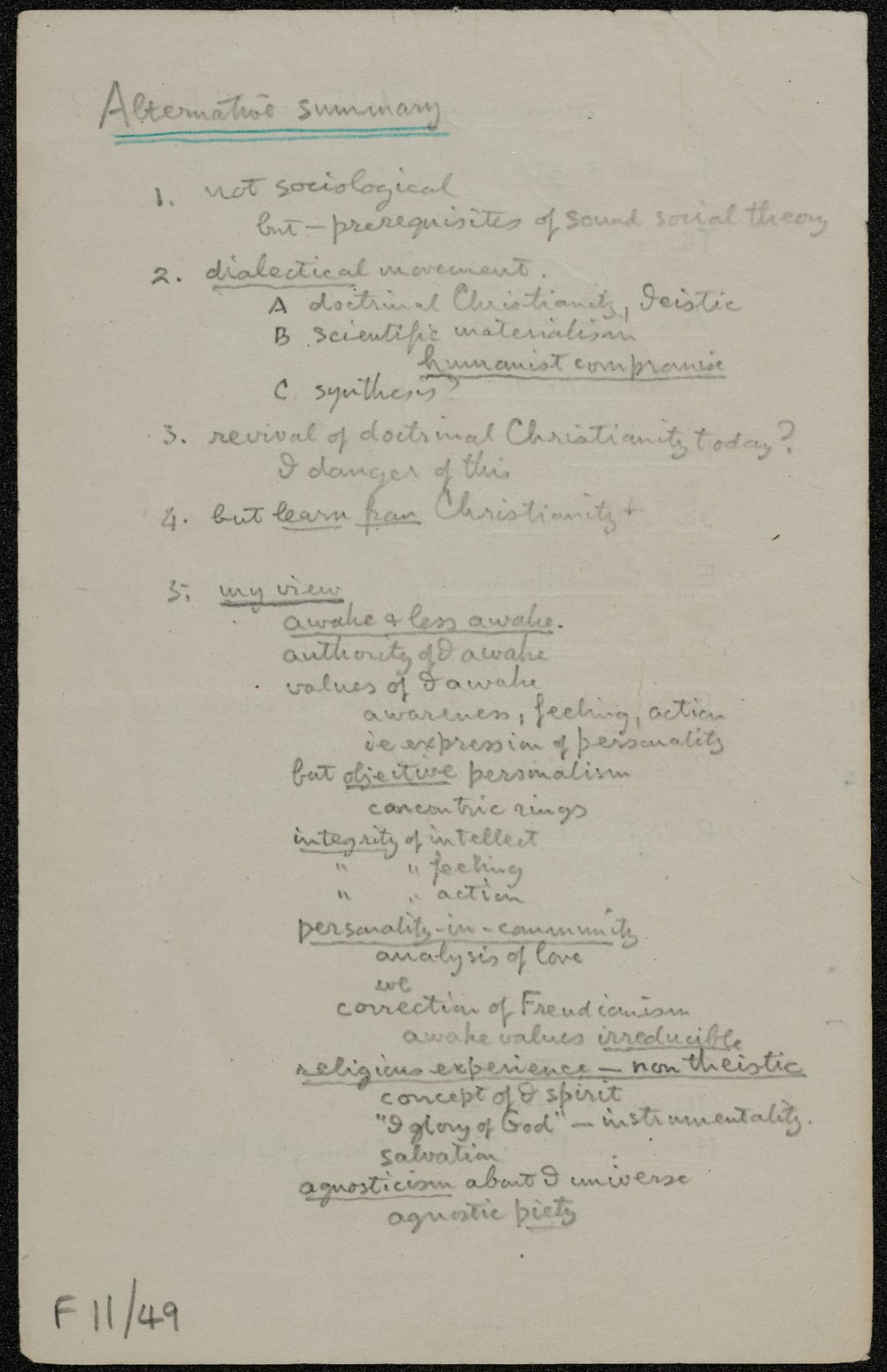
Alternative Summary
1. not sociological
but — prerequisites of sound social theory
2. dialectical movement.
A doctrinal Christianity, Deistic
B. scientific materialism
humanist compromise
C. synthesis →
3. revival of doctrinal Christianity, today?
θ danger of this
4. but learn from Christianity +
5. my view
awake + less awake.
authority of θ awake
values of θ awake
awareness; feeling, action
i.e. expression of personality
but objective personalism
concentric rings
integrity of intellect
"    " feeling
"    " action
personality-in-community.
analysis of love
evil
correction of Freudianism
awake values irreducible
religious experience — non theistic
concept of θ spirit
"θ glory of God" — instrumentality.
salvation
agnosticism about θ universe
agnostic piety
F 11/49