← All lectures
Living On Other Planets
Original manuscript — sheet 1
scan sheet 1
Transcription
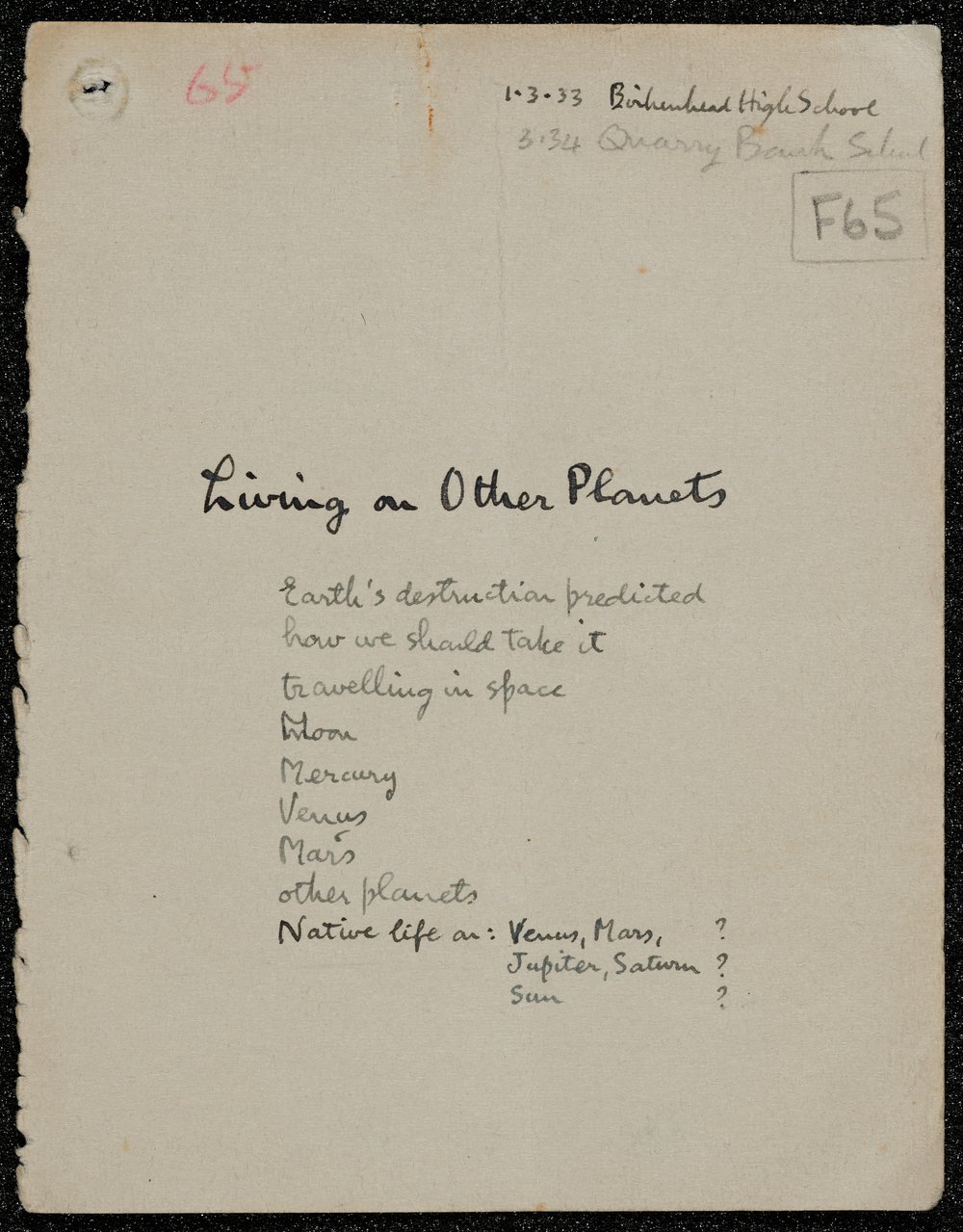
[illegible]   65
1·3·33 Birkenhead High School
3·34 Quarry Bank Schl.
F65
Living on Other Planets
Earth's destruction predicted
how we should take it
travelling in space
Moon
Mercury
Venus
Mars
other planets
Native life on: Venus, Mars,    ?
Jupiter, Saturn  ?
Sun           ?
Original manuscript — sheet 2
scan sheet 2
Transcription
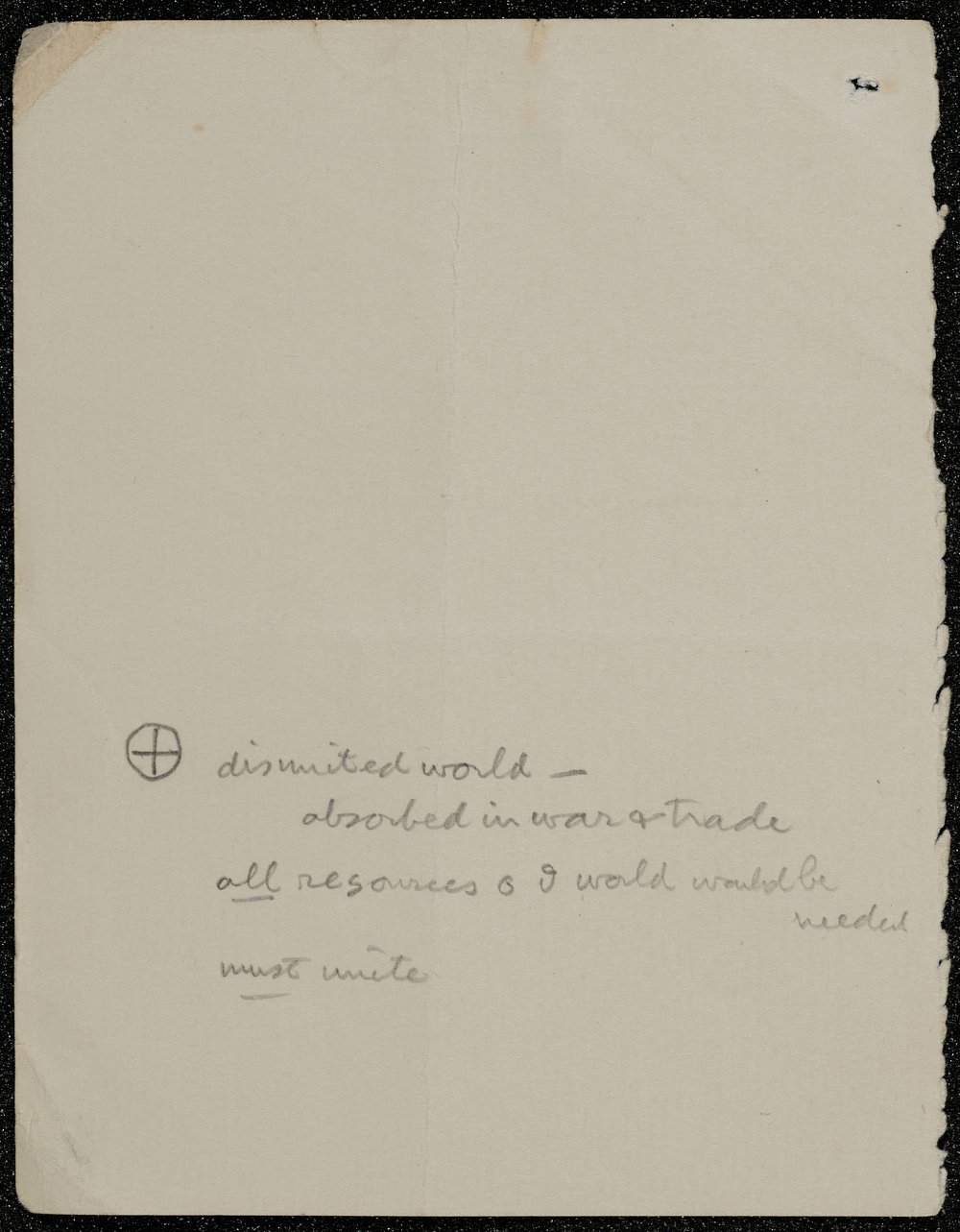
⊕disunited world —
absorbed in war & trade
all resources o ð world would be
needed
must unite
Original manuscript — sheet 3
scan sheet 3
Transcription
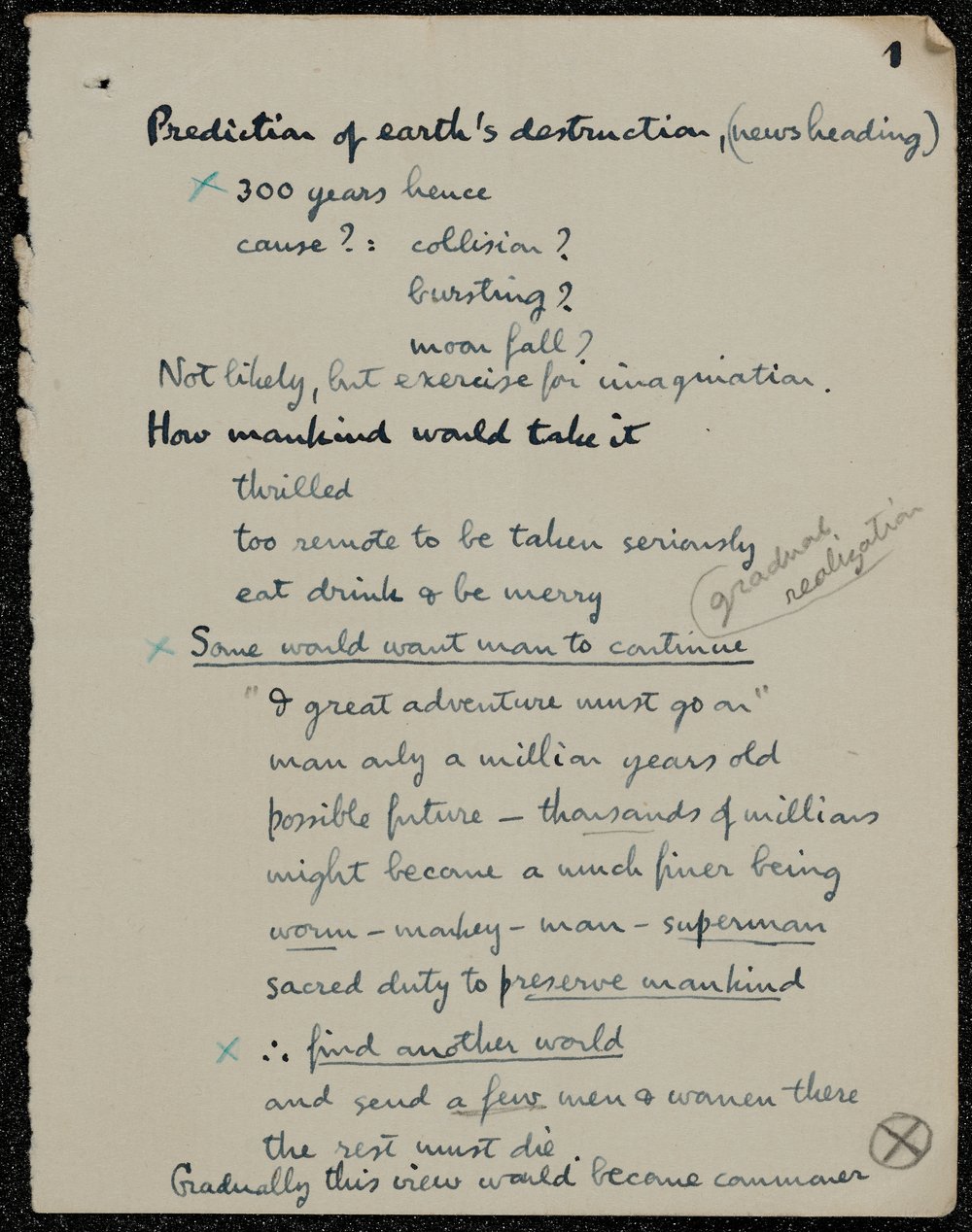
1
Prediction of earth's destruction, (news heading)
× 300 years hence
cause ? : collision ?
bursting ?
moon fall ?
Not likely, but exercise for imagination.
How mankind would take it
thrilled
too remote to be taken seriously
eat drink & be merry gradual realization
× Some would want man to continue
"A great adventure must go on"
man only a million years old
possible future — thousands of millions
might become a much finer being
worm - monkey - man - superman
sacred duty to preserve mankind
× ∴ find another world
and send a few men & women there
the rest must die. ⊗
Gradually this view would become commoner
Original manuscript — sheet 4
scan sheet 4
Transcription
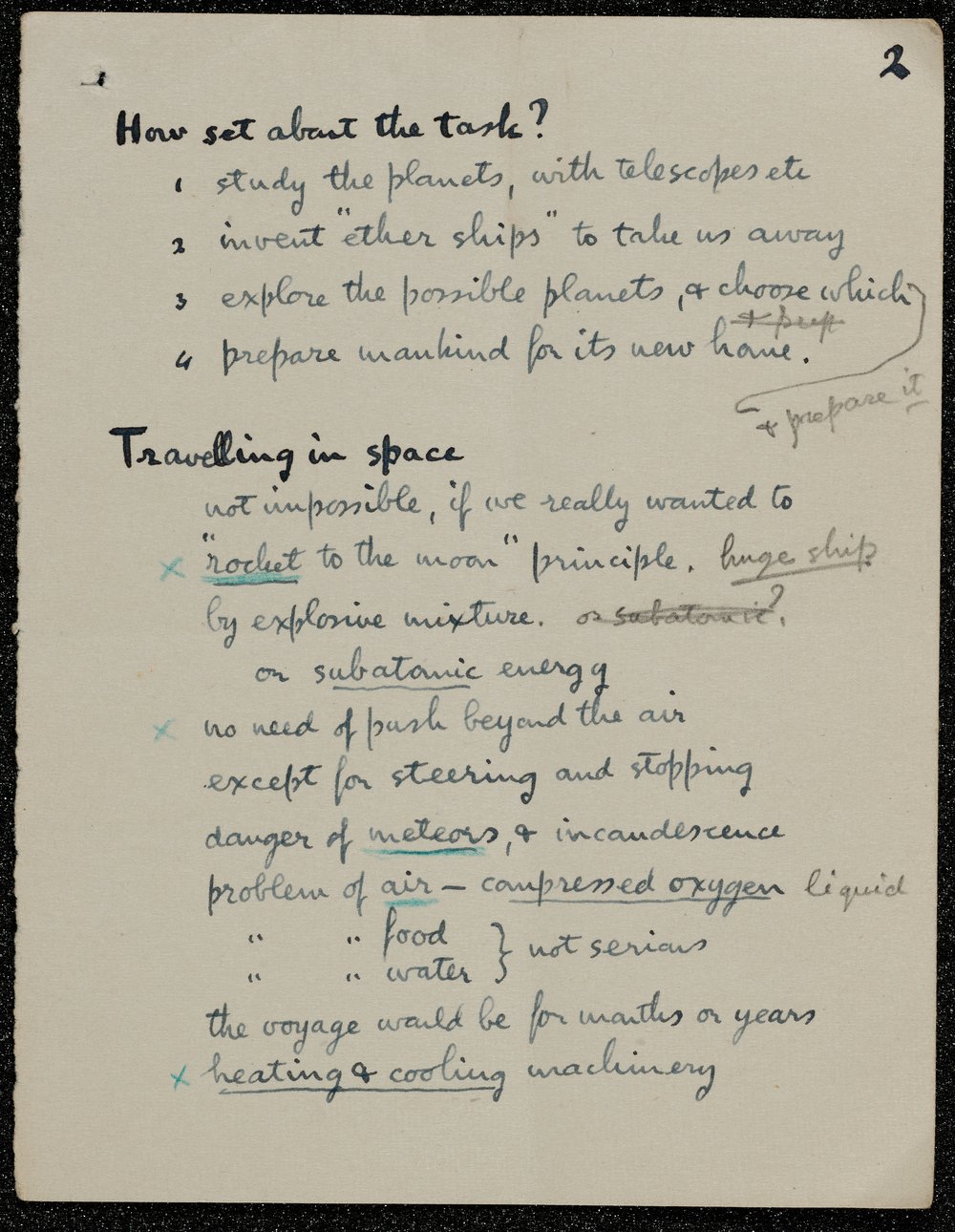
2
[puncture]
How set about the task?
1  study the planets, with telescopes etc
2  invent "ether" ships to take us away
3  explore the possible planets, & choose which+ prep
4  prepare mankind for its new home.+ prepare it
Travelling in space
not impossible, if we really wanted to
x  "rocket to the moon" principle. huge ship
by explosive mixture. or subatomic?
or subatomic energy
x  no need of push beyond the air
except for steering and stopping
danger of meteors, & incandescence
problem of air — compressed oxygen liquid
"        "    foodnot serious
"        "    water
the voyage would be for months or years
x  heating & cooling machinery
Original manuscript — sheet 5
scan sheet 5
Transcription
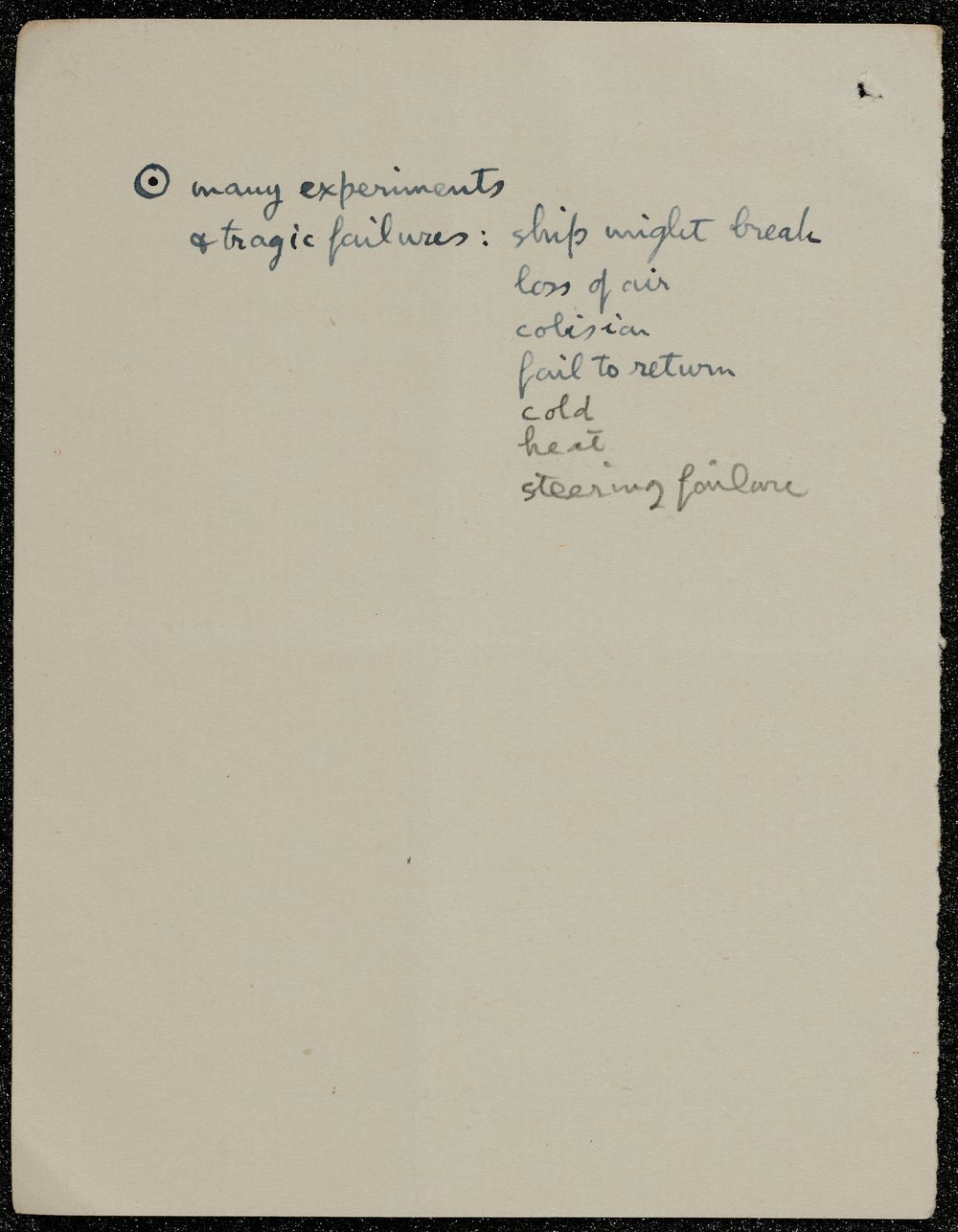
⊙many experiments
& tragic failures: ship might break
loss of air
colision
fail to return
cold
heat
steering failure
Original manuscript — sheet 6
scan sheet 6
Transcription
3
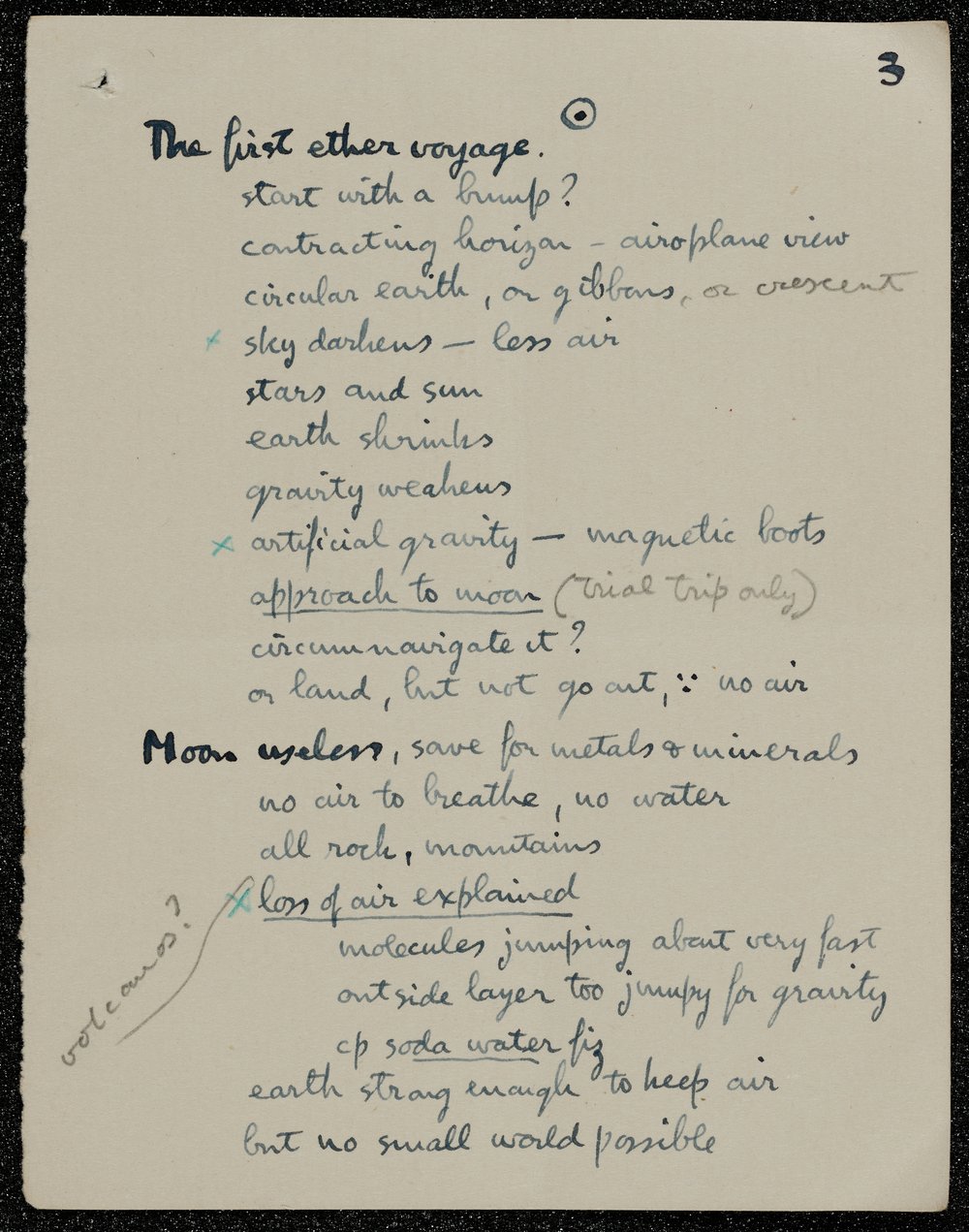
The first ether voyage. ⊙
start with a bump?
contracting horizon - airoplane view
circular earth, or gibbous, or crescent
× sky darkens — less air
stars and sun
earth shrinks
gravity weakens
× artificial gravity — magnetic boots
approach to moon (Trial Trip only)
circumnavigate it?
or land, but not go out, ∵ no air
Moon useless, save for metals & minerals
no air to breathe, no water
all rock, mountains
× loss of air explained
molecules jumping about very fast
outside layer too jumpy for gravity
volcano ? cp soda water fiz
earth strong enough to keep air
but no small world possible
Original manuscript — sheet 7
scan sheet 7
Transcription
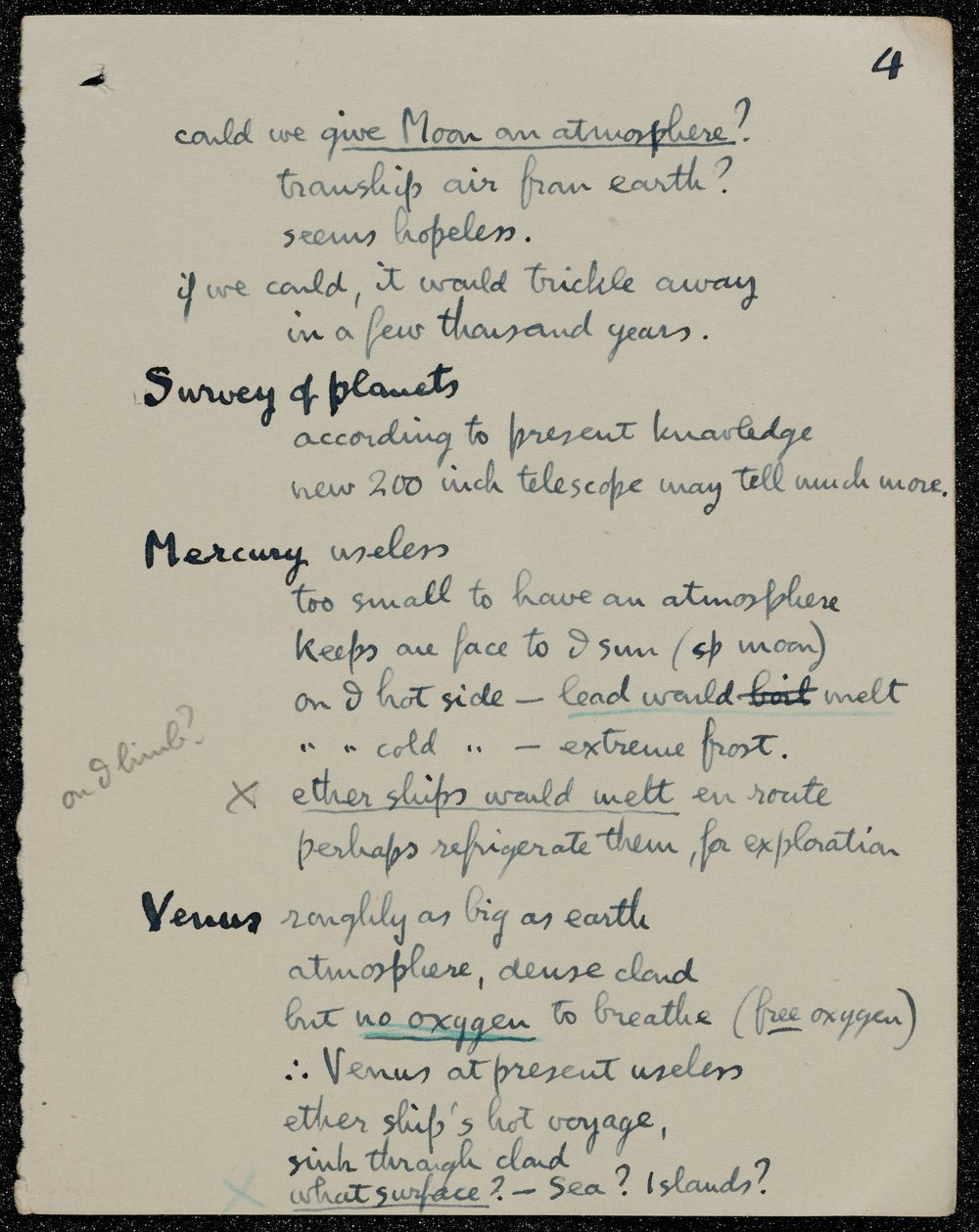
4
could we give Moon an atmosphere?
tranship air from earth?
seems hopeless.
if we could, it would trickle away
in a few thousand years.
Survey of planets
according to present knowledge
new 200 inch telescope may tell much more.
Mercury useless
too small to have an atmosphere
keeps one face to ð sun (cp moon)
on ð hot side — lead would boil melt
on ð limb?„ „ cold „ — extreme frost.
X ether ships would melt en route
perhaps refrigerate them, for exploration
Venus roughly as big as earth
atmosphere, dense cloud
but no oxygen to breathe (free oxygen)
∴ Venus at present useless
ether ship’s hot voyage,
sink through cloud
Xwhat surface? — Sea? Islands?
Original manuscript — sheet 8
scan sheet 8
Transcription
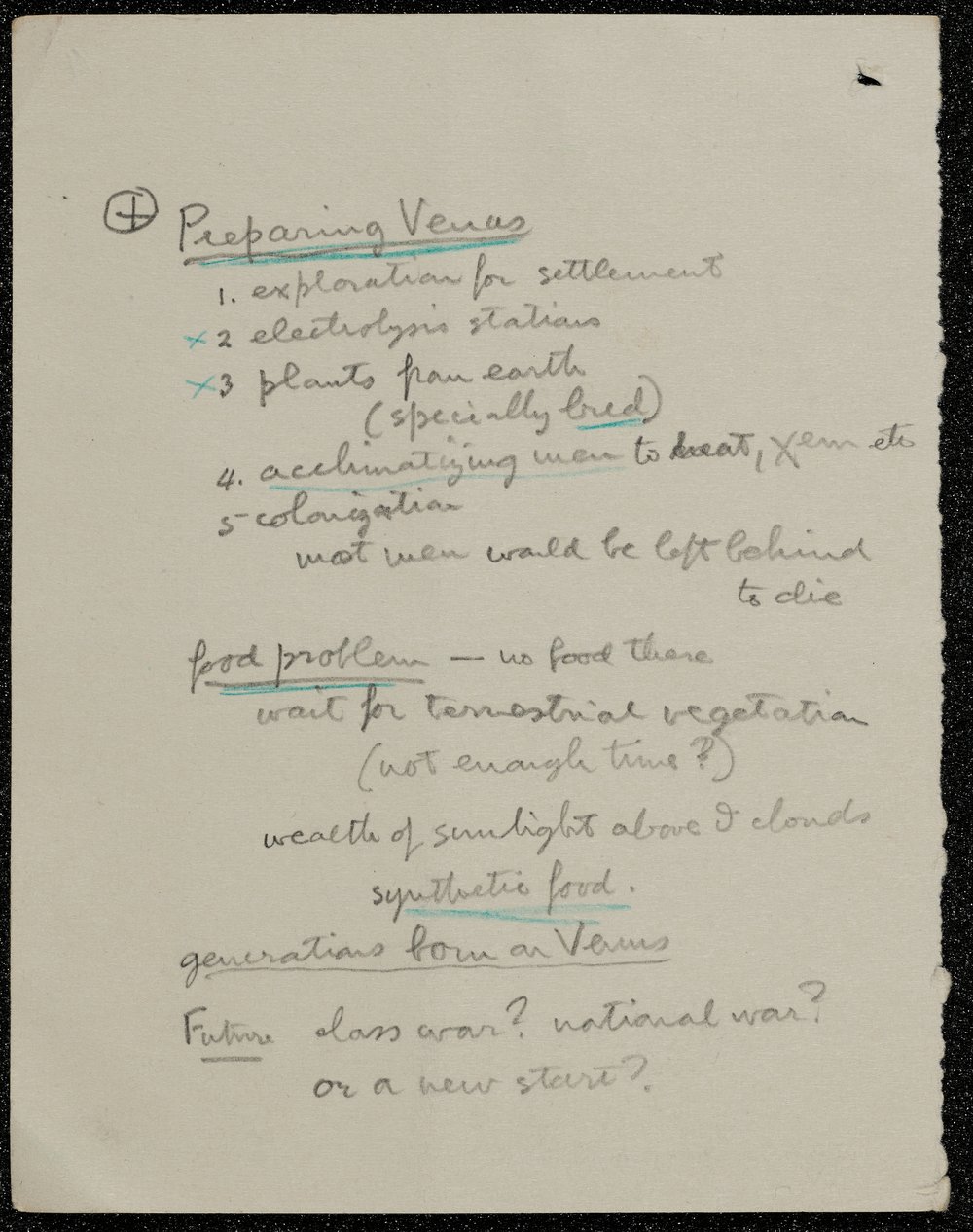
+ Preparing Venus
1. exploration for settlement
× 2 electrolysis stations
× 3 plants from earth
(specially bred)
4. acclimatizing men to heat, X rays etc
5- colonization
most men would be left behind
to die
food problem — no food there
wait for terrestrial vegetation
(not enough time?)
wealth of sunlight above ð clouds
synthetic food.
generations born on Venus
Future    class war? national war?
or a new start?
Original manuscript — sheet 9
scan sheet 9
Transcription
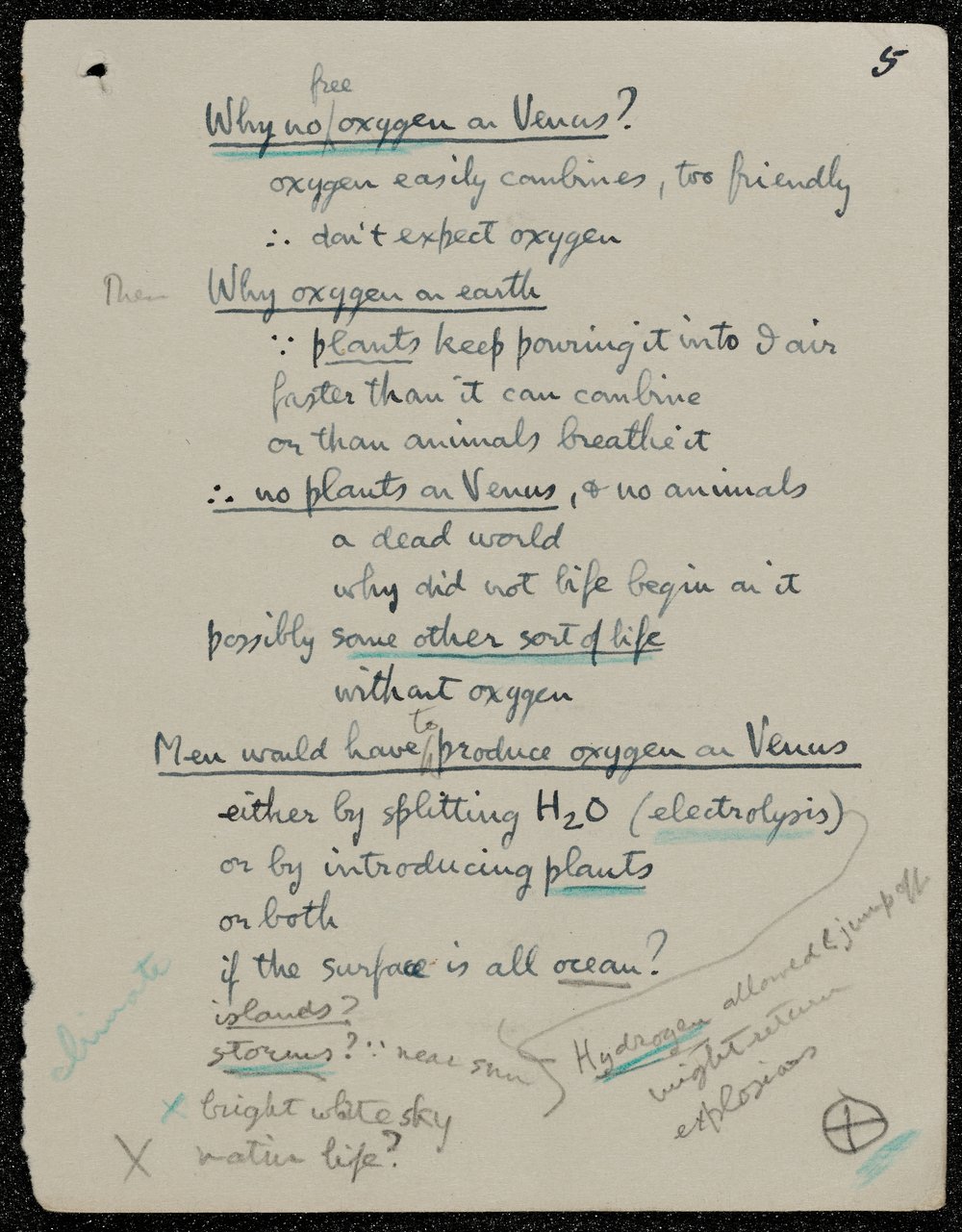
5
Why no free oxygen on Venus?
oxygen easily combines, too friendly
∴ don't expect oxygen
Then Why oxygen on earth
∵ plants keep pouring it into ð air
faster than it can combine
or than animals breathe it
∴ no plants on Venus, & no animals
a dead world
why did not life begin on it
possibly some other sort of life
without oxygen
Men would have to produce oxygen on Venus
either by splitting H₂O (electrolysis)
or by introducing plants
or both
climate? if the surface is all ocean?
islands?
storms? ∵ near sun Hydrogen allowed to jump off
might return
explosions
x bright white sky? ⊕ /
X native life?
Original manuscript — sheet 10
scan sheet 10
Transcription
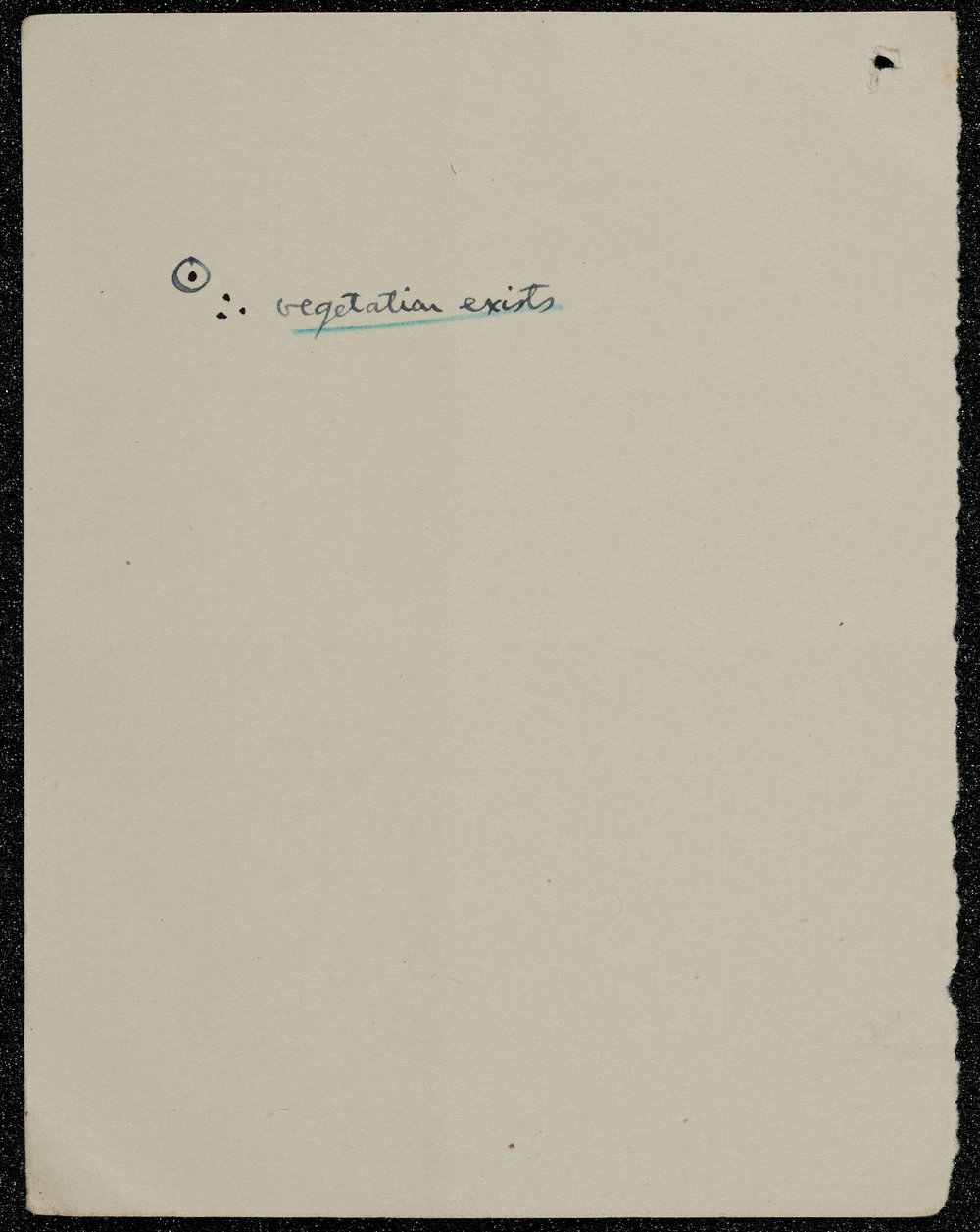
⊙ ∴ vegetation exists
Original manuscript — sheet 11
scan sheet 11
Transcription
6
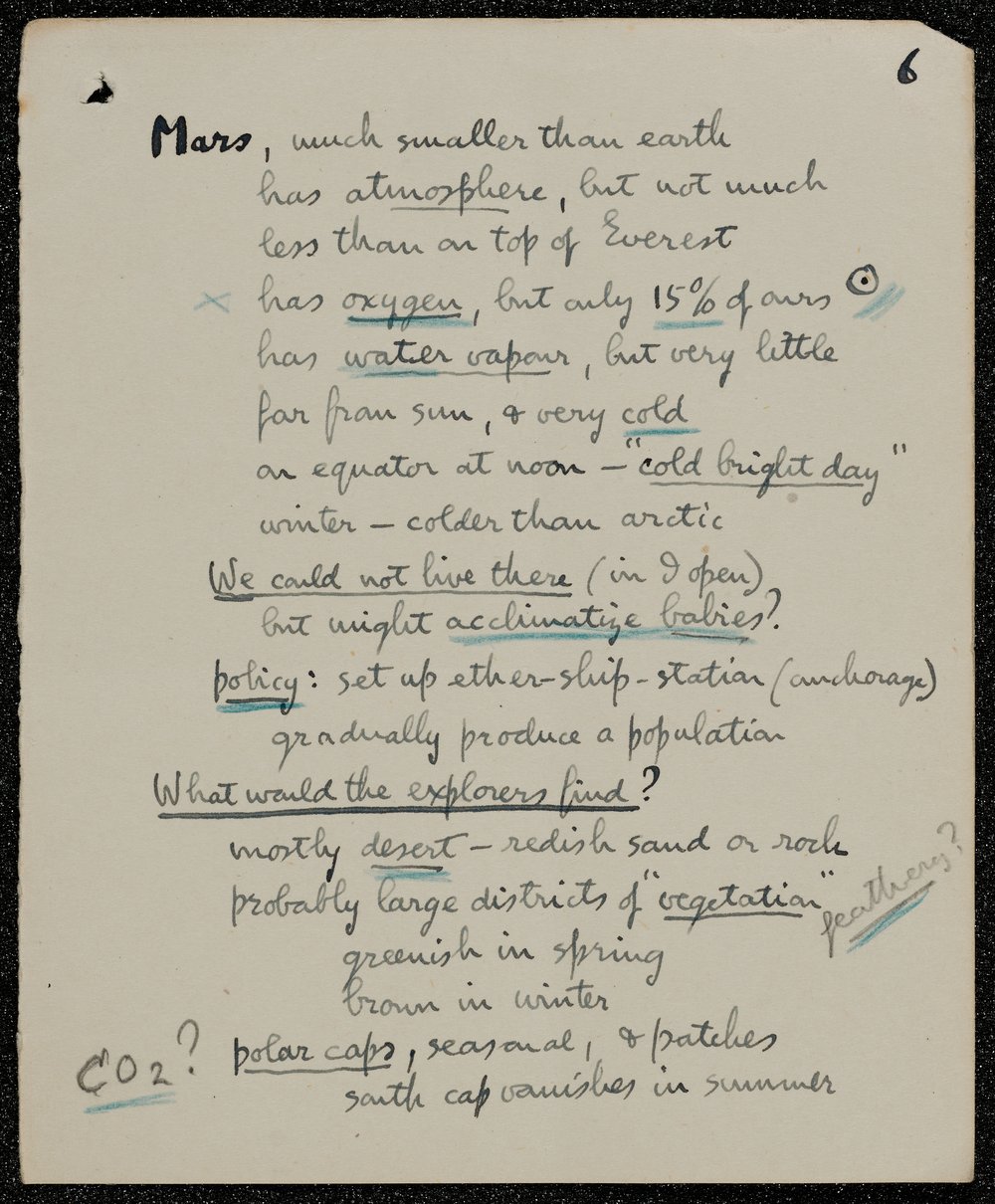
Mars, much smaller than earth
has atmosphere, but not much
less than on top of Everest
× has oxygen, but only 15% of ours ⊙
has water vapour, but very little
far from sun, & very cold
on equator at noon – “cold bright day”
winter – colder than arctic
We could not live there (in ð open)
but might acclimatize babies?
policy: set up ether-ship-station (anchorage)
gradually produce a population
What would the explorers find?
mostly desert – redish sand or rock
probably large districts of “vegetation” feathery?
greenish in spring
brown in winter
CO₂? polar caps, seasonal, & patches
south cap vanishes in summer
Original manuscript — sheet 12
scan sheet 12
Transcription
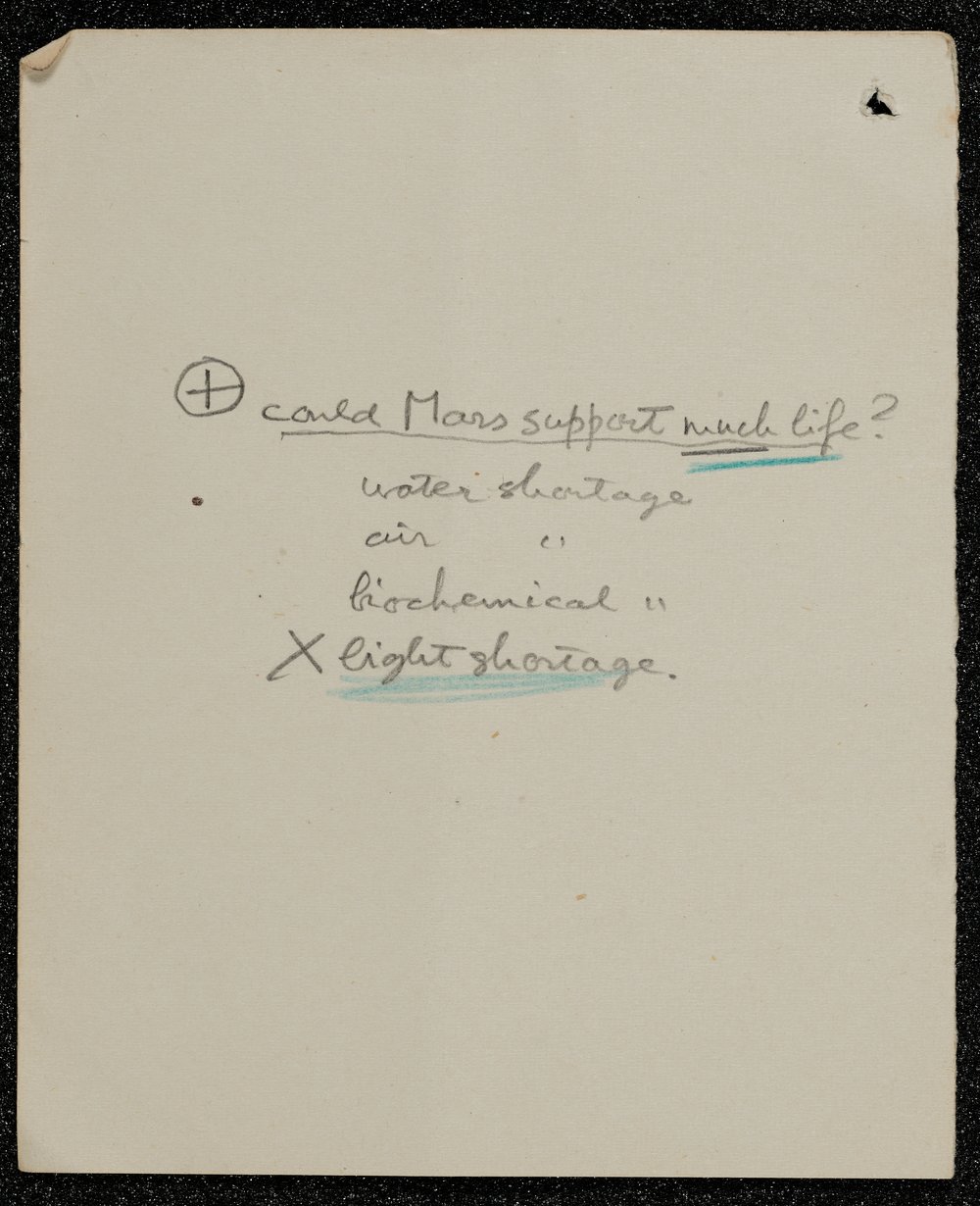
⊕ could Mars support much life?
• water shortage
air   〃
biochemical  〃
X light shortage.
Original manuscript — sheet 13
scan sheet 13
Transcription
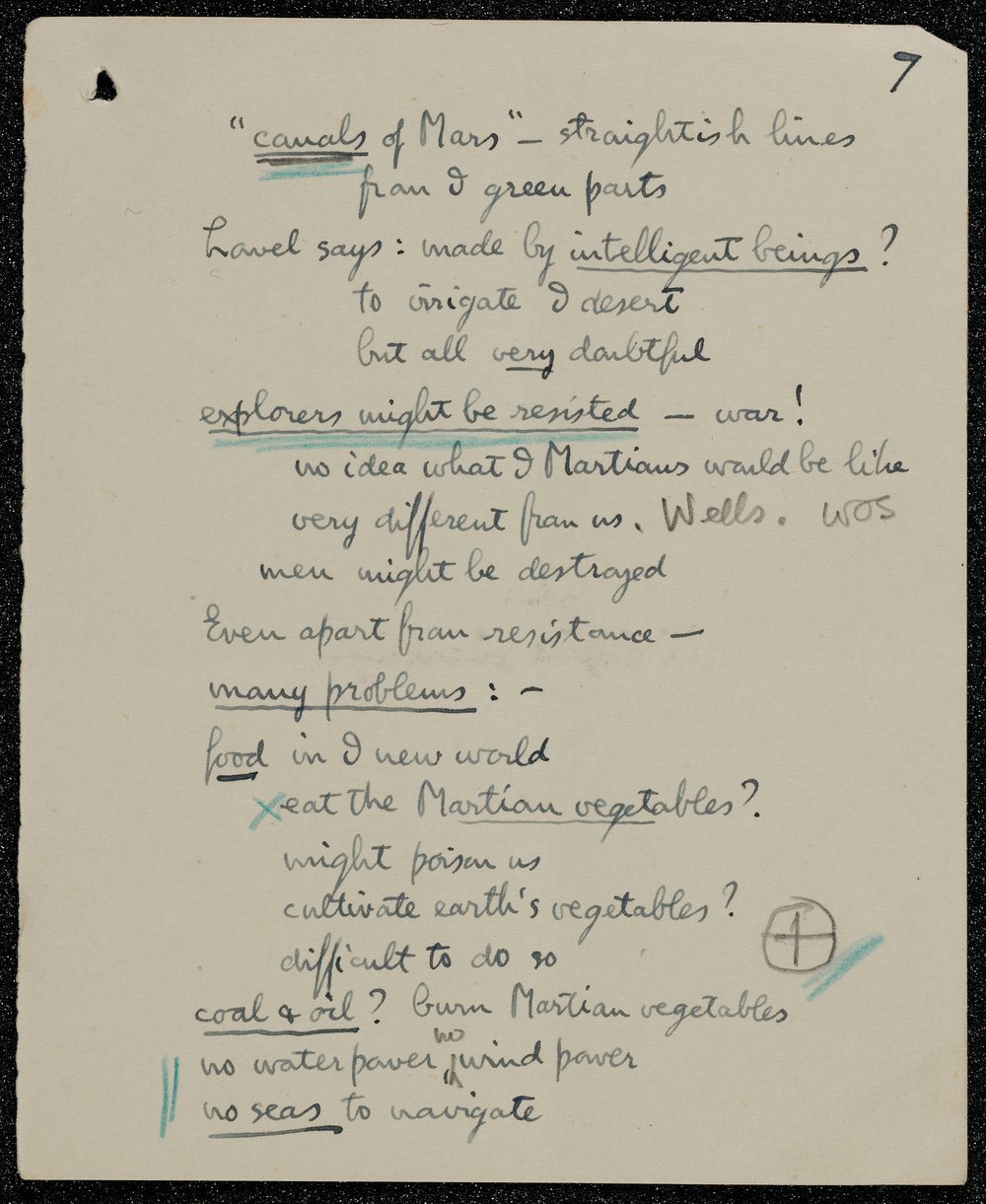
7
“canals of Mars” — straightish lines
~from ð green parts
Lowel says: made by intelligent beings?
to irrigate ð desert
but all very doubtful
explorers might be resisted — war!
no idea what ð Martians would be like
very different from us, Wells. WOS
men might be destroyed
Even apart from resistance —
many problems:—
food in ð new world
×eat the Martian vegetables?
might poison us
cultivate earth’s vegetables?+ //
difficult to do so
coal & oil? Burn Martian vegetables
||no water power, no wind power
no seas to navigate
Original manuscript — sheet 14
scan sheet 14
Transcription
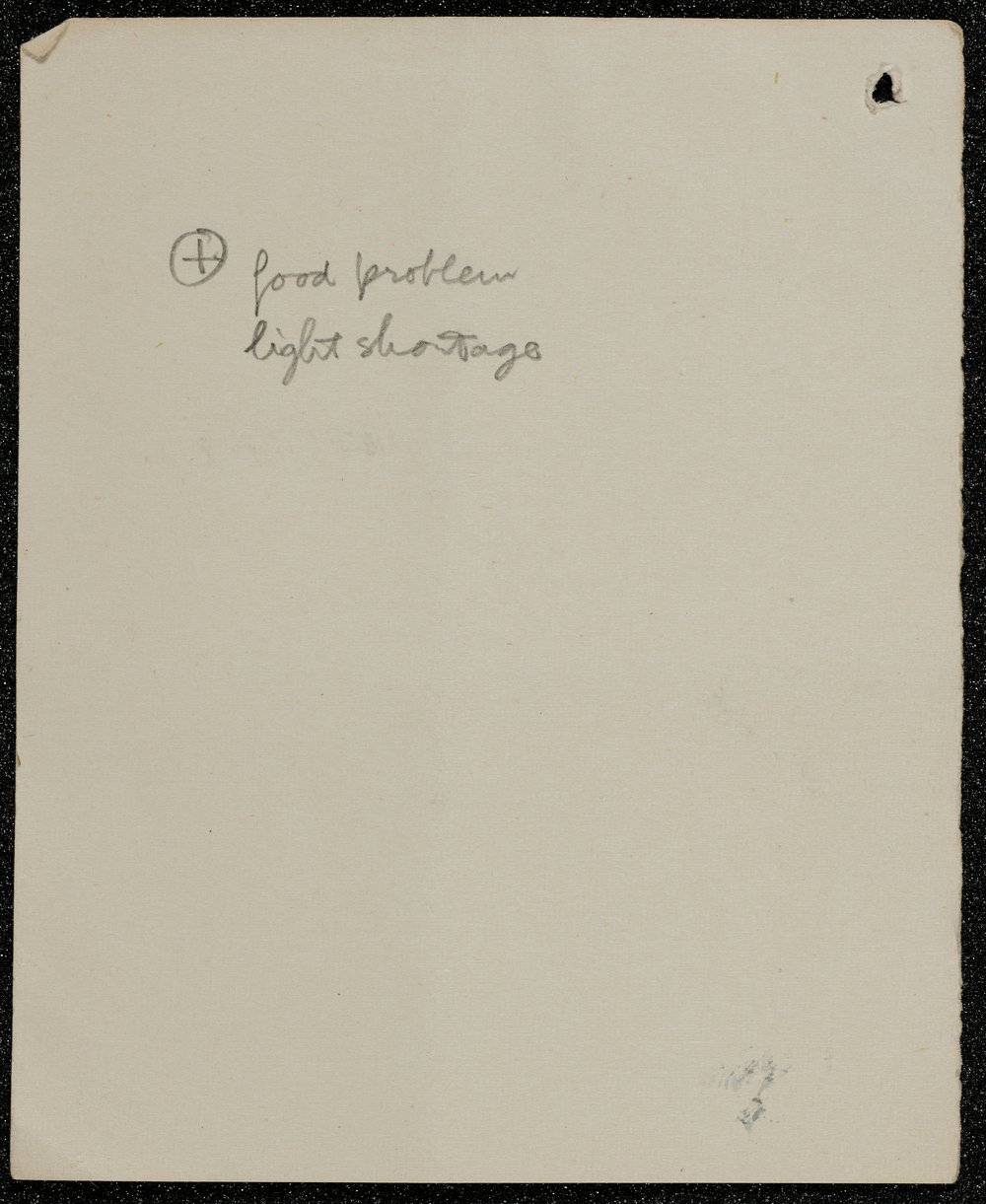
⊕food problem
light shortage
Original manuscript — sheet 15
scan sheet 15
Transcription
8
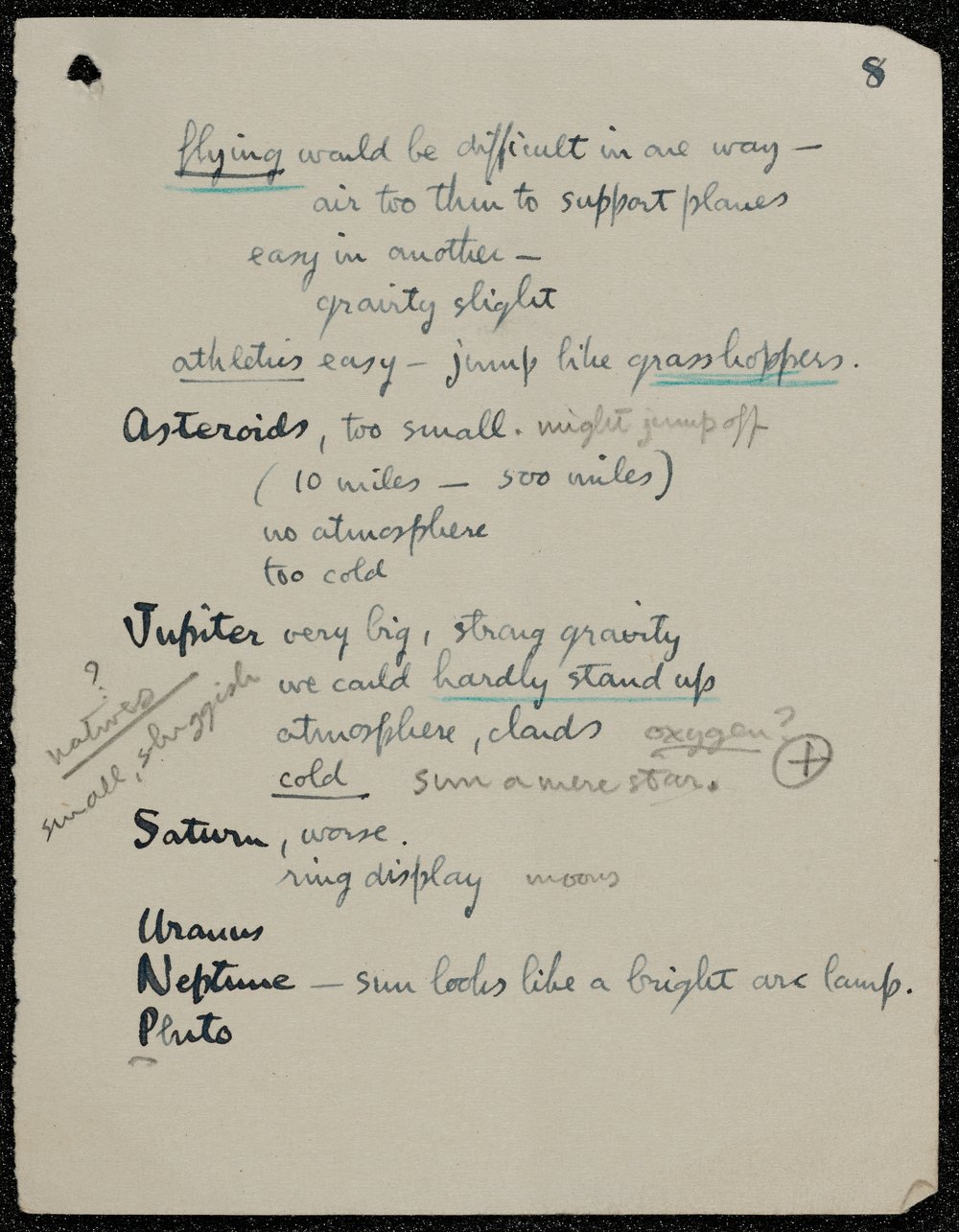
flying would be difficult in one way —
air too thin to support planes
easy in another —
gravity slight
athletics easy — jump like grasshoppers.
Asteroids, too small. might jump off
( 10 miles — 500 miles)
no atmosphere
too cold
Jupiter very big, strong gravity
?
natives
small, sluggish
we could hardly stand up
atmosphere, clouds    oxygen? ⊕
cold    Sun a mere star.
Saturn, worse.
ring display    moons
Uranus
Neptune — Sun looks like a bright arc lamp.
Pluto
Original manuscript — sheet 16
scan sheet 16
Transcription
2
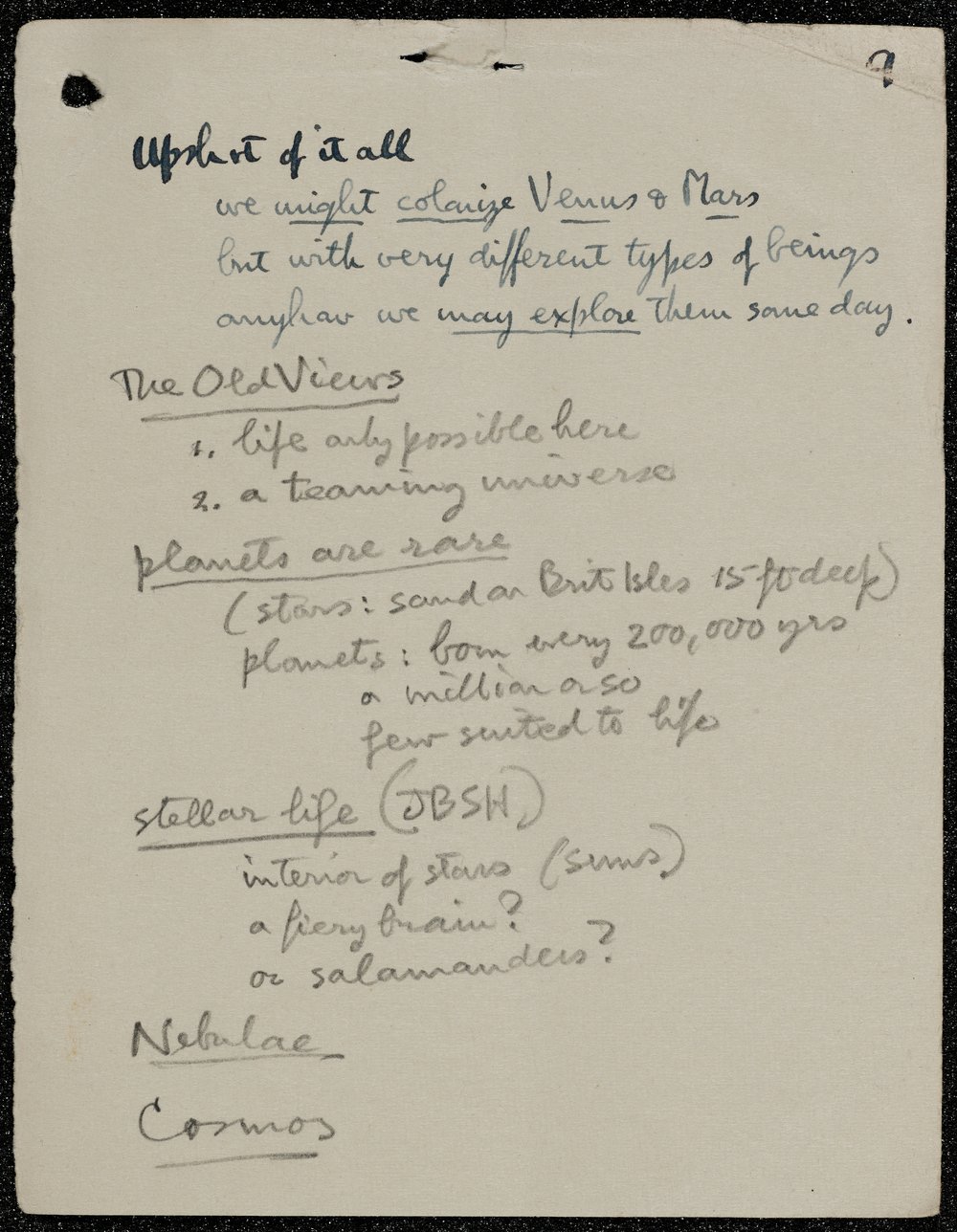
Upshot of it all
we might colonize Venus & Mars
but with very different types of beings
anyhow we may explore them some day.
The Old Views
1. life only possible here
2. a teeming universe
planets are rare
(stars: sand on Brit Isles 15-ft deep)
planets : born every 200,000 yrs
a million or so
few suited to life
stellar life (JBSH)
interior of stars (suns)
a fiery brain?
or salamanders?
Nebulae
Cosmos
Original manuscript — sheet 17
scan sheet 17
Transcription
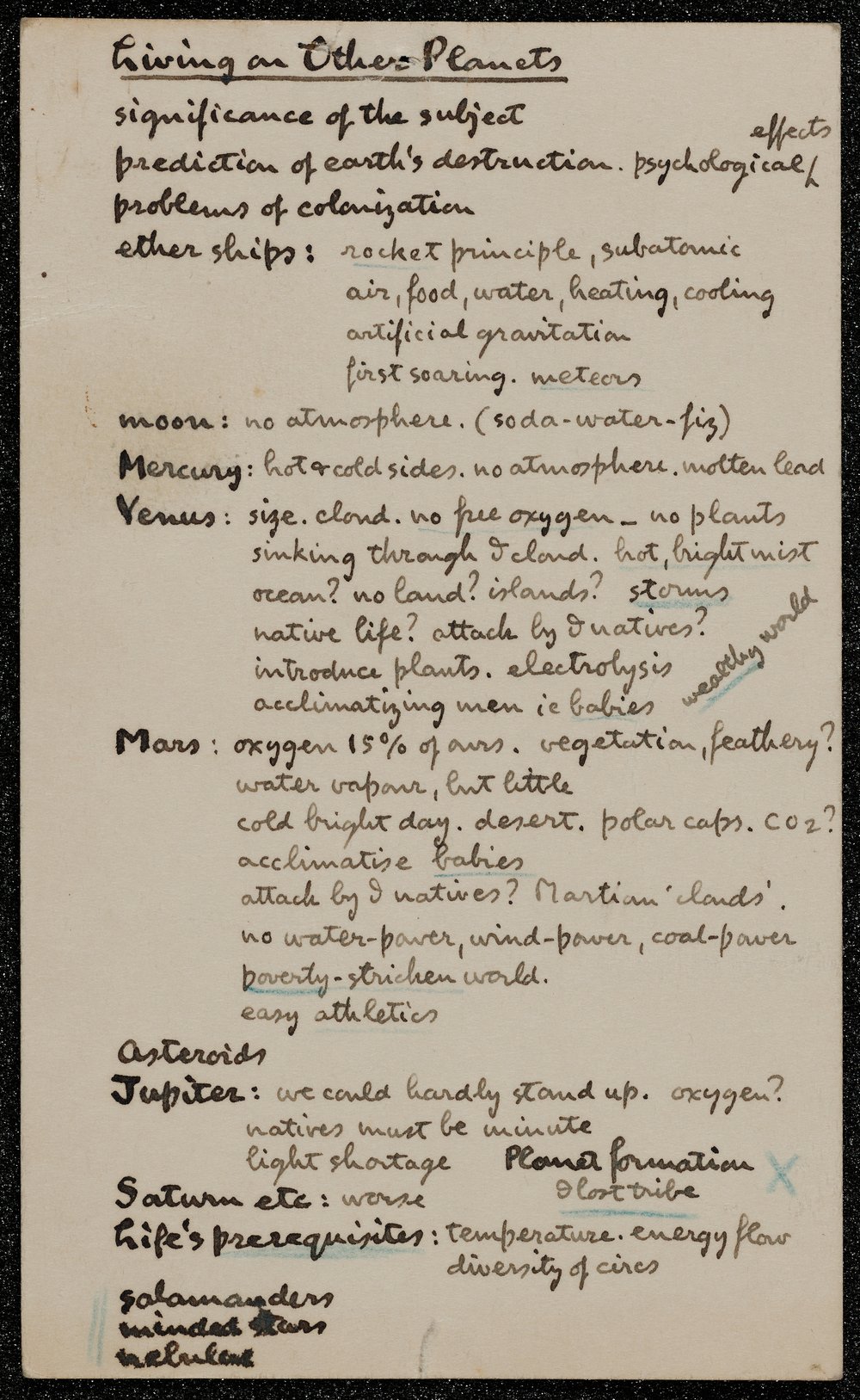
Living on Other Planets
significance of the subject
prediction of earth's destruction. psychological effects
problems of colonization
ether ships: rocket principle, subatomic
air, food, water, heating, cooling
artificial gravitation
first soaring. meteors
moon: no atmosphere. (soda-water-fiz)
Mercury: hot + cold sides. no atmosphere. molten lead
Venus: size. cloud. no free oxygen — no plants
sinking through ð cloud. hot, bright mist
ocean? no land? islands? storms
native life? attack by ð natives?
introduce plants. electrolysis
acclimatizing men ie babies wealthy world
Mars: oxygen 15% of ours. vegetation, feathery?
water vapour, but little
cold bright day. desert. polar caps. CO2?
acclimatize babies
attack by ð natives? Martian ‘clouds’.
no water-power, wind-power, coal-power
poverty-stricken world.
easy athletics
Asteroids
Jupiter: we could hardly stand up. oxygen?
natives must be minute
light shortage Planet formation X
Saturn etc: worse ð lost tribe
Life's prerequisites: temperature. energy flow
diversity of circs
salamanders
minded stars
nebulae
Original manuscript — sheet 18
scan sheet 18
Transcription
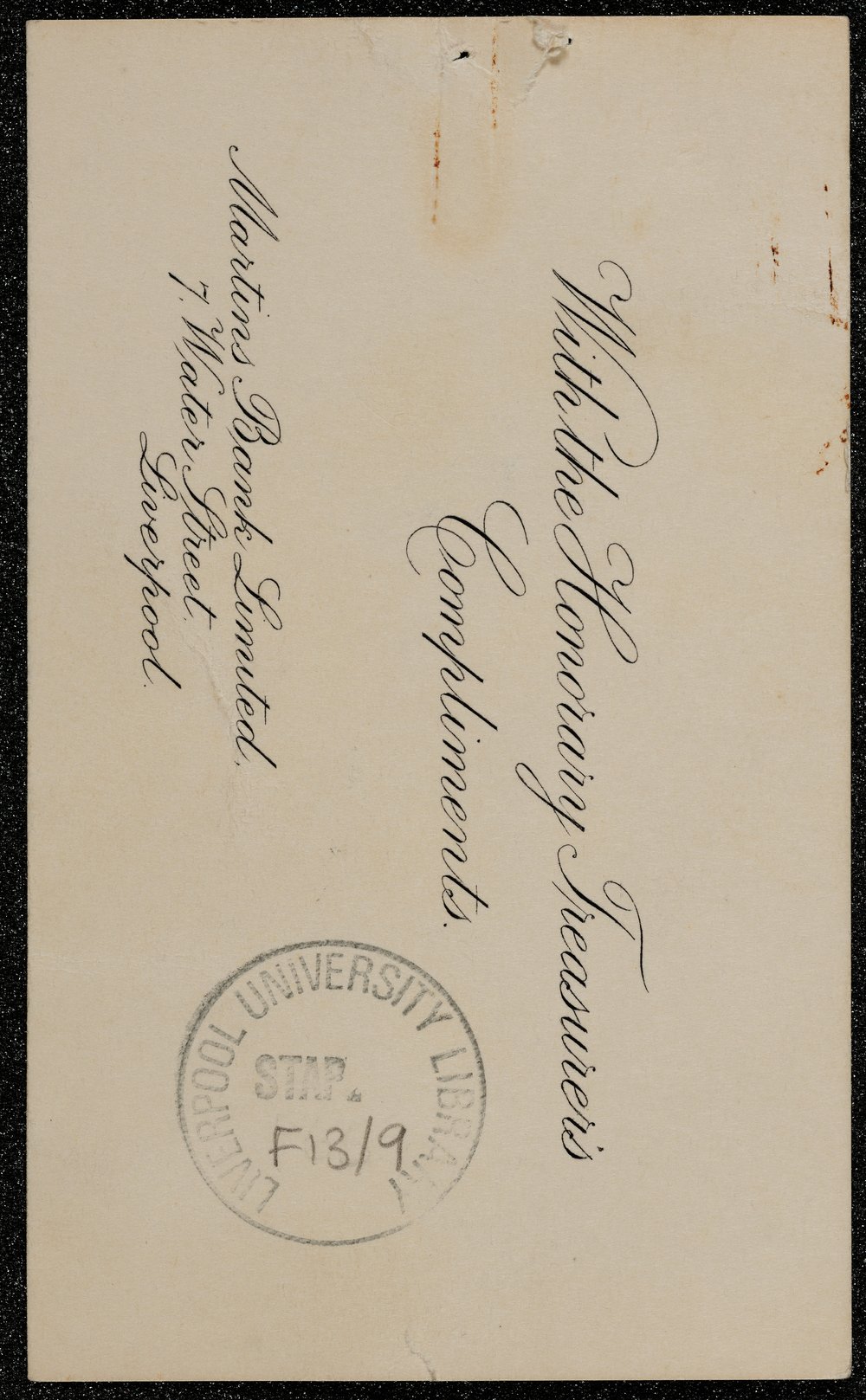
With the Honorary Treasurers'
Compliments.
Martins Bank Limited,
7, Water Street,
Liverpool.
LIVERPOOL UNIVERSITY LIBRARY
STAP.
F13/9