← All lectures
Ourselves And The Future
Original manuscript — sheet 1
scan sheet 1
Transcription
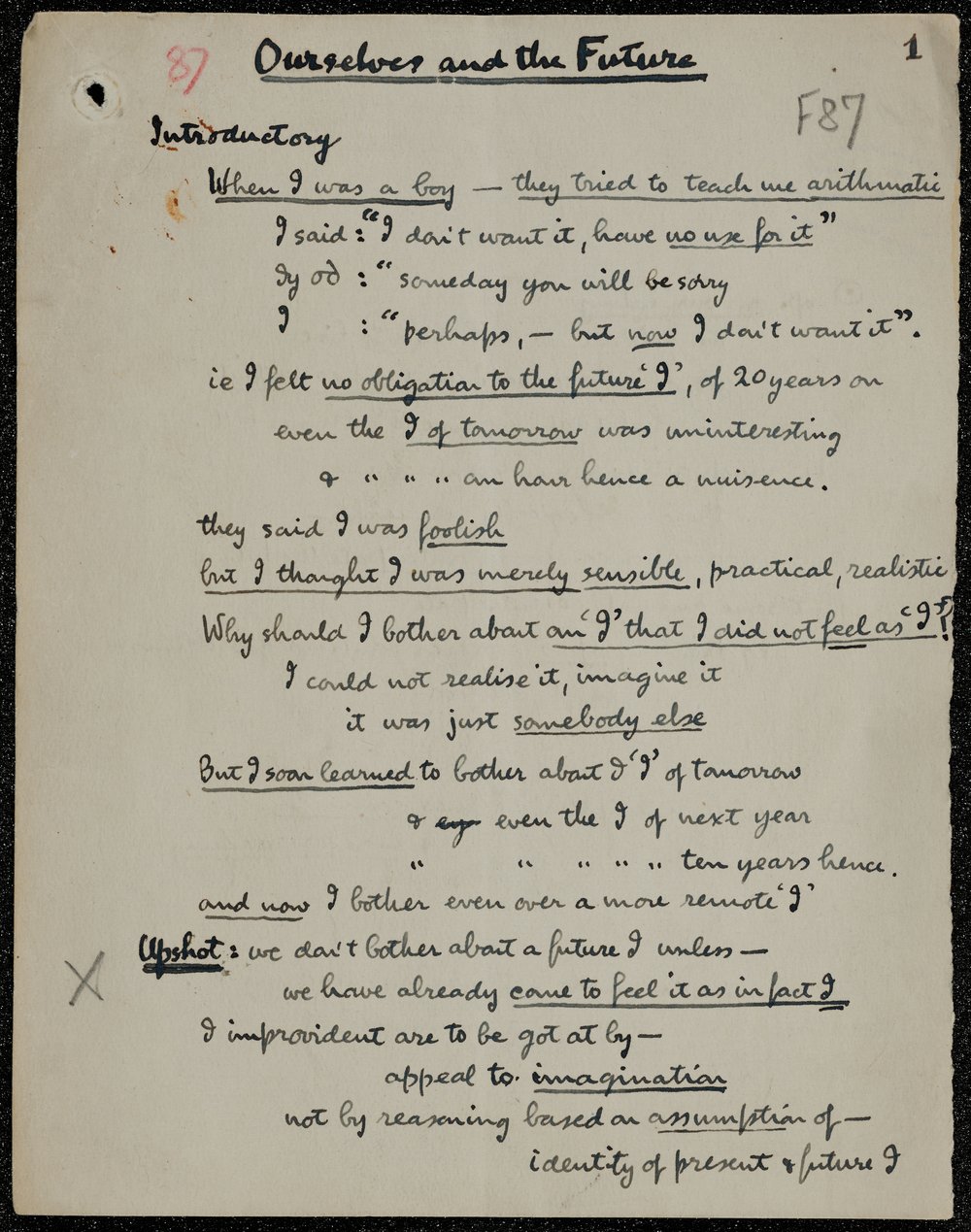
1
87Ourselves and the Future
F87
Introductory
When I was a boy — they tried to teach me arithmetic
I said : “I don't want it, have no use for it”
Ty sd : “someday you will be sorry
I      : “perhaps,— but now I don't want it”.
ie I felt no obligation to the future ‘I’, of 20 years on
even the I of tomorrow was uninteresting
&  “  “  “ an hour hence a nuis-ence.
they said I was foolish
but I thought I was merely sensible, practical, realistic
Why should I bother about an ‘I’ that I did not feel as ‘I’?
I could not realise it, imagine it
it was just somebody else
But I soon learned to bother about ð ‘I’ of tomorrow
& any even the I of next year
“    “  “  “  “ ten years hence.
and now I bother even over a more remote ‘I’
XUpshot: we don't bother about a future I unless —
we have already come to feel it as in fact I
ð improvident are to be got at by —
appeal to imagination
not by reasoning based on assumption of —
identity of present & future I
Original manuscript — sheet 2
scan sheet 2
Transcription
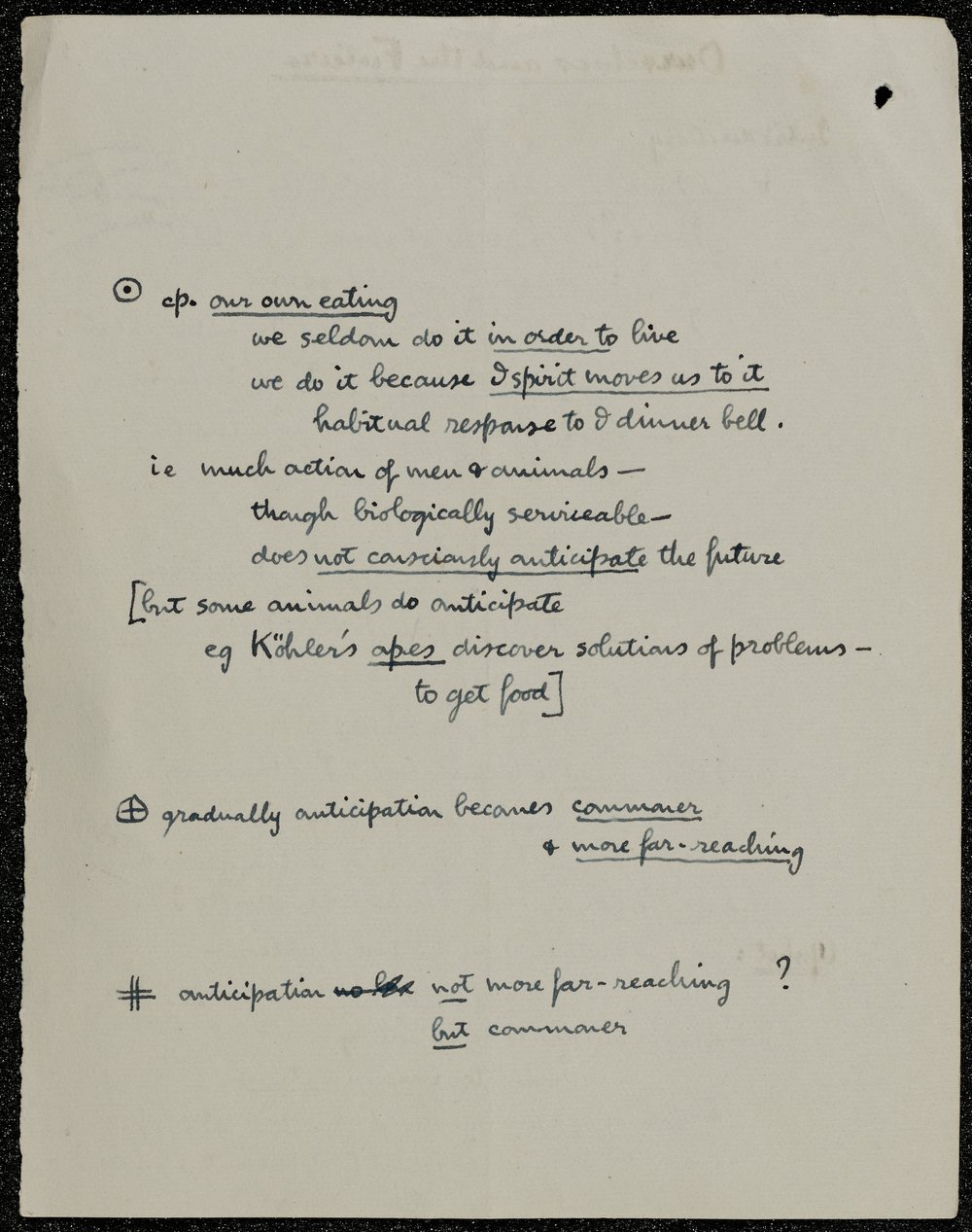
⊙ cp. our own eating
we seldom do it in order to live
we do it because θ spirit moves us to it
habitual response to θ dinner bell.
ie much action of men & animals —
though biologically serviceable—
does not consciously anticipate the future
[but some animals do anticipate
eg Köhler's apes discover solutions of problems —.
to get food]
⊕ gradually anticipation becomes commoner
& more far·reaching
# anticipation no less not more far·reaching ?
but commoner
Original manuscript — sheet 3
scan sheet 3
Transcription
2
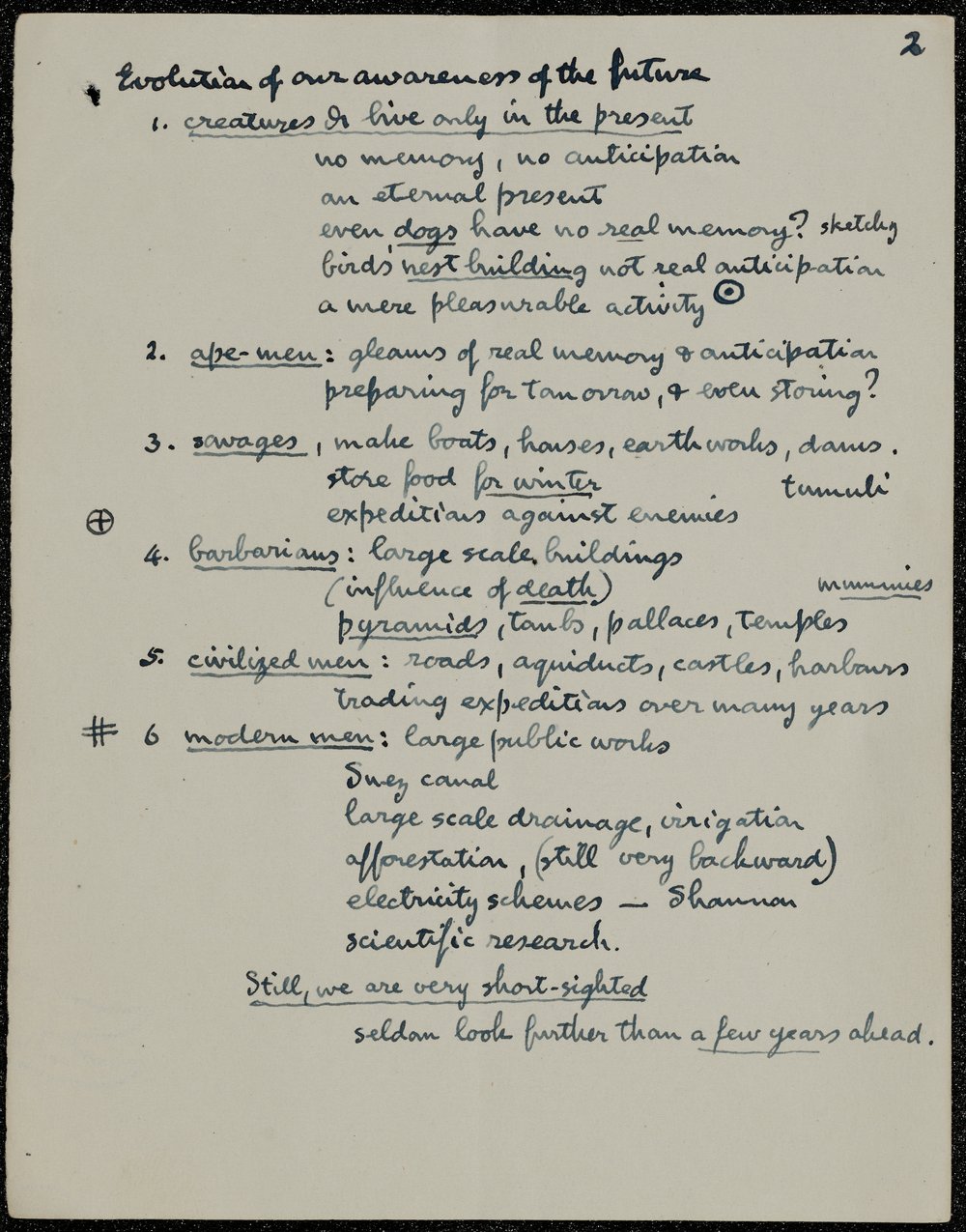
[illegible] Evolution of our awareness of the future
1. creatures ð live only in the present
no memory, no anticipation
an eternal present
even dogs have no real memory? sketchy
birds' nest building not real anticipation
a mere pleasurable activity ⊙
2. ape-men: gleams of real memory & anticipation
preparing for Tomorrow, & even storing?
3. savages, make boats, houses, earth walls, dams.
store food for winter tumuli
⊕ expeditions against enemies
4. barbarians: large scale, buildings
(influence of death) mummies
pyramids, tombs, pallaces, Temples
5. civilized men: roads, aquiducts, castles, harbours
trading expeditions over many years
# 6 modern men: large public works
Suez canal
large scale drainage, irrigation
afforestation, (still very backward)
electricity schemes — Shannon
scientific research.
Still, we are very short-sighted
seldom look further than a few years ahead.
Original manuscript — sheet 4
scan sheet 4
Transcription
3
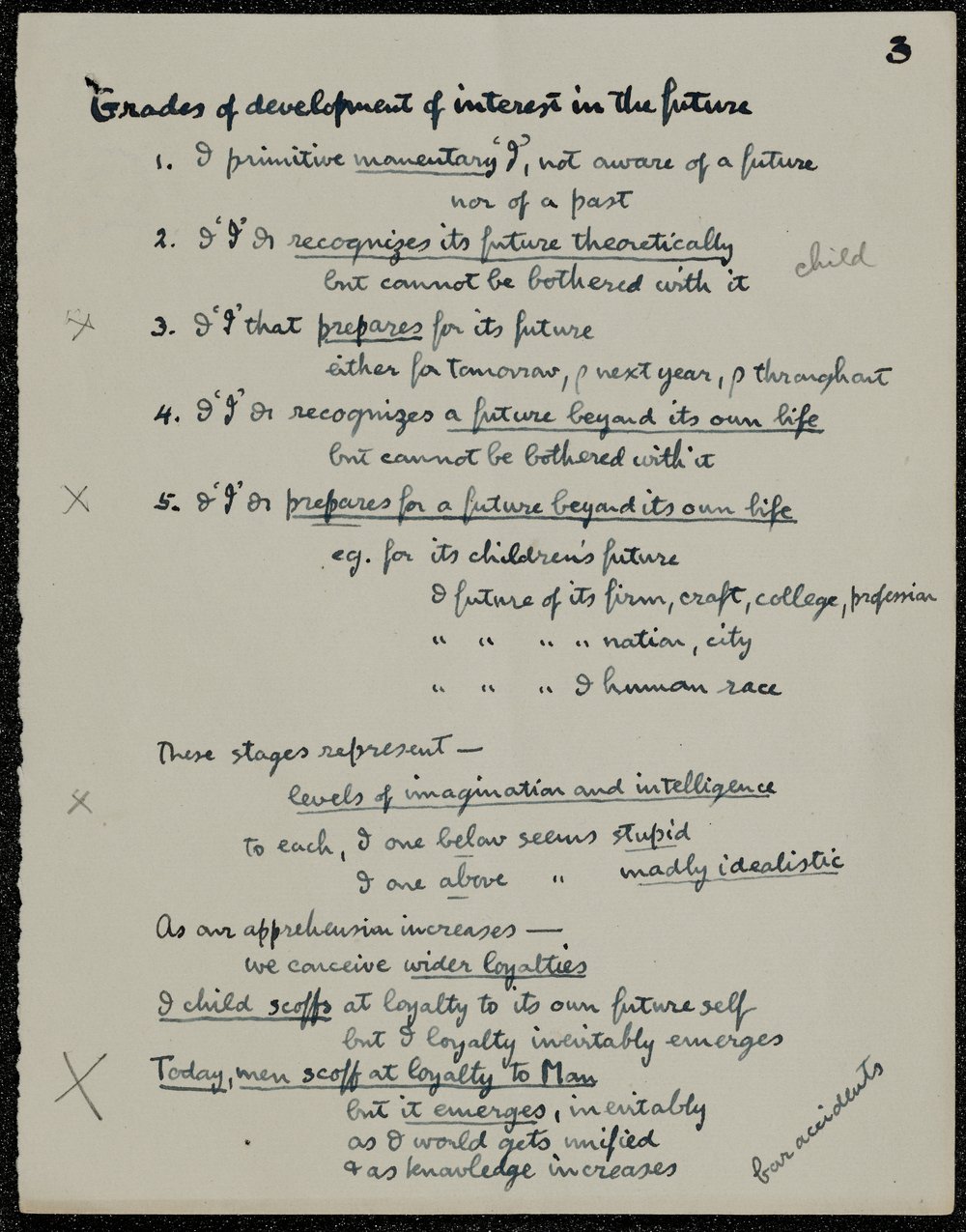
Grades of development of interest in the future
1. ð primitive momentary 'I', not aware of a future
nor of a past
2. ð 'I' ð recognizes its future theoretically child
but cannot be bothered with it
X3. ð 'I' that prepares for its future
either for tomorrow, ρ next year, ρ throughout
4. ð 'I' ð recognizes a future beyond its own life
but cannot be bothered with it
X5. ð 'I' ð prepares for a future beyond its own life
· eg. for its children's future
ð future of its firm, craft, college, profession
"   "   "   " nation, city
"   "   "   ð human race
 
These stages represent —
Xlevels of imagination and intelligence
to each, ð one below seems stupid
ð one above   "   madly idealistic
As our apprehension increases —
we conceive wider loyalties
ð child scoffs at loyalty to its own future self
but ð loyalty inevitably emerges
XToday, men scoff at loyalty to Man
but it emerges, inevitably
as ð world gets unified
+ as knowledge increases bar accidents
Original manuscript — sheet 5
scan sheet 5
Transcription
4
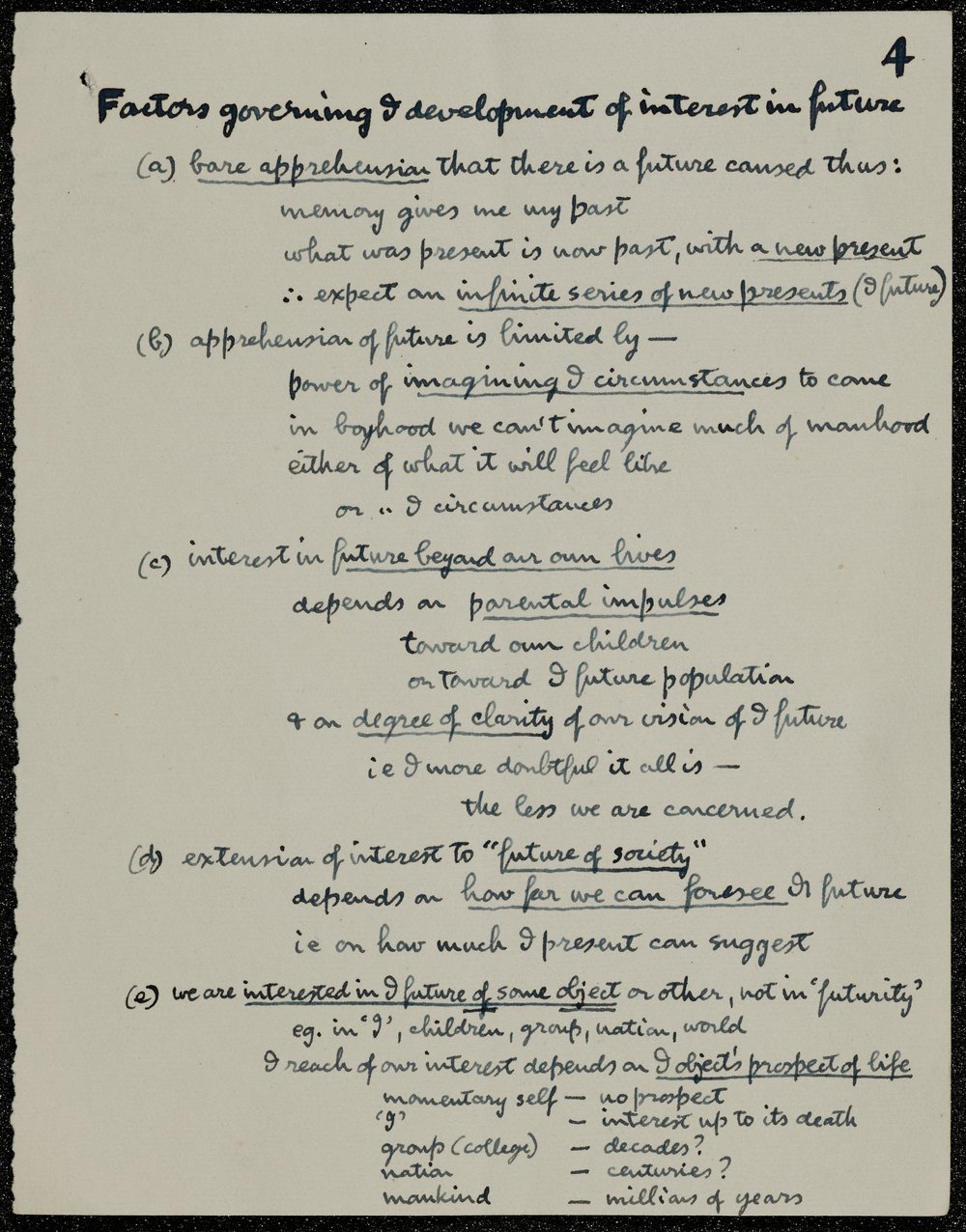
Factors governing ð development of interest in future
(a) bare apprehension that there is a future caused thus:
memory gives me my past
what was present is now past, with a new present
∴ expect an infinite series of new presents (ð future)
(b) apprehension of future is limited by —
power of imagining ð circumstances to come
in boyhood we can't imagine much of manhood
either of what it will feel like
or „ ð circumstances
(c) interest in future beyond our own lives
depends on parental impulses
toward our children
or toward ð future population
& on degree of clarity of our vision of ð future
i e ð more doubtful it all is —
the less we are concerned.
(d) extension of interest to “future of society”
depends on how far we can foresee ð future
i e on how much ð present can suggest
(e) we are interested in ð future of some object or other, not in ‘futurity’
eg. in ‘I’, children, group, nation, world
ð reach of our interest depends on ð object’s prospect of life
momentary self — no prospect
‘I’ — interest up to its death
group (college) — decades?
nation — centuries?
mankind — millions of years
Original manuscript — sheet 6
scan sheet 6
Transcription
⊕ I have been talking about our interest in ð future
Now I shall talk about future events themselves.
Original manuscript — sheet 7
scan sheet 7
Transcription
5
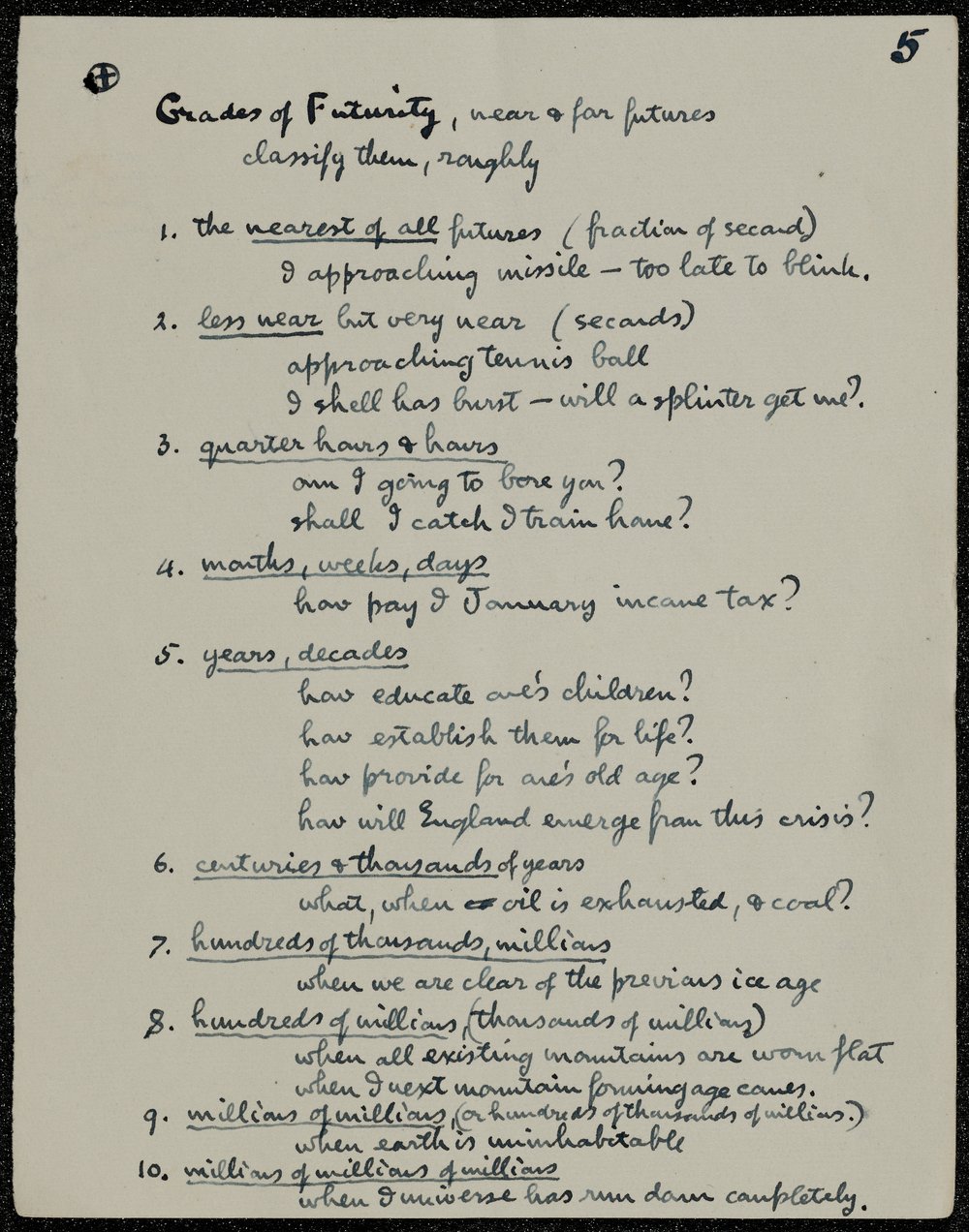
⊕Grades of Futurity, near & far futures
classify them, roughly
1. the nearest of all futures (fraction of second)
ð approaching missile — too late to blink.
2. less near but very near (seconds)
approaching tennis ball
ð shell has burst — will a splinter get me?
3. quarter hours & hours
am I going to bore you?
shall I catch ð train home?
4. months, weeks, days
how pay ð January income tax?
5. years, decades
how educate one's children?
how establish them for life?
how provide for one's old age?
how will England emerge from this crisis?
6. centuries & thousands of years
what, when co oil is exhausted, & coal?
7. hundreds of thousands, millions
when we are clear of the previous ice age
8. hundreds of millions (thousands of millions)
when all existing mountains are worn flat
when ð next mountain forming age comes.
9. millions of millions (or hundreds of thousands of millions.)
when earth is uninhabitable
10. millions of millions of millions
when ð universe has run down completely.
Original manuscript — sheet 8
scan sheet 8
Transcription
6
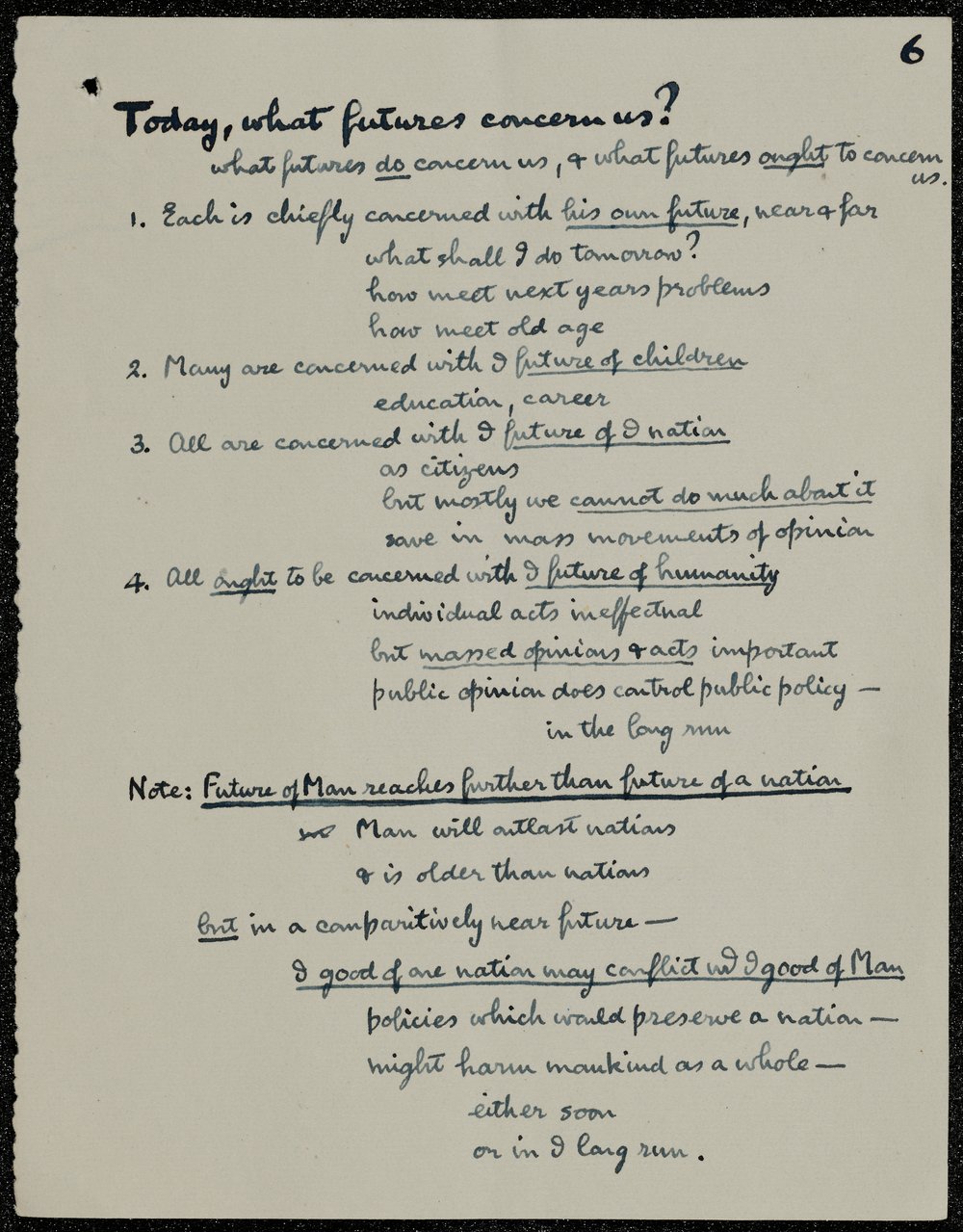
Today, what futures concern us?
what futures do concern us, + what futures ought to concern
us.
1. Each is chiefly concerned with his own future, near + far
what shall I do tomorrow?
how meet next years problems
how meet old age
2. Many are concerned with θ future of children
education, career
3. All are concerned with θ future of θ nation
as citizens
but mostly we cannot do much about it
save in mass movements of opinion
4. All ought to be concerned with θ future of humanity
individual acts ineffectual
but massed opinions + acts, important
public opinion does control public policy —
in the long run
Note: Future of Man reaches further than future of a nation
so Man will outlast nations
& is older than nations
but in a comparitively near future —
θ good of one nation may conflict wᵈ θ good of Man
policies which would preserve a nation —
might harm mankind as a whole —
either soon
or in θ long run.
Original manuscript — sheet 9
scan sheet 9
Transcription
7
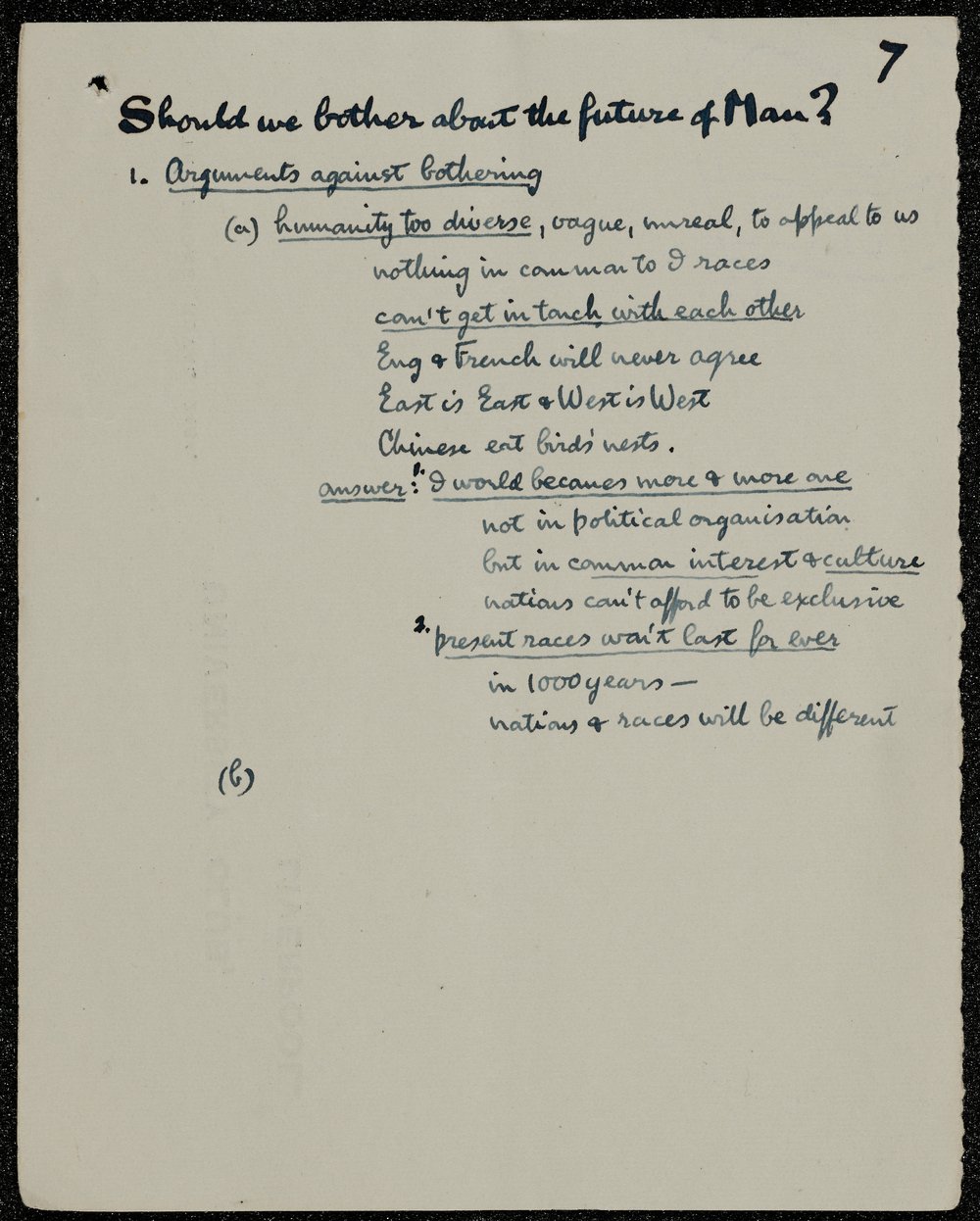
Should we bother about the future of Man?
1. Arguments against bothering
(a) humanity too diverse, vague, unreal, to appeal to us
nothing in common to ð races
can't get in touch with each other
Eng & French will never agree
East is East & West is West
Chinese eat birds' nests.
answer: 1. ð world becomes more & more one
not in political organisation.
but in common interest & culture
nations can't afford to be exclusive
2. present races won't last for ever
in 1000 years —
nations & races will be different
(b)
Original manuscript — sheet 10
scan sheet 10
Transcription
TELEPHONE ROYAL 2464,
UNIVERSITY CLUB,
LIVERPOOL.
Original manuscript — sheet 11
scan sheet 11
Transcription
8
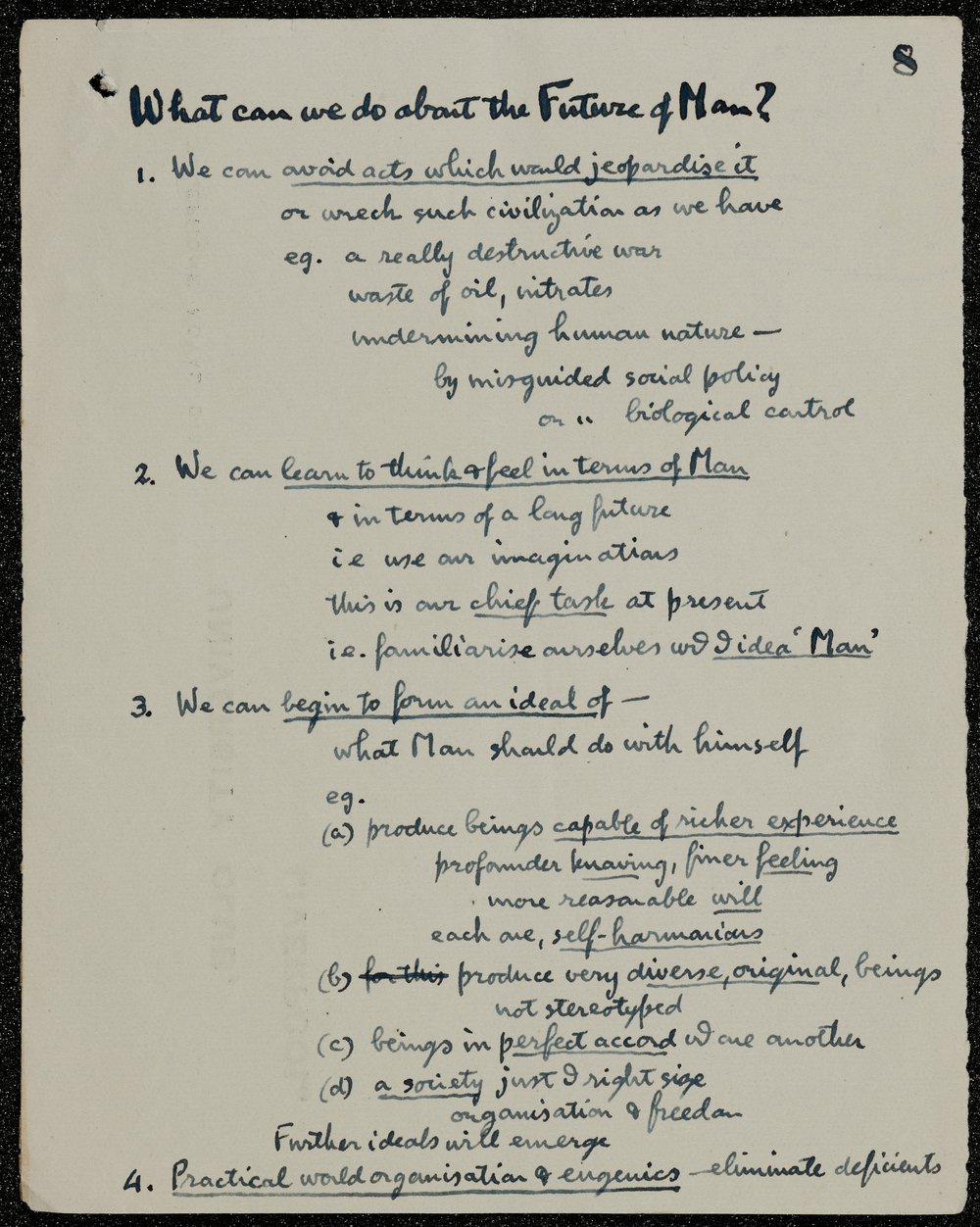
What can we do about the Future of Man?
1. We can avoid acts which would jeopardise it
or wreck such civilization as we have
eg. a really destructive war
waste of oil, nitrates
undermining human nature —
by misguided social policy
or ,, biological control
2. We can learn to think & feel in terms of Man
& in terms of a long future
i.e. use our imaginations
this is our chief task at present
i.e. familiarize ourselves wd θ idea ‘Man’
3. We can begin to form an ideal of —
what Man should do with himself
eg.
(a) produce beings capable of richer experience
profounder knowing, finer feeling
, more reasonable will
each one, self-harmonious
(b) for this produce very diverse, original, beings
not stereotyped
(c) beings in perfect accord wd one another
(d) a society just θ right size
organisation & freedom
Further ideals will emerge
4. Practical world organisation & eugenics — eliminate deficients
Original manuscript — sheet 12
scan sheet 12
Transcription
TELEPHONE ROYAL 2464,
UNIVERSITY CLUB,
LIVERPOOL.
LIVERPOOL UNIVERSITY LIBRARY
STAP.
F13/34