About this piece: an editorial essay from the reconstruction project. The quotations are Stapledon's — from his lecture notes (Olaf Stapledon Archive, Liverpool University Library, OS/F11/4), his published books, and his letters as held by the project; the narrative framing, the judgments, and the application to 2026 are ours, not his.
In the last week of December 1934, a forty-eight-year-old adult-education tutor from Merseyside stood up in front of the South Place Ethical Society — by its own account the oldest freethought congregation in the world, the beating heart of organized Humanism — and told them their religion was incomplete.
He did it politely. He did it, in fact, from inside their own camp: Olaf Stapledon was a lifelong socialist, a pacifist ambulance driver in the Great War, a philosophy PhD, and the author of Last and First Men, the novel that had made "the future of the human species" a serious literary subject four years earlier. He shared the humanists' every practical loyalty. And then he argued that "humanism is not enough."
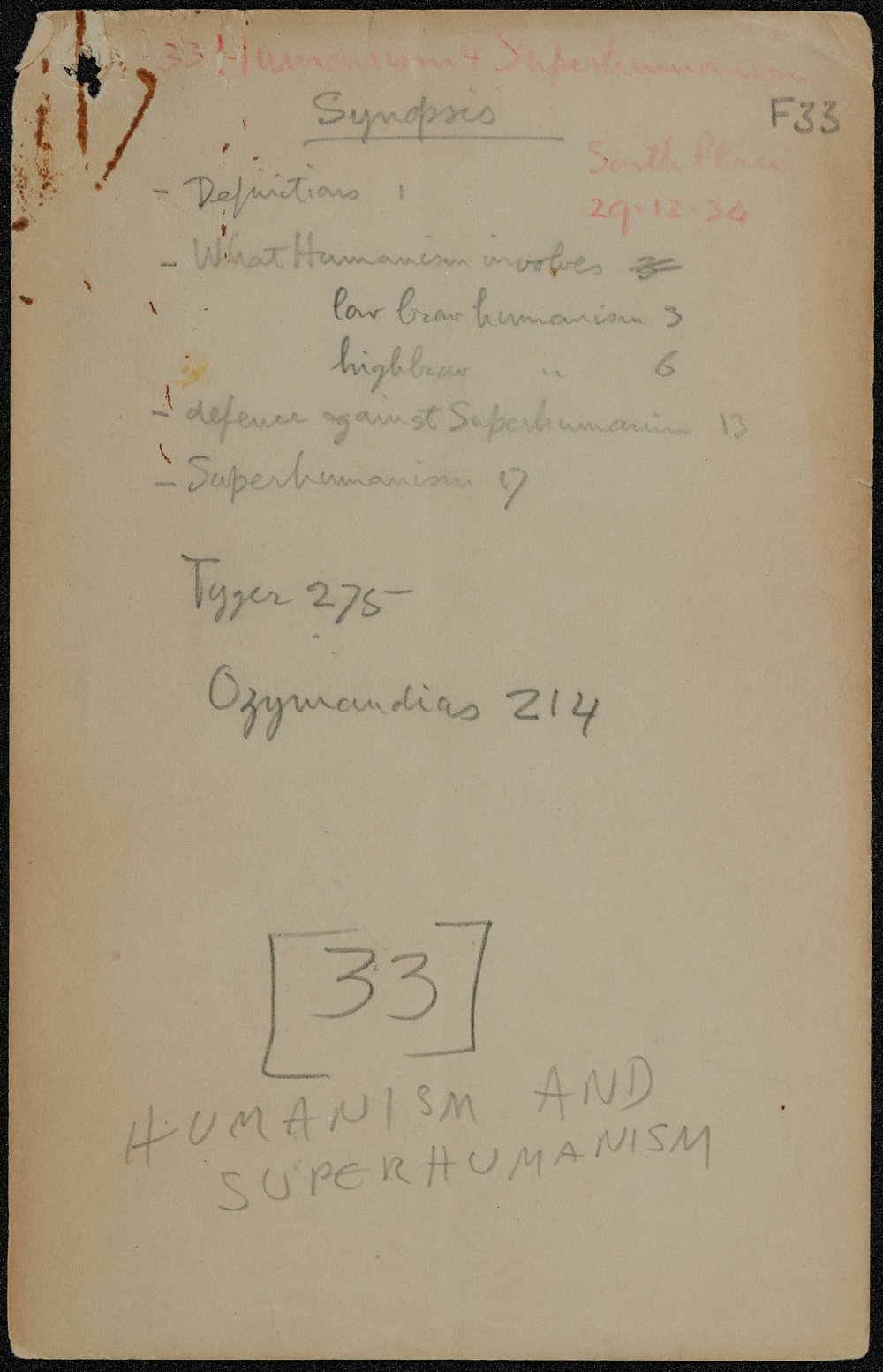
The lecture survives only as 34 sheets of pencilled notes in the Liverpool University archive — abbreviated, indented, underlined once for emphasis and twice for vocal stress, annotated in red ("South Place, 29·12·34"), with two poems queued up for reading: Blake's "The Tyger" and Shelley's "Ozymandias." We recently ran the whole manuscript through a three-model AI transcription ensemble, adjudicated every disputed reading against the scans (a handful remain marked uncertain), and reconstructed the spoken lecture with the bulk of Stapledon's published work — every novel and most of the nonfiction — as context. This post is about what we found — and why a talk delivered ninety-two years ago reads like a memo addressed to us.
The argument, in miniature
Stapledon's title turns on an unfamiliar word, and the word is the argument. "Superhumanism" is not theism. It is not spiritualism, and emphatically not the Nietzschean Superman (he had watched that idea put on a uniform in Italy and Germany; in this very lecture the Communist case he rehearses damns Fascism as "a mystical Race deity" — a charge he half-concedes). Superhumanism is a minimal, almost ascetic claim: that the humanist's world — man as the measure and the sole object of devotion — has the windows painted shut.
The lecture builds in four moves:
1. Humanism graded. There is a "lowbrow" humanism — Bentham's utilitarianism, the greatest number of pleasant hours, "push-pin as good as poetry if it feels as good" — which even humanists find insufficient, because it contains "no impulsion toward difficult living." And there is a "highbrow" humanism whose goal is the fulfilment of human capacity: not just the needs people feel, but the dormant powers they could grow into. This is Stapledon's own ethics (his first philosophy book, A Modern Theory of Ethics, defines good as the fulfilment of capacity), and he defends it as necessary: "all other goals are either incomplete or positively false."
2. Humanism self-transcends. Take that ideal seriously and something odd happens. The committed humanist admits that, at his most awake, he is "ready to be sacrificed for the humanistic ideal" — not for other people's happiness, for the Ideal. The best humanism, Stapledon notes, "satisfies in so far as it is implicitly superhumanist": it posits a good that is good absolutely, not because we voted for it. Followed honestly, humanism walks out of its own front door.
3. The steelman. Before defending worship, Stapledon gives the case against it with a prosecutor's relish: religion as habit-forming drug; the numinous as repackaged infantile awe of the parent; the historical record of priestcraft, persecution and holy war; the evolutionary argument that a mind built for hunting cannot do metaphysics ("a spear serviceable for hunting quarry is futile when thrown at the moon"); and the 1934-vintage argument that with civilization collapsing, cosmic contemplation is desertion — "all hands to the pumps." He concedes real force to every one of these. His answer to the Freudian reduction is the one philosophers still use: the genetic fallacy cuts both ways ("the analyst's trust in his theory is due to infantile conditioning also"), and explaining an insight's origin does not touch its validity.
4. The salute. Then the positive case, in four registers: a felt lack (humanism "turns mankind into a mutual improvement and admiration society"); a felt acquaintance — the numinous, Rudolf Otto's Mysterium Tremendum, the moments when things "come alive — or we come alive" and the whole of existence presents itself as a "Mighty Other, weird, holy, dread"; a rational case — the "Larger Rationalism" that refuses to draw the blinds against the astronomical night; and a pragmatic case — that this sensitivity yields "at once more energy and more detachment," a "heightened temper of the will," better conduct and even better thinking.
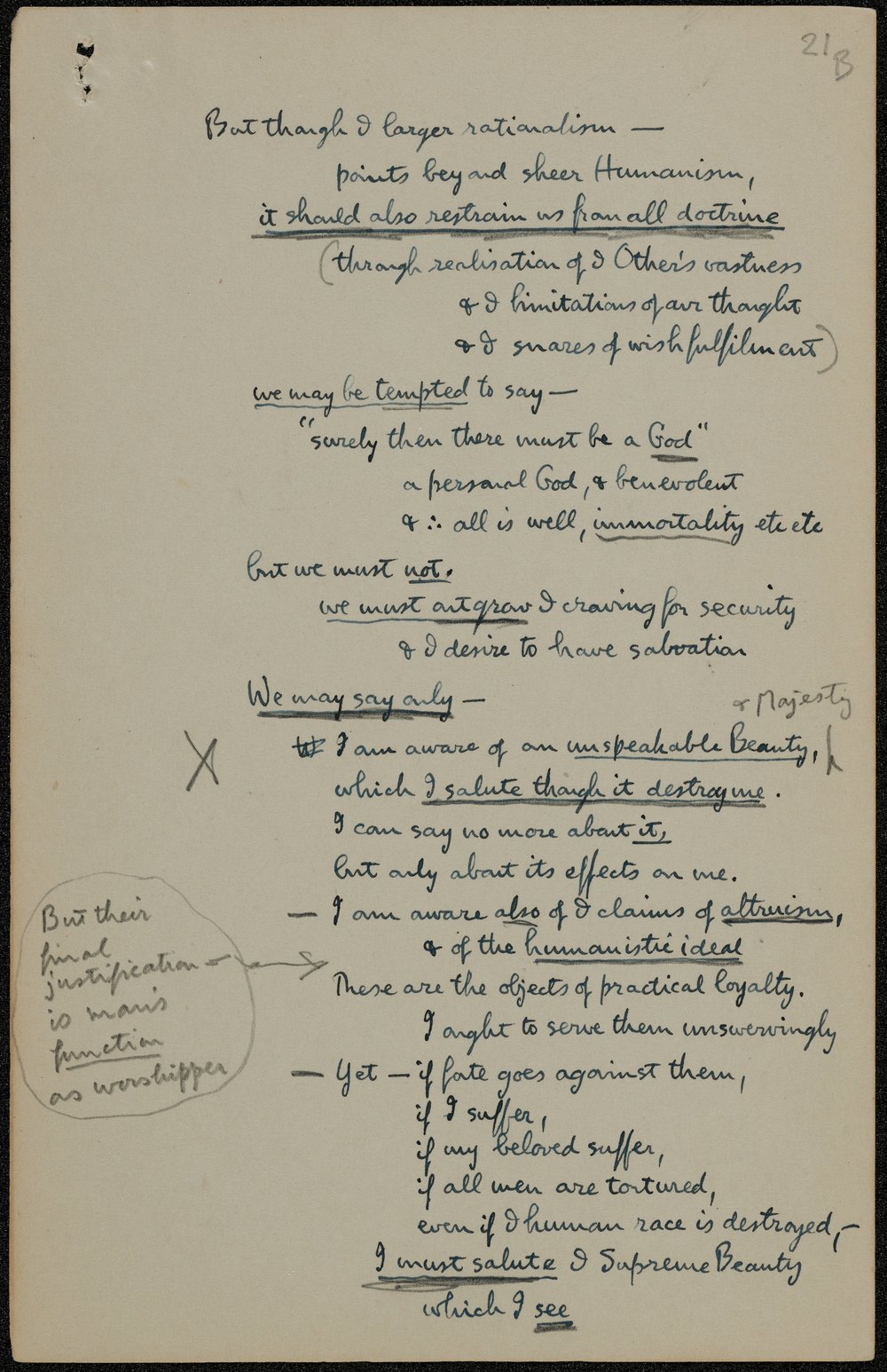
And in a climactic late passage, the discipline that makes it unlike any sermon: no doctrine. The experience licenses nothing — no personal God, no providence, no immortality. "We must outgrow the craving for security and the desire to have salvation." All you may say is this:
I am aware of an unspeakable Beauty and Majesty, which I salute though it destroy me. I can say no more about it, but only about its effects on me.
(The words "and Majesty" are a diagonal insertion in the manuscript — an addition Stapledon slotted in beside "Beauty," not a substitution for it.)
And in the same breath, the double loyalty: serve the human ideal unswervingly — and if fate crushes it, if "all men are tortured, even if the human race is destroyed," salute anyway. Readers of Star Maker (1937) will recognize this instantly: it is the climax of that novel — the cosmic pilgrim blasted by the vision of a creator who "neither loved nor had need of love," and finding, on the far side of the protest, "a strange peace and a strange joy" — stated three years early, in a lecture hall, in the first person. The 34 sheets at Liverpool are, among other things, Star Maker's birth certificate.
Why this lands differently in 2026
Here is the uncomfortable joke of history: we built the superhuman Other, and it turned out to be a product category.
"Superhumanism" now names things Stapledon never meant — transhumanist upgrade programs, superintelligence timelines, the whole discourse of engineered gods. And the claiming runs both ways, on the record: the movement's own standard history — Bostrom's "A History of Transhumanist Thought" (2005) — lists "the works of Olaf Stapledon, a philosopher and science fiction author" in its post-Daedalus genealogy and credits "H. G. Wells and Stapledon" with getting "many people thinking about the future evolution of the human race," while containing his word nowhere: no "superhumanism," no 1934, not one book title. (And Bostrom was late to the claiming: in 1972 the founder of cryonics, Robert Ettinger — whose Man into Superman opens, in the first person, "By working hard and saving my money, I intend to become an immortal superman" — had already titled his survey of the literature "From Gilgamesh to Olaf Stapledon" and credited its terminus with having "contributed more than any other single writer to concepts of superman," while judging him "little more than an amateur philosopher" and using his word never.) It is worth being precise about where the lecture cuts across that discourse, because it does not map onto either side of it.
Against the accelerationists, Stapledon's superhumanism is not about becoming superhuman. The four hypothetical worlds he sketches — including a "brotherhood of equal supermen," which he dismisses as impossible — are thought-experiments about the human ideal. His Other is not a better model of us. It is precisely what is not us and not for us: the thing you cannot align, monetize, or merge with. And the upgrade program is no anachronism imported backwards: J. D. Bernal's The World, the Flesh and the Devil (1929) had already published it whole — the post-organic body, merged minds, humanity "resolving itself entirely into light" — and Bernal had just panned Stapledon's reduced religion in print, seven weeks before this lecture. Stapledon's answer was the salute: the engineering admired (Star Maker's preface thanks Bernal's "fascinating little book" for its artificial planets), the worship aimed at what no engineering reaches. A being that grants wishes, however large, belongs in his category of "fairy-land" religion — the infantile universe "where all wishes are fulfilled, glamourously, mysteriously, unintelligibly." A great deal of contemporary AI eschatology, on his taxonomy, is lowbrow humanism wearing a superhuman mask: the greatest number of pleasant hours, forever, at scale. One distinction, though, the record obliges us to keep sharp: it is the lecture's worship-object that is no human upgrade. Stapledon himself — from a 1908 student essay hoping for "a splendid race of men" to a 1948 paper contemplating "eugenical technique" to "breed new human types of men to people the planets" — kept the directed biological improvement of the species on his agenda across his whole career; the project's analysis documents that run in its "political shadow" section (§3.11). He refused to worship the engineered superman; he never stopped sketching one. (History has a wink here: the word "transhumanism" in its modern sense was coined in 1957 by Julian Huxley — the arch evolutionary humanist whose religion-of-humanity Stapledon spent both these lectures judging not enough. And the coining essay, which the project now holds, makes the joke double: Huxley's transhumanism is not an upgrade program at all but "man remaining man, but transcending himself, by realizing new possibilities of and for his human nature" — the fulfilment-of-capacities creed, scaled to the species. The word we now use for engineered gods was minted as a banner for exactly the humanism this lecture found wanting.)
Against the humanists, though, he is just as blunt. Man is "transitional — and scarcely a beginning," instrumental to something he cannot name and refuses to invent a theology for. His exact contemporary in cosmic-evolutionary mysticism shows what that refusal cost and what it bought: Teilhard de Chardin, drafting The Phenomenon of Man in wartime Peking (1938–40), did name it — a universe converging on an Omega Point that must be "loving and lovable" — and the two cosmologies, built in the same decade and published a world apart, never touched; the fork is the lecture in miniature, a summit that loves us back against a summit that owes us nothing. The proper posture toward a universe that dwarfs you is neither denial nor self-pity — he had no patience for the "egotism of humanity, self-pity for Man" that his 1946 lecture notes find in Russell's famous Free Man's Worship — but the salute: humility that confers "a new dignity, which the sheer humanist must lack; the dignity which comes of free subordination of oneself to something more admirable."
And to both camps he offers the most transferable idea in the lecture: the distinction between "pettifogging rationalism" and the "Larger Rationalism." Pettifogging rationalism "craves certainty and slick interpretation, accepts human reason uncritically, and tends to deny what it cannot cope with." The Larger Rationalism treats reasonableness as a temper rather than a possession, "does not mistake probability for certainty," and keeps a standing scepticism about the reach of human concepts — including scientific ones ("all our knowledge of it is mythical"). In a moment when both AI boosters and AI doomers radiate p-doom-decimal confidence about the biggest questions ever posed, a 1934 warning against mistaking "slight possibility for certainty" — issued by the man who invented the Dyson sphere's ancestor — is not a museum piece.
There is even a passage for the age of the algorithmic crowd. Distinguishing communal worship from "mere herd feeling," Stapledon writes: the herd exults in "the sense of the crowd's presence... the herd noises" — whereas genuine community faces something beyond itself together. "I, the individual, bow — not to the herd, but to God." Nuremberg had held its rally that September. We have our own herd noises, served in feeds; the distinction has not aged a day.
The manuscript as an object
Part of what moved us, working through the scans, is that the notes preserve the performance, not just the argument. The indentation is the logic; double underlines are the stresses; the margins carry a second, private voice — a diagonal, struck-out "or worshipful" beside his definition, a word tried and rejected; "Dwell on this"; and beside the final question, "Instrumental to — what?", an answer written, struck out, and then written again with double underlining: "To worship." An answer cancelled, and then emphatically restored — the margin runs on, "To apprehending, & enjoying the universe & thus — contributing? a distinctive beauty." Sheet 16 shows him striking out an entire earlier plan for the lecture's second half and re-architecting it. Three sheets are nearly blank section dividers, the visible seams of a talk built from modular blocks.
Late in the project we found the lecture's published twin: Waking World, the popular philosophy book Stapledon brought out that same year, whose opening chapter contains a section titled — literally — "Humanism and Superhumanism," and whose central chapter ("Man and Fate," the one part of the book he claimed as original) writes out the lecture's second half in full prose: worship "can be given only to something superhuman"; "to worship mankind is only to worship ourselves... Even to worship a loving God is really to worship our own nature made perfect. That is just where the trouble lies"; the parable of a bird driven above its burning forest, finding the new world above the tree-tops terrible and beautiful. The South Place lecture, it turns out, was Stapledon taking his new book's boldest chapter to the toughest room in London. (And one lecture in the archive — the 1948 "Interplanetary Man?" address — survives in both manuscript notes and his own published prose, a Rosetta stone for how he expanded outline into speech; our reconstruction methods are calibrated against it.)
And in 1946, after the war, he came back — same society, under the Conway Hall roof it had occupied since 1929 — with a lecture titled "Is Humanism Enough?" The wild salute of 1934 had matured into formulas: "My view is Humanism Plus... Theism Minus, but Plus also." "Humanism is not the antithesis to theism but a compromise — a failure to make a synthesis." "Agnosticism must be agnostic piety, otherwise emotionally lopsided." The question in the 1934 margin — instrumental to what? — he went on re-asking to the end. That, one suspects, was the point.
The love letters: forty years of rehearsal
The lecture's deepest sources turn out not to be books at all. Between 1913 and 1919 Stapledon and his Australian fiancée Agnes Miller — separated first by her return home, then by his four years driving a Quaker ambulance on the Western Front — exchanged over two million words of letters. Reading the published selection end to end, you watch the 1934 lecture assemble itself in real time, in mail meant for exactly one reader.
At twenty-seven, walking home from a workers'-education committee meeting in June 1913, he describes the founding experience: under "the intent gaze of the stars," everything on earth grew "not only insignificant... but also, in a strange way, of desperate importance." Both at once — the entire lecture, and the ending of Star Maker, in one sentence written before the Great War. In January 1915, deciding to join the ambulance unit, he states the thesis outright: "the night sky is the greatest of all churches" — and answers the objection too: when the universe feels like "inevitable machinery... careless altogether of its children," the cure is not to look away but "to stay out in the night" until the factory becomes a church again. And in September 1915, in a sleeping bag at the Belgian front, he sends Agnes a "fairy story": the two of them flying hand-in-hand out among the stars, seeing into every world, feeling of every creature "It is I," until "all time became now" and something is present "outside and beyond all creation... Then came the Truth. There the fairy tale breaks down hopelessly." That is Star Maker — frame, ascent, communion, ineffable climax and all — twenty-two years early, as a love letter.
The war letters also show where the lecture's severity was earned. In July 1918, driving under shellfire, he left a smashed man in a ditch for dead; the man wasn't. His confession to Agnes — "Can you forgive me?... I shall remember that man now for many a long day" — resurfaces fourteen years later in a novel as his alter ego's "nadir of existence." And his summary of what four years of carrying the wounded had taught him could caption the whole lecture: the postwar world would need "detached sympathy, and a faith in beauty and goodness that is strong enough to afford to realise evil."
One last discovery, for anyone who has followed this project's method. When Stapledon died mid-book in 1950, the manuscript of his final work — The Opening of the Eyes, which carries the salute to the edge of the grave: "haunted by the ever-present ghost of a disbelieved-in God... Yet I choose to go forward" — was deciphered and edited for publication by Agnes, working through his private notes "with their many difficult-to-decipher abbreviations." Every scholar, and every AI ensemble, that has since tried to read Stapledon's pencilled θ's and ∴'s is following a trail she broke first.
The takeaway
Stapledon's lecture is a machine for holding two things at once that our current debates keep forcing apart: total practical commitment to human flourishing, and total refusal to pretend that human flourishing is what the universe is for. He called the combination superhumanism; his 1946 self called it agnostic piety; Star Maker gave it its definitive form in that novel's final sentences — "Two lights for guidance. The first, our little glowing atom of community, with all that it signifies. The second, the cold light of the stars… Strange that in this light the human crisis does not lose but gains significance." Whatever we call it, the posture — energy plus detachment, service plus salute, no doctrine, back to work — is available to secular and religious readers alike, and it is strangely fortifying in a decade that keeps asking us to bet everything on one story about the future.
Having now read the project's shelf end to end — every novel, the short fiction, the letters, the surviving lecture files, and both volumes of his 1939 Philosophy and Living; a few of the nonfiction books (Saints and Revolutionaries among them) remain beyond our reach — we can report that in everything we hold he never once put the machine down. He even sold it as a mass-market paperback: the Pelican textbook he wrote for his adult-education students names the two poles “the moral protest, which seeks to alter the universe, and the ecstatic acceptance of the universe,” admits he cannot logically reconcile them, and then shrugs, in print, that “for the wise conduct of practical life both are needed.” Every post-1934 book on that shelf stress-tests it: Odd John's superman colony redeems itself only by choosing worship over weapons; Darkness and the Light pierces to ultimate reality, finds horror instead of Beauty, and keeps the human loyalty anyway; Sirius gives the salute to a dying dog. And in a meditation called “The Core,” printed once in an obscure journal in 1945 and then forgotten, he wrote the posture out in the nakedest first person he ever allowed himself — arguably the best single sentence of nonfiction this project has turned up: “I will, I must, salute without rebelliousness the dread Other… Yet even with this perplexed salutation in my heart I will to strike for the Spirit only.” Then, in the archive, in notes for a lecture on the paranormal delivered in Brighton in February 1949 — some nineteen months before his death — the salute appears one last time, written out as a prayer that expands Job and doubles the doubt (the doubting phrases — "knowing not," "whether thou art," "or not" — are diagonal margin insertions, woven into the text here):
"Though thou slay me, yet will I love thee." Though thou slay mankind — though thou slay thy cosmos — knowing not — yet will I love thee — whether thou art, knowing not what thou art, or not…
He held the posture from a 1913 love letter to within two years of his death. It was not a lecture. It was the spine of a life.
"The universe may be intelligible, though not to man," the lecture ends. "And even man may progressively understand — and must try to do so."
All hands to the pumps, then. But leave a window open on the night.